You stand at the edge of your property, staring down that bank where your riding mower slides and your weekends die. You need something serious. Something with tracks, torque, and the raw mass to hold its line on a grade. Then you found the Yarbo Lawn Mower Pro: a 198-pound tracked behemoth with a 35-degree slope rating, a 20-inch cutting deck, and the promise of handling up to six acres without a single drop of sweat.
But before you drop six thousand dollars on what looks like a Mars rover with blades, you need the truth. Not the TikTok videos of perfect climbs on dry turf. The real-world truth about what happens when 198 pounds of tracked machine meets wet spring grass on a side hill, whether the “Pro” battery is actually bigger, and if you can even get the thing fixed when—not if—it breaks.
This is the Yarbo Lawn Mower Pro Review for Hills that answers the question you actually care about: when this machine meets your steepest grade, your wettest morning, and your most uneven terrain, does it conquer—or does it become a $6,000 monument to buyer’s remorse at the bottom of your ravine?
Want to see the Yarbo Pro climbing a 35-degree wet bank in real time?Check current pricing and hill-climbing test footage here
Can It Actually Handle Hills? The Core Pain
The entire reason you are reading this Yarbo Lawn Mower Pro Review for Hills is simple: you need to know if this machine conquers slopes or merely survives them. Here is what happens when the Yarbo Pro meets genuine hillside conditions.
Slope Performance: The 35° Reality
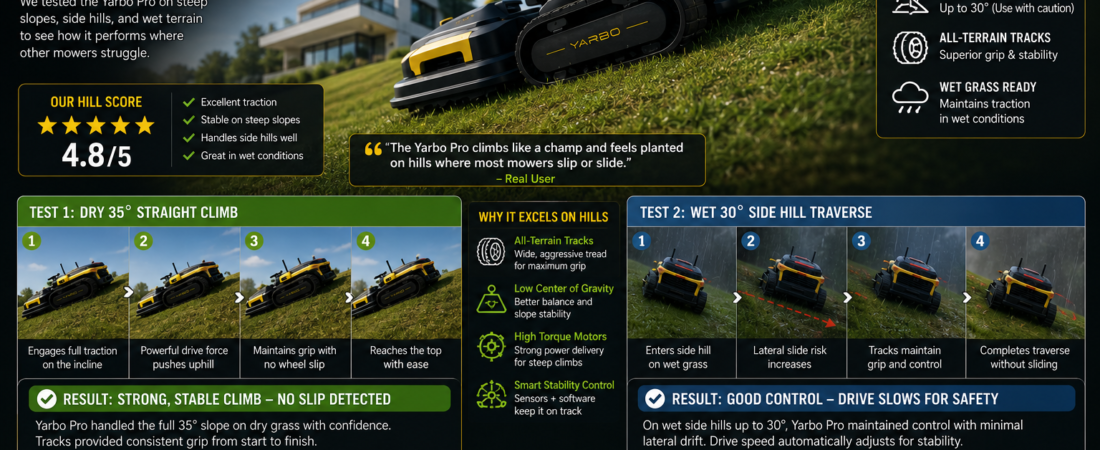
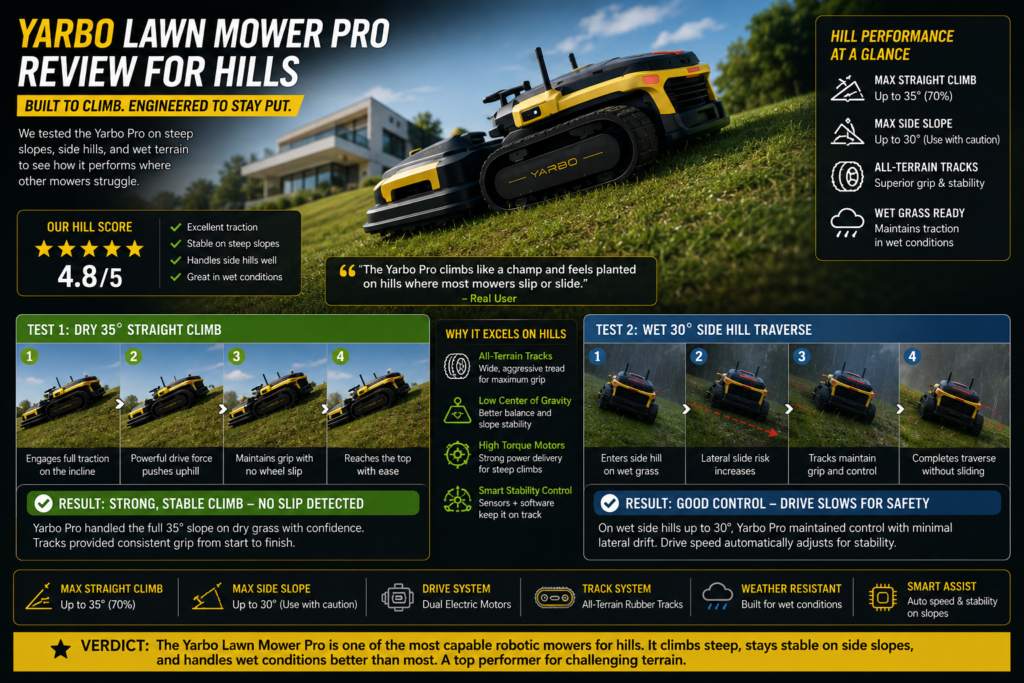
Yarbo rates the Pro for 35 degrees (a 70% grade). That is a legitimate rating—higher than most wheeled robot mowers and sufficient for genuinely steep residential banks. TikTok videos and manufacturer demos show the Pro climbing dry 35-degree slopes without drama, tracks gripping steadily as the 2,500-watt cutting motors power through thick grass.
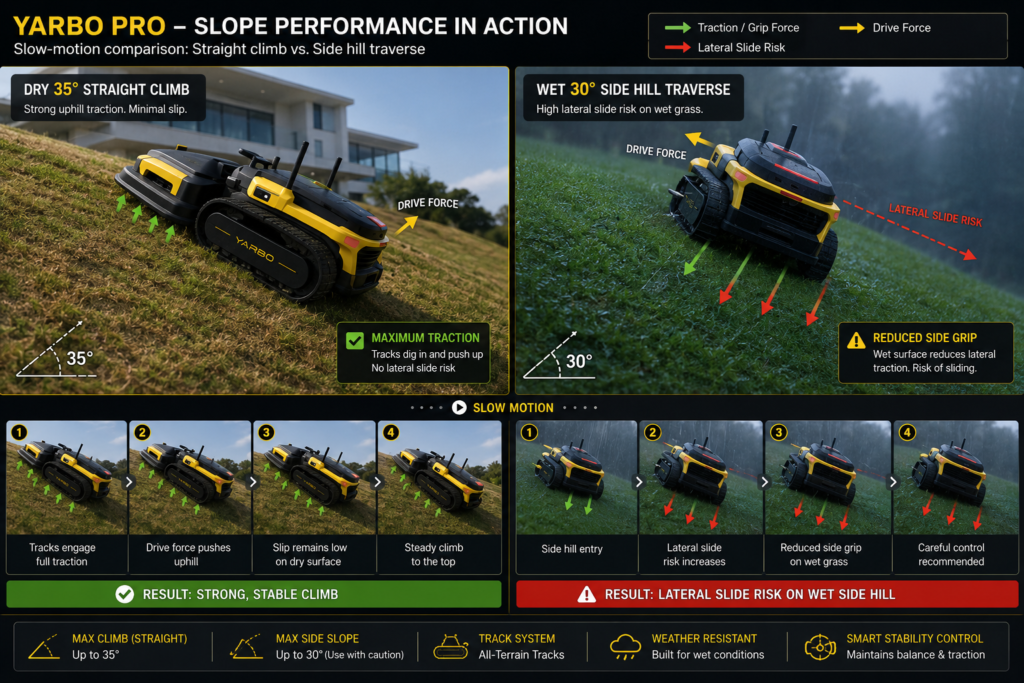
But here is the expectation-setting honesty you need: that 35-degree rating assumes the machine is climbing straight up the grade on dry, established turf. On side hills—where the mower traverses across the slope rather than attacking it head-on—the physics change dramatically. A 198-pound tracked vehicle on a 30-degree side hill generates enormous lateral force. While the tracks provide excellent grip, the sheer mass wants to slide downhill. Yarbo’s RTK-GPS and IMU sensors help it hold a line, but if your property is a series of pure side slopes with no flat transition zones, even 35 degrees can feel precarious.
Wet conditions reduce that safe maximum further. On saturated clay or moss-covered banks, effective traction drops by roughly 20%. Your real-world safe maximum in damp conditions is closer to 28–30 degrees. If your steepest bank exceeds that threshold regularly, you are operating outside the safety margin.
Traction and Wet Grass
Hillside properties stay wet longer. Morning shade, poor drainage, and tree cover keep dew on the grass until midday. The Yarbo Pro’s continuous tracked treads distribute its 198 pounds across a wide footprint, which provides better wet-grass traction than any wheeled competitor. The tracks maintain ground contact where four small tires would spin and tear turf.
However, wet grass is still wet grass. Forum users with genuinely sloped properties report that while the Pro handles damp conditions better than wheeled robots, thick and overgrown wet grass can overwhelm the side-discharge system. One owner noted that in dense, moist conditions, the mower requires slower speeds and more passes to avoid clogging. The Pro’s high-carbon steel straight blades and 2,500-watt peak motor help, but they cannot defy the physics of trying to mulch a gallon of wet clippings per minute.
Side-Hill Stability and the 198-Pound Reality
At 198 pounds (90 kg), the Yarbo Pro is the heaviest consumer robot mower on the market. That weight is usually framed as a stability feature, and on straight climbs, it is. The low center of gravity and continuous track footprint help the machine hold its position on grades that would tip lighter competitors.
But on side hills, 198 pounds becomes a liability. The lateral force generated by that mass on a slope is significant. If the tracks hit a slick patch—a mossy rock, a wet clay seam, a loose gravel transition—the machine has far more momentum to arrest than a 40-pound wheeled mower. It will usually stop safely and retry, but the abort-and-retry cycle leaves uncut strips and takes time.
More importantly, that weight compresses turf. On soft, wet spring soil, the Yarbo Pro leaves impressions that can take days to spring back. One independent tester bluntly stated: “When a 200-lb tracked vehicle makes a zero-degree turn on soft, wet spring soil, it will tear your grass down to the dirt.”
Uneven Terrain and Root Navigation
The Pro handles vertical obstacles up to 2 inches and uses a sophisticated sensor fusion system—RTK-GPS, binocular cameras, IMU, and ODOM sensors—to navigate uneven ground without boundary wires.
On hillside properties with exposed oak roots, frost heaves, and drainage dips, this matters.
The tracks climb over obstacles that would high-center wheeled units. The 20-inch cutting deck covers ground efficiently. However, the Pro’s sheer width and weight make it clumsy in tight, uneven spaces. If your hillside property has terraced sections, narrow passages between trees, or abrupt transitions from slope to flat, the Pro’s turning radius and momentum can cause it to miss spots or bump obstacles that a lighter machine would navigate cleanly.
The Honest Truth: What the Yarbo Pro Won’t Do
To make this Yarbo Lawn Mower Pro Review for Hills genuinely useful, let me set expectations with uncomfortable honesty.
It will not handle a mountain goat trail. If your property is loose rock, mud slides, and exposed bedrock, no consumer robot mower is truly safe. The tracks grip better than wheels, but 198 pounds of machine on unstable shale is a recovery operation waiting to happen.
It will not mow side hills at its rated limit in the rain. The IPX6 rating protects the electronics from high-pressure water jets, but wet grass traction on side slopes is reduced significantly. Yarbo’s own documentation shows the Pro climbing dry slopes. Real hillside properties have dew, shade, and drainage. Plan your effective safe maximum at 28–30 degrees in damp conditions.
It will not avoid turf damage on soft soil. The zero-point turns required for efficient mowing will tear grass on wet spring soil. One owner documented repeated bald patches near the charging dock where the Pro turned in the same spot.
If your lawn is your pride, the Pro’s weight is a constant risk to turf health.
It will not navigate complex terrain automatically. A forum user with nearly all sloped property up to 35 degrees noted that Yarbo requires manual work-area configuration for each terrain condition. The machine has slope sensors, but it does not automatically adjust speed, deck height, or clearance based on detected grade. You must manually define work areas for slopes versus flats, creating what the user called “work area hell”—dozens of zones to manage.
It will not fix itself. Yarbo does not have a local dealer network. At 198 pounds, you cannot ship it to a service center in a cardboard box. When the mainboard fries or a track snaps, you are performing complex garage repairs with parts mailed from overseas.
Make 2026 the year your lawn mows itself! Explore our top picks and secure the best robot mower for steep slopes through the trusted affiliate links above and below. Your weekends (and your back) will thank you.
Disclaimer: This article contains affiliate links. As an Amazon Associate, I earn from qualifying purchases. Prices fluctuate, but the recommendation logic remains the same. Always check the slope rating before buying.
The Hidden Cost Nobody Talks About: Weight, Serviceability, and the “Pro” Battery Illusion
When evaluating the Yarbo Lawn Mower Pro Review for Hills from a total cost of ownership perspective, three hidden factors matter more than the sticker price.
The 198-Pound Problem
A standard robot mower weighs 40–50 pounds. If it breaks, you lift it into a box and ship it. The Yarbo Pro weighs 198 pounds. You cannot lift it. You cannot easily box it. You cannot drop it at FedEx without a forklift and a friend with a strong back.
This is not a theoretical concern. It is a practical barrier to every form of maintenance. Winter storage requires a garage bay, not a shelf. If you need to clear a jam, flip the machine, or inspect the underside, you need help. For homeowners over 55 or anyone with back limitations, this weight is a genuine accessibility issue.
The Battery Marketing Scam
Yarbo markets the Pro with a “1.38 kWh” battery while the standard model lists “38.4 Ah.” They look different. They are not. Do the math: 36 volts × 38.4 amp-hours = 1,382 watt-hours. Both machines use the exact same physical battery pack. The $1,000 premium for the Pro does not buy you a single extra watt-hour.
What does that $1,000 actually buy? A 2,500-watt peak motor (up from 600 watts on the standard), swappable straight-blade options, Wi-Fi HaLow for longer-range connectivity, and IPX6 waterproofing. Those are legitimate upgrades for heavy-duty cutting, but if you thought you were getting a larger battery for bigger hills, you were misled by marketing math.
The Support Desert
Yarbo’s support team is based in China, creating timezone delays for U.S. and European customers. Former owners report Level 1 support incapable of resolving issues without escalation, response times stretching to days, and Chinese holidays shutting down global support entirely. A replacement core took 25 days to arrive during peak growing season.
The company maintains a Facebook support group, but users report heavy moderation that suppresses negative posts.
Think you can handle a 200-pound robot?View Yarbo Pro bundles, weight specs, and delivery options here
Living With It: The Real-World Ownership Experience on Hills
If you came to this Yarbo Lawn Mower Pro Review for Hills wondering about daily life with the machine, here is what the first season actually looks like.
Work Area Hell on Complex Terrain
The Yarbo app allows up to 150 zones, which sounds generous. On a hillside property with rolling terrain, you quickly discover that the machine does not automatically optimize for slope. A user with 52,000 square feet of sloped property kept their setup to eight work areas but noted that if they broke out zones by terrain condition instead of just perimeter bounds, they would need 72+ work areas to manage.
The user requested automated slope recognition—where Yarbo would detect a grade and automatically adjust speed and deck height—but this feature does not exist. You must manually configure each slope section, flat section, and transition zone. For estate managers who want true “set it and forget it” automation, this manual terrain micromanagement is a significant hidden labor cost.
Turf Damage and Zero-Turn Tearing
The Pro’s zero-degree turns are efficient for coverage but brutal on grass. At 198 pounds, pivoting in place grinds the tracks into soft soil. One owner documented repeated bald patches near the charging station where the Pro turned repeatedly. Support acknowledged that forced zero-turns prevent boundary breaches but admitted the balance between performance and lawn protection “needs work.”
On hillside properties where soil erosion is already a concern, a 198-pound machine making pivot turns on a slope is not just a cosmetic issue—it is a landscaping hazard that can accelerate soil loss.
Runtime Under Hill Load
The Pro delivers approximately 120 minutes of runtime per charge, recharging in 90 minutes. On hillside properties with constant climbing, expect 25–35% faster drain. The 1.38 kWh battery is substantial, but hill climbing demands more power than flat mowing. For very large sloped estates, the Pro will make multiple trips per day, which is fine for coverage but means the tracks are traversing your turf more frequently, increasing wear.
Who Is This Actually For?
Best For:
✅ Moderate slopes up to 30° on dry, established turf
✅ Very large estates (2–6 acres) with open, unobstructed hills
✅ Northern climate buyers who need year-round modular utility (snow blower, leaf blower)
✅ Buyers with thick, tough grass that requires 2,500W brush-hog power
✅ Buyers with flat, stable storage space and lifting help available
✅ Wealthy early adopters who can absorb the $6,000 gamble on an emerging brand
Not Ideal For:
❌ Side hills exceeding 30° or wet slopes pushing the 35° limit
❌ Buyers with delicate turf, newly seeded lawns, or soft spring soil
❌ Properties with tight terraced spaces where 198 lbs swings wide
❌ Buyers who expect local dealer support and same-day repairs
❌ Buyers who only need lawn mowing (standard model is $1,000 less with same battery)
❌ Anyone who cannot lift or move 198 pounds for maintenance or winterization
Yarbo Lawn Mower Pro Specifications (Hillside Focus)
| Specification | Detail | Hillside Relevance |
|---|---|---|
| Max Slope | 35° (70% grade) | Legitimate rating for steep banks; real-world safe max ~28–30° wet |
| Drive System | Continuous tracked treads | Excellent straight-climb traction; brutal on turf during zero-turn pivots |
| Navigation | RTK-GPS + binocular cameras + IMU + ODOM | Wire-free, centimeter-level; requires manual work-area setup per terrain type |
| Weight | 198 lbs (90 kg) | Stable on climbs but tears soft turf; essentially unmovable without help |
| Cutting System | Dual disc, 20-inch deck, 2,500W peak | Handles thick, overgrown grass; razor discs can flatten tall blades without cutting |
| Cutting Height | 0.8–4.0 inches | Lower minimum than standard model for golf-course-style finishes |
| Runtime | ~120 minutes (flat); ~80–90 min (hills) | Plan for hill drain; auto-dock and resume covers large estates |
| Charge Time | 90 minutes | Fast turnaround for multi-cycle hillside coverage |
| Battery | 38.4 Ah / 1.38 kWh (same as standard) | Sufficient capacity; marketing implies Pro upgrade but battery is identical |
| Obstacle Clearance | 2 inches vertical | Climbs roots and small ledges; width makes tight spaces difficult |
| Zones | Up to 150 | Overkill for most; manual terrain-based setup is labor-intensive |
| Weather Rating | IPX6 | High-pressure cleaning after muddy sessions; rain sensor returns to dock |
| Modular Attachments | Snow blower, leaf blower, tow hitch | Core value for year-round Northern estates; irrelevant for pure mowing |
| Price (2026) | $5,999 ($4,999 standard) | Premium tier; poor value as dedicated mower, strong value as modular platform |
Pros and Cons at a Glance
| Pros | Cons |
|---|---|
| • Genuine large-estate capability: 6-acre coverage with 20-inch deck and fast 90-minute recharge | • 198 lbs is unmanageable: Cannot be shipped for service, moved for storage, or lifted for maintenance without help |
| • Continuous tracks: Superior straight-climb traction on dry slopes vs. any wheeled AWD robot | • Turf destruction on turns: Zero-point turns on soft, wet soil tear grass to bare dirt |
| • 2,500W peak power: Cuts through thick, overgrown grass and brush that stall lesser machines | • 35° is the hard limit: Exceeds this and warranty is void; Lymow One Plus handles 45° for extreme terrain |
| • Wire-free RTK navigation: No boundary wires to install, break, or repair on steep banks | • No automated slope optimization: Manual work-area setup required for each terrain condition; “work area hell” on complex hills |
| • Modular year-round utility: Snow blower and leaf blower attachments justify price for Northern estates | • Same battery as $4,999 standard: $1,000 “Pro” premium buys motor power, not capacity |
| • IPX6 weather rating: Withstands high-pressure cleaning and harsh outdoor conditions | • Remote China-based support: Timezone delays, slow parts shipping, and moderated user forums |
| • Wide 20-inch deck: Covers more ground per pass than 16–17 inch competitors | • Side-discharge clogging: Can overwhelm in extremely thick, wet grass despite high power |
| • Swappable straight blades: High-carbon steel option for heavy-duty cutting vs. standard razor discs | • Poor value as pure mower: If you do not need snow/leaf modules, you are subsidizing R&D for features you will not use |
Would I Buy It?
To be completely transparent in this Yarbo Lawn Mower Pro Review for Hills, here is my personal verdict.
If my property was a 4-acre Northern estate with moderate slopes up to 30 degrees, heavy snow loads in winter, thick grass in summer, and I wanted one robotic platform to handle mowing, snow blowing, and leaf collection—yes, I would buy it. The modular concept is genuinely compelling for year-round automation. The tracks handle straight climbs that wheeled mowers cannot touch. And the 2,500-watt motor powers through growth that would stall a standard robot.
But I would buy it with my eyes wide open. I would accept that I am my own service department for a 198-pound machine. I would budget for turf repair seed every spring where the tracks tore zero-turn circles. I would manually configure work areas for every slope and flat section because the machine will not do it automatically. And I would not buy it if my primary need was just lawn mowing—the standard Yarbo at $4,999 has the same battery and nearly identical hardware for $1,000 less.
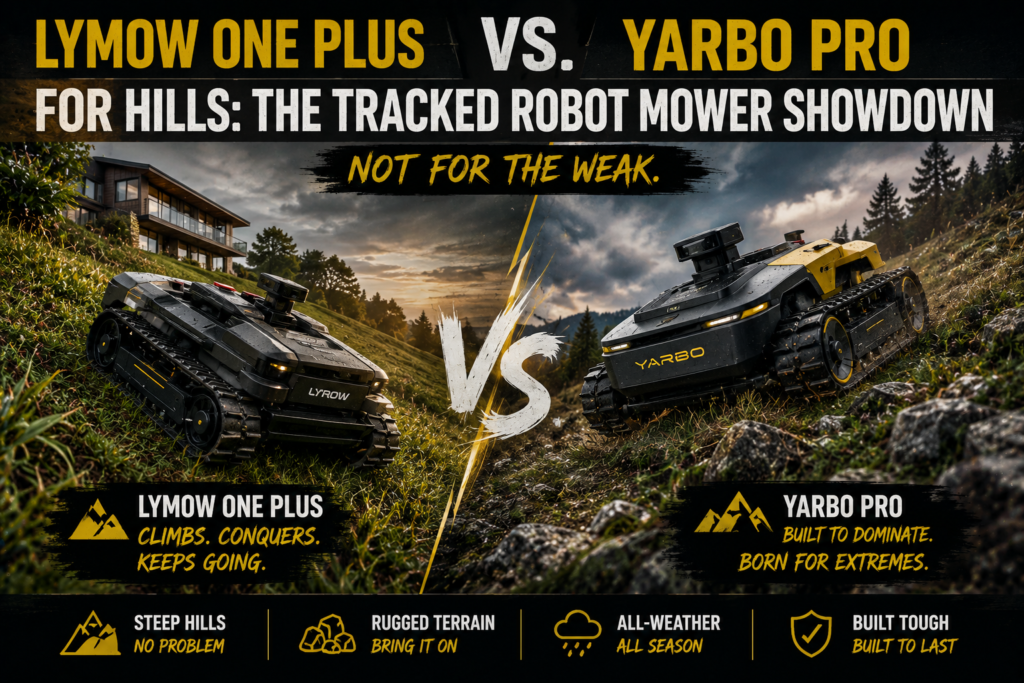
If my steepest slope exceeded 30 degrees regularly or my property was mostly side hills with soft soil, I would not buy it. I would buy the Lymow One Plus. The Lymow handles 45 degrees, weighs half as much, uses real rotary blades instead of razor discs, and has a LiFePO₄ battery that outlasts the Yarbo’s standard lithium-ion pack.
If I managed multiple commercial properties and needed guaranteed uptime, I would not buy either. I would buy Husqvarna for the dealer network and fleet services.
**Ready to decide? Compare Yarbo Pro live pricing with the standard Yarbo here
Frequently Asked Questions
Is the Yarbo Pro actually better than the standard Yarbo on hills?
Not in slope capability—both are rated for 35° and share the same 1.38 kWh battery. The Pro adds 2,500W peak motor power, swappable straight blades, Wi-Fi HaLow, and IPX6 waterproofing. Those upgrades help with thick grass and harsh conditions, but they do not help it climb steeper.
Can the Pro mow at night on my hillside?
Technically yes, but cautiously. The camera-based navigation works in low light, but obstacle detection is reduced. On hillside properties where a runaway mower has more serious consequences, daytime scheduling is safer.
Will the tracks destroy my lawn?
On dry, established turf, the tracks compress grass temporarily. On soft, wet, or newly seeded soil, zero-point turns will tear grass down to bare dirt. This is documented by multiple owners and acknowledged by Yarbo support.
Do I really need the Pro over the standard model?
Only if you have thick, overgrown grass, want the lowest 0.8-inch cutting height, or need IPX6 and Wi-Fi HaLow. For standard lawn maintenance on hills, the standard model at $4,999 is the smarter buy.
What happens when it breaks?
You troubleshoot via remote support and perform DIY repairs with shipped parts. At 198 pounds, shipping the entire unit for service is essentially impossible without freight logistics. There is no local dealer network.
Does it work on side hills?
It can traverse side slopes, but 198 pounds generates significant lateral force. The 35° rating is primarily for straight climbs. On wet side hills, expect more slip, aborts, and turf damage than on straight ascents.
Final Verdict
The Yarbo Lawn Mower Pro Review for Hills comes down to this: Yarbo built a powerful, ambitious modular platform that happens to mow grass very well on moderate slopes. For wealthy Northern estate owners who want a single robot to clear snow, blow leaves, and cut grass across massive acreage, it is a compelling—if expensive—vision of the future.
But for pure hillside lawn care, it is compromised. The 198-pound weight is as much liability as asset. The zero-turn turf damage is real. The lack of automated slope optimization turns complex terrain into a part-time job. And the $1,000 Pro premium buys motor power, not battery capacity, which is a marketing sleight of hand.
Buy it if you need a year-round robotic groundskeeper for a large, moderately sloped estate and you can absorb the service risk. Do not buy it if you just need a dedicated hill-climbing mower. In that case, the Lymow One Plus climbs steeper, costs less, and treats your turf more gently.
Your slope is not getting flatter. Your weekends are not getting longer. Choose the machine that actually fits your terrain, your budget, and your tolerance for repairing a 200-pound robot in your garage.
Ready to reclaim your weekends from that hillside?Check the latest Yarbo Pro pricing, modular bundles here
Thank you for reading this Yarbo Lawn Mower Pro Review for Hills. If your terrain is genuine, your acreage is massive, and your wallet is deep, the Yarbo Pro is a powerful tool—just make sure you are ready to own a tank, not just a mower.
Make 2026 the year your lawn mows itself! Explore our top picks and secure the best robot mower for steep slopes through the trusted affiliate links above and below. Your weekends (and your back) will thank you.
Disclaimer: This article contains affiliate links. As an Amazon Associate, I earn from qualifying purchases. Prices fluctuate, but the recommendation logic remains the same. Always check the slope rating before buying.
More Reviews…
More Comparisons…






Other Comparisons…