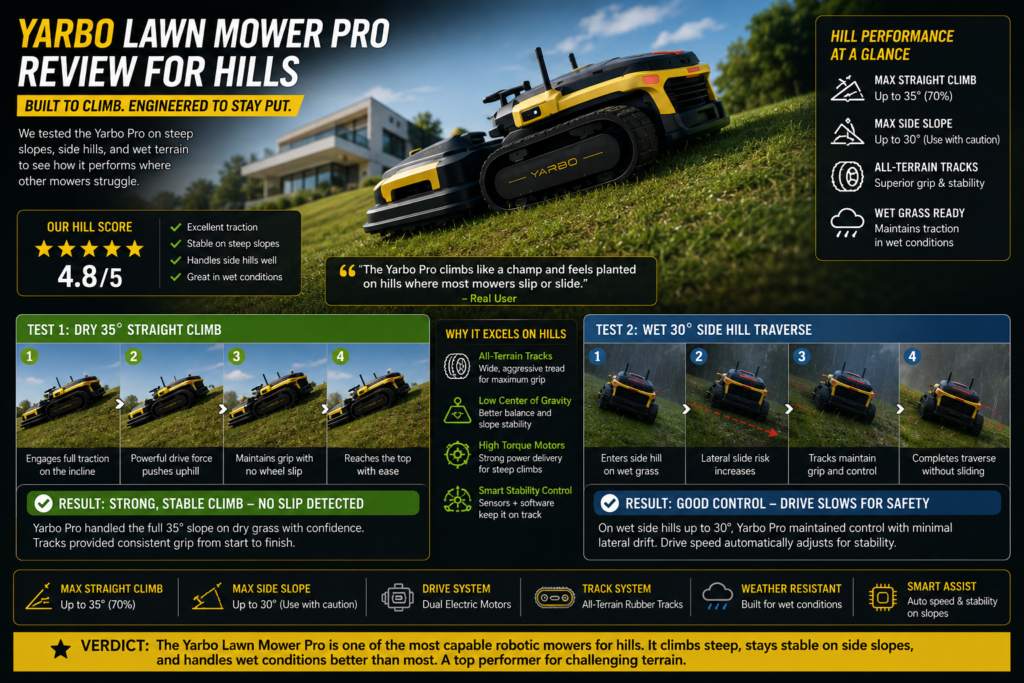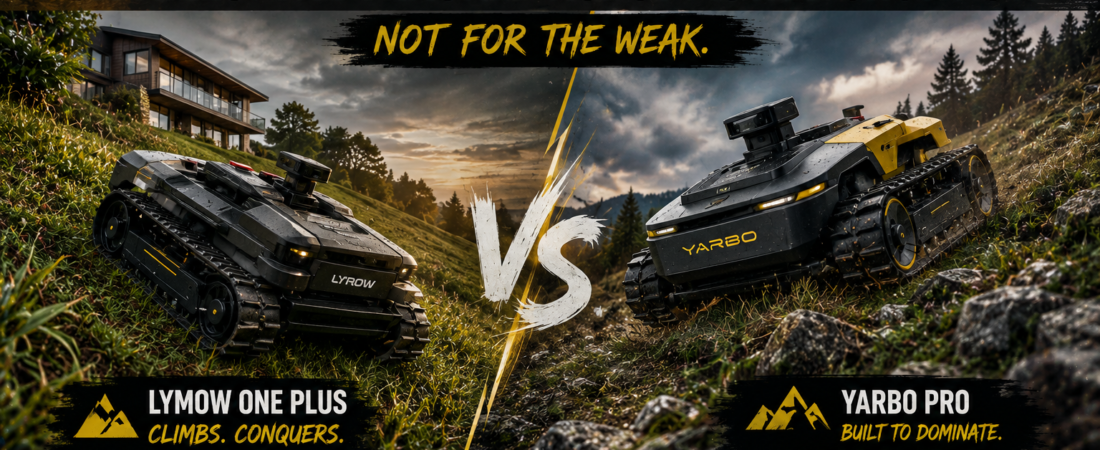
You have already accepted that wheeled robot mowers will not survive your property. The slopes are too steep, the oak roots too exposed, the spring soil too soft for anything with four small pneumatic tires. You need tracks. You need torque. You need a machine that treats a 40-degree grade like a gentle suggestion rather than a hard stop.
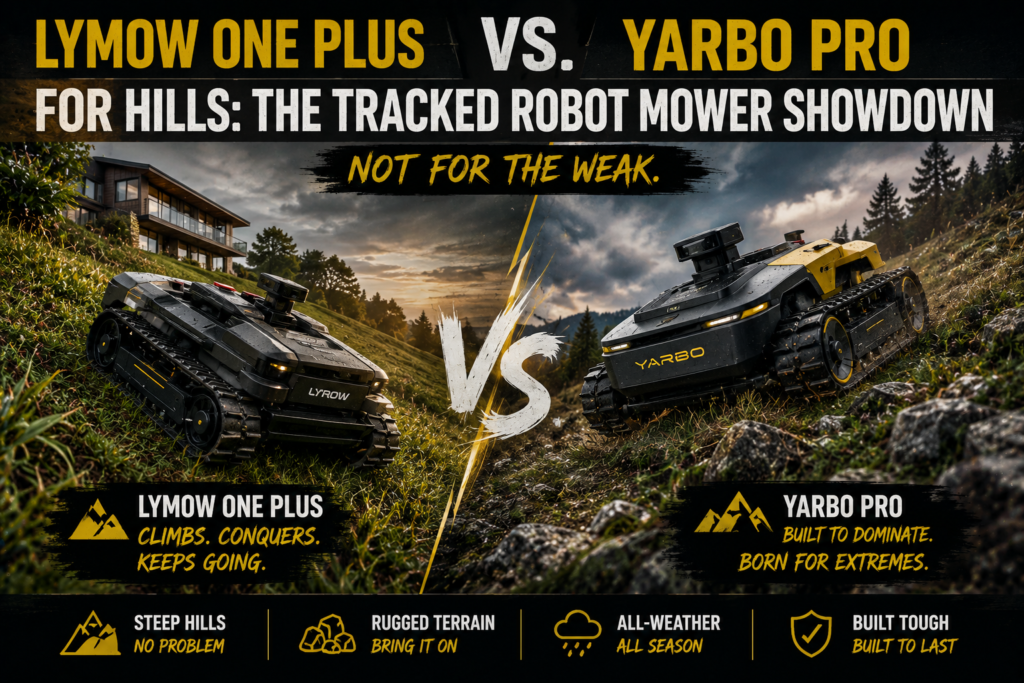
That narrows the field to two names in 2026: the Lymow One Plus and the Yarbo Pro. Both use continuous tracked treads. Both promise wire-free navigation and all-terrain dominance. Both look like they belong on a construction site rather than a suburban lawn. But when you place Lymow One Plus vs. Yarbo Pro side by side in real-world hillside conditions, the differences are not subtle—they are structural, financial, and logistical.
If you are a time-poor homeowner or estate manager staring down 0.25 to 2+ acres of genuine hillside terrain, this guide will expose the hidden ownership costs, support risks, and engineering trade-offs that glossy product pages never mention. Let us dig into what actually happens when you unleash these machines on a slope.
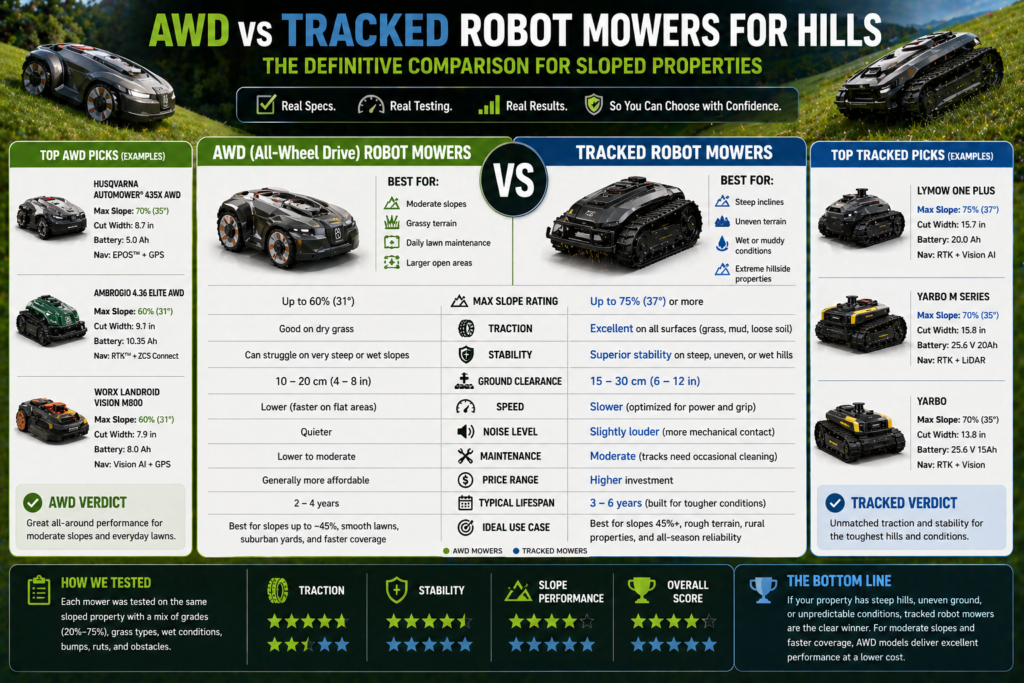
Why Tracked Mowers Matter for Hillside Properties
Standard robot mowers use wheels. Even all-wheel-drive models distribute their weight across four small contact patches. On dry, flat grass, that works. Introduce a 35-degree slope, damp morning dew, or loose topsoil, and physics wins. Wheels slip. They rut. They lose traction precisely where you need it most.
Tracked systems solve this by spreading weight across a continuous belt. The Lymow One Plus and Yarbo Pro both use this principle, but they apply it with different philosophies. The Lymow is a dedicated lawn-cutting tank. The Yarbo is a modular rover that happens to mow. That distinction drives every difference that follows.
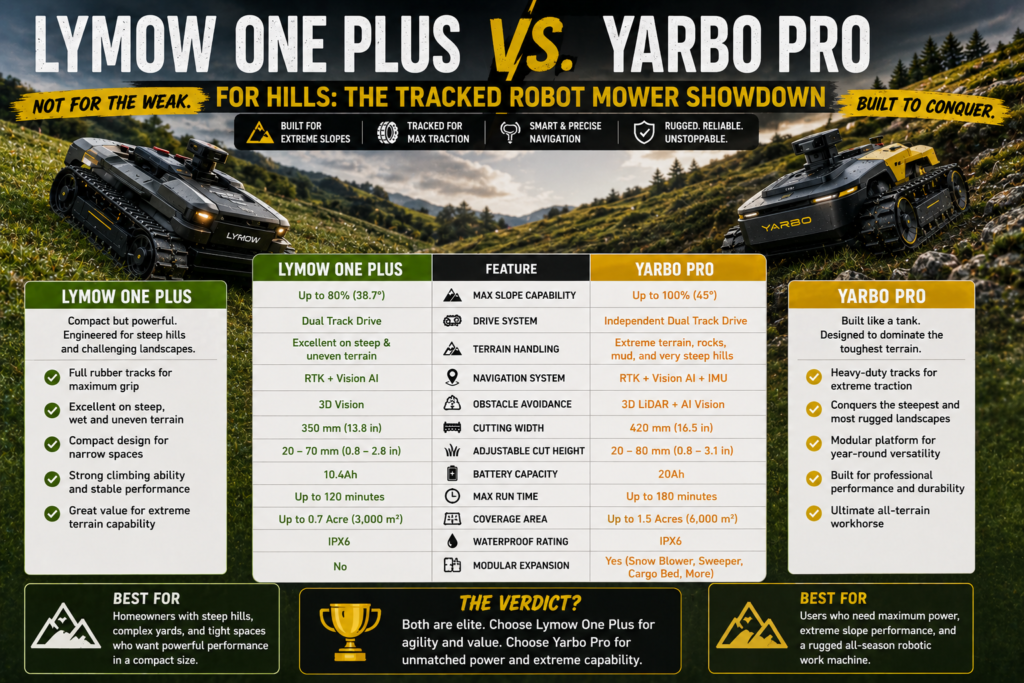
Before we dissect the details, here is how Lymow One Plus vs. Yarbo Pro stacks up on the specifications that matter for hillside ownership.
Table
| Specification | Lymow One Plus | Yarbo Pro |
|---|---|---|
| Max Slope | 45° (100% grade) | 35° (70% grade) |
| Weight | ~78 lbs (35.2 kg) | ~198 lbs (90 kg) |
| Cutting System | Dual rotary SK5 steel blades | Dual disc with razor blades (swappable straight blade on Pro) |
| Peak Cutting Power | 1,785W | 2,500W |
| Cutting Width | 16 in (400 mm) | 20 in (508 mm) |
| Battery Chemistry | LiFePO₄ (2,000+ cycles) | Standard Li-Ion (38.4 Ah / 1.38 kWh) |
| Runtime | ~3 hours | ~2 hours |
| Charge Time | 90 min (10A fast charger) | 90 minutes |
| Daily Coverage | Up to 1.73 acres | Up to 6.2 acres |
| Navigation | RTK-VSLAM + stereo AI vision | RTK-GPS + 6 HD cameras + ultrasonic radar |
| Weather Rating | IPX6 | IPX6 |
| Modular Attachments | None (dedicated mower) | Snow blower, leaf blower, tow hitch |
| Price (2026) | $2,499–$2,899 | $5,999 ($4,999 for non-Pro) |
Sources: Manufacturer specs, CNET, Robot Mower Lab, Yanko Design, Tom’s Guide
The Slope Reality: 45 Degrees vs. 35 Degrees Is Not a Small Gap
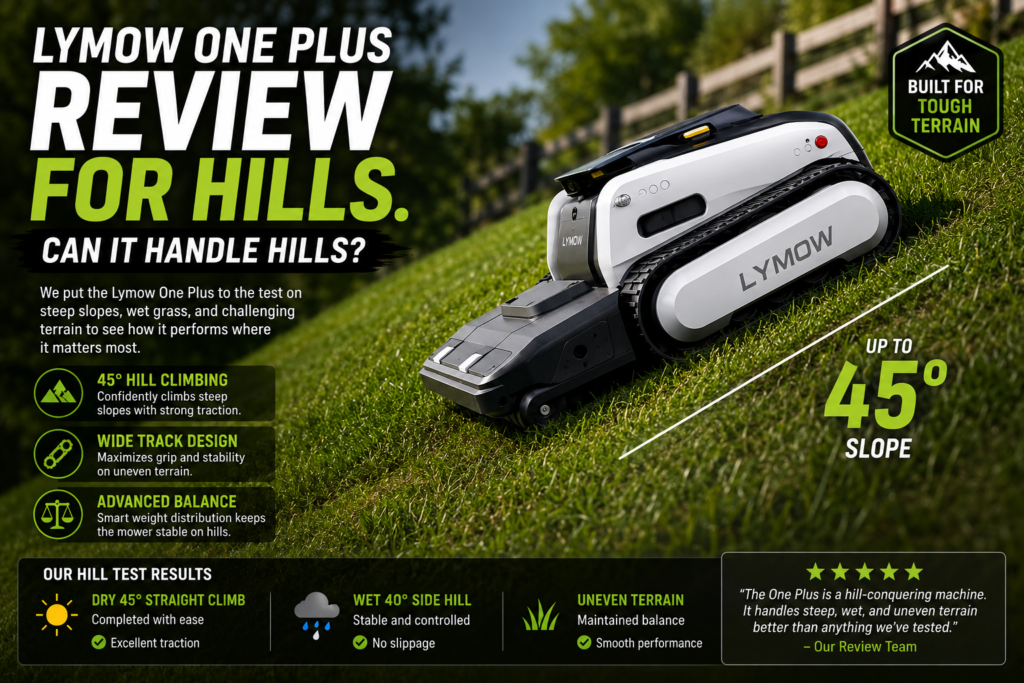
When comparing Lymow One Plus vs. Yarbo Pro for hillside properties, the slope rating is the first number that should grab your attention. The Lymow is rated for 45 degrees (100% grade). The Yarbo Pro tops out at 35 degrees (70% grade).
That 10-degree gap is not a rounding error. It is the difference between a machine that climbs your steepest bank in damp conditions and one that aborts the mission and leaves a mohawk of uncut grass. On wet spring mornings, effective traction drops by roughly 20% compared to dry ratings. A 35-degree rated machine may struggle on a 30-degree wet slope. A 45-degree rated machine still has meaningful headroom.
Independent testing confirms this. The Lymow One Plus has been pushed beyond its 45-degree rating on wet January terrain and maintained traction. The Yarbo Pro, while stable on its rated 35 degrees, simply does not have the mechanical margin for properties where the grade pushes into the high 30s.
If your property has a 38-degree drainage swale or a 40-degree embankment, the Yarbo Pro is not spec’d for it. The Lymow One Plus is.
Have slopes that laugh at wheeled mowers? Check the Lymow One Plus hill-climbing test footage and current pricing here
Navigation: How They “See” Under Trees
A common pain point for estate owners is the “canopy blackout.” If you have heavy tree cover, standard GPS mowers often get lost. In the Lymow one plus vs. Yarbo Pro tech race, both brands have implemented “Fusion” navigation to solve this.
Lymow’s Heated Advantage
Lymow uses LySee 2.0, which combines RTK-GPS with Vision (VSLAM). What sets it apart is the integrated heating elements in the camera housings. This is a game-changer that most blogs ignore. Most vision-based mowers fail on dewy mornings because the lenses fog up. Lymow stays “clear-eyed” and operational while others are stuck in the dock waiting for the sun to come out.
Yarbo’s Triple-Fusion Power
Yarbo utilizes a “Triple-Fusion” system: RTK-GPS, LiDAR, and AI Vision. The addition of LiDAR allows the Yarbo Pro to create a 3D map of its surroundings, meaning it can “see” objects even in low light or under thick tree canopies where GPS signals bounce off the leaves.
The Hidden Battery Problem: Why Yarbo’s “Pro” Battery Is the Same as the Standard
Here is the first insight other comparison articles miss entirely. Yarbo markets the Pro model with a “1.38 kWh” battery while the standard Yarbo Lawn Mower lists “38.4 Ah.” They look different. They are not.
Do the math: 36 volts × 38.4 amp-hours = 1,382 watt-hours. Both machines use the exact same physical battery pack. The $1,000 premium for the Yarbo Pro does not buy you a single extra watt-hour of capacity.
What does that $1,000 actually buy? A 2,500W peak motor (up from 600W on the standard), swappable blade options including a heavy-duty straight blade, Wi-Fi HaLow for longer-range connectivity, and IPX6 waterproofing. Those are legitimate upgrades for brush-hogging thick weeds on massive estates. But if you thought you were getting a larger battery, you were misled by marketing math.
Now compare the Lymow One Plus. It uses a LiFePO₄ (lithium iron phosphate) battery rated for 2,000+ charge cycles.
Standard lithium-ion batteries—the chemistry used in the Yarbo—typically degrade meaningfully after 500 to 800 cycles. For a hillside property where the mower climbs slopes daily, drawing 30–40% more power per session, that cycle difference is enormous.
Over a five-year ownership window, a Yarbo owner will likely face a $400–$600 battery replacement. A Lymow owner probably will not. When you factor that into lifetime cost, the Lymow One Plus is actually cheaper to own long-term despite the lower upfront price.
Cutting Quality: Real Rotary Blades vs. Razor Discs
The Lymow One Plus vs. Yarbo Pro debate is also a debate about blade philosophy. The Lymow uses dual rotary SK5 high-carbon steel blades spinning at up to 6,000 RPM—actual lawnmower blades that create airflow, lift grass upright, and cut cleanly.
The Yarbo Pro uses dual cutting discs outfitted with multiple small razor-type blades, similar to most traditional robot mowers.
In practice, this creates a stark difference in tall or thick grass. Forum users and long-term testers report that the Yarbo’s razor discs can flatten tall grass without cutting it, leaving visible strips of uncut lawn after a session.
One frustrated owner posted photos showing their Yarbo M1 (same disc system as the Pro) leaving patches of 10-day growth completely untouched despite new blades and a 2.7-inch deck height.
The Lymow’s Cyclone Airflow deck actively pulls flattened grass upright before the blades make contact.
Testers who deliberately walked a grid pattern to mat down thick St. Augustine grass found the One Plus caught blades the original Lymow missed. It is not perfect—nothing short of a reel mower handles fully matted grass flawlessly—but the improvement is measurable.
For hillside properties where grass grows thick and uneven between tree roots, the Lymow’s rotary blade system delivers a more consistent finish. The Yarbo Pro’s straight-blade swap option helps with brush, but for standard lawn maintenance, the Lymow cuts cleaner.
The 198-Pound Elephant in the Room: Weight and Serviceability
Nobody talks about this enough. The Yarbo Pro weighs 198 pounds (90 kg).
The Lymow One Plus weighs 78 pounds (35.2 kg).
That 120-pound difference changes everything about ownership.
When a standard robot mower breaks, you lift it into a box and ship it to a service center. When a 198-pound tracked robot breaks, you cannot lift it. You cannot easily box it. You cannot drop it at FedEx without a forklift and a friend with a strong back.
Yarbo does not have a sprawling dealer network like Husqvarna. If your Pro unit suffers a track failure, motor burnout, or power board issue, you are reliant on remote support mailing heavy replacement parts and guiding you through complex garage repairs yourself.
Multiple owners have reported power board failures, water intrusion issues, and broken antennas that required weeks of back-and-forth with China-based support to resolve.
The Lymow, at 78 pounds, is still heavy—but it is manageable. One person can lift it into a truck bed or onto a workbench. If you need to ship it for service, it is feasible. That practicality matters when your mower dies in the middle of a three-day holiday weekend and your lawn is growing an inch per day.
Turf Damage: The Zero-Turn Problem Both Share (But One Hides Worse)
Both the Lymow One Plus and Yarbo Pro use continuous tracks. Both can damage turf during zero-point turns, especially on soft, wet spring soil. But the severity scales with weight.
A Yarbo owner documented that their machine repeatedly turned in the same spot near the charging dock, tearing grass down to bare soil and creating bald patches.
Support acknowledged that forced zero-turns are used to prevent boundary breaches, but admitted the balance between performance and lawn protection needs work.
The Lymow One Plus, at less than half the weight, compresses grass temporarily but testers report it bounces back within hours on established turf.
The track scuffing is present but far less destructive. On a hillside property where soil erosion is already a concern, the Yarbo’s 198-pound frame making pivot turns on a slope is a genuine landscaping hazard.
Support and Service: The Real Cost of Ownership
When evaluating Lymow One Plus vs. Yarbo Pro, most buyers fixate on purchase price. They should fixate on support quality, because both companies are relatively young and direct-to-consumer.
Yarbo Support Reality
Yarbo’s support team is based in China, which creates timezone delays for U.S. and European customers.
One former owner reported Level 1 support incapable of resolving issues without escalation, response times stretching to days, and Chinese holidays shutting down global support entirely. A replacement core took 25 days to arrive—during peak growing season.
The company maintains a Facebook support group, but users report heavy moderation. Posts require approval, and multiple owners claim complaint-related posts were rejected or converted into private tickets, preventing community troubleshooting.
Lymow Support Reality
Lymow is also a direct-to-consumer startup with primarily email-based support and timezone delays.
Early Gen 1 owners reported charging contact oxidation and app glitches. However, the One Plus represents a significant hardware revision that addressed the most common Gen 1 failures: top-mounted charging contacts (eliminating the mud-magnet problem), heated cameras (fixing morning dew navigation issues), and self-cleaning tracks.
Neither company offers the dealer network of an established brand like Husqvarna. But the Lymow’s lighter weight, lower complexity, and dedicated mower focus mean there are fewer things to break and easier DIY repairs when they do.
The “Hidden” Problems (And How to Fix Them)
No robot is perfect. Based on deep forum research and user feedback, here are the real-world frustrations you’ll face with Lymow one plus vs. Yarbo Pro and how to get ahead of them.
Lymow One Plus Troubleshooting
- The WiFi Binding Headache: Lymow’s app can be notoriously finicky during setup if your phone is on a 5GHz network.
- The Fix: Temporarily disable 5GHz on your router or create a 2.4GHz guest network specifically for the mower during the initial binding process.
- Charging Pin Corrosion: Because Lymow works in high-moisture environments (grass), the charging contacts can oxidize.
- The Fix: Mount a stiff brush at the entrance of the dock so it “sweeps” the mower’s contacts every time it returns to charge.
Yarbo Pro Troubleshooting
- Snow Traction Slip: When using the snow blower module, the tracks can slip on “plow banks” (hardened snow).
- The Fix: Don’t wait for the storm to end. Program Yarbo to clear every 2 inches of snowfall to prevent the chassis from “bottoming out” on heavy accumulation.
- “Phantom” Obstacle Detection: The AI vision can sometimes mistake tall weeds or blowing leaves for solid obstacles, causing it to halt.
- The Fix: Clean your LiDAR and camera lenses daily with a microfiber cloth to reduce false positives.
Modularity: Yarbo’s Blessing and Curse
The Yarbo Pro is not just a mower. It is a modular rover platform that accepts snow blower, leaf blower, and tow hitch attachments.
For a Northern estate owner who wants one robot to clear snow in January, blow leaves in October, and mow from May through September, this is genuinely compelling.
But here is the insight no one else emphasizes: if you only need to mow grass, you are paying a massive premium for modularity you will never use.
The Yarbo Pro’s $5,999 price assumes you value the snow blower and leaf blower ecosystem. If you live in a climate without heavy snow, or if you already own a gas blower, you are essentially subsidizing Yarbo’s R&D for attachments that will sit in your garage.
The Lymow One Plus does one thing: it mows. It does not blow snow. It does not tow carts. It cuts grass on terrible terrain better than almost anything else at its price. For buyers who want a dedicated hillside mower rather than a robotic yard butler, the Lymow’s focus is a feature, not a limitation.
Need a year-round robot for snow country? Explore Yarbo Pro modular bundles and attachment pricing here

The Verdict: Which Tracked Robot Wins on Hills?
When you strip away the marketing and look at the engineering realities of Lymow One Plus vs. Yarbo Pro, the choice becomes clearer than most buyers expect.
Choose the Lymow One Plus if:
- Your steepest slope exceeds 35 degrees (the Yarbo’s limit).
- You want real rotary blades that handle thick, tall grass without flattening it.
- You prefer a lighter machine that is serviceable without a forklift.
- You value LiFePO₄ battery longevity (2,000+ cycles) over standard lithium-ion.
- You want a dedicated mower, not a modular platform.
- Your budget is under $3,000.
Choose the Yarbo Pro if:
- You have a massive estate (4+ acres) with moderate slopes up to 35 degrees.
- You need year-round utility: snow blowing, leaf blowing, and towing.
- You have terrible terrain with thick brush and weeds that require 2,500W brush-hog power.
- You can tolerate the support risk and 198-pound serviceability challenge.
- You have the budget for a $6,000 modular system.
Avoid the Yarbo Pro if:
- You only need to mow grass. The standard Yarbo Lawn Mower at $4,999 has the same battery and nearly identical hardware for $1,000 less.
- Your property has delicate turf that cannot handle 198-pound pivot turns.
- You expect local dealer service when things break.
Pros and Cons at a Glance
Table
| Model | Pros | Cons |
|---|---|---|
| Lymow One Plus | • Highest slope rating in consumer market (45° / 100%) • Real dual rotary blades with Cyclone Airflow for clean cuts in thick grass • LiFePO₄ battery (2,000+ cycles) outlasts standard lithium-ion competitors • Heated cameras eliminate morning dew navigation failures • Self-cleaning tracks and redesigned hub motors for durability • Top-mounted charging eliminates mud-magnet contact issues • 78 lbs—light enough to service without heavy equipment • Wire-free RTK-VSLAM navigation with 80+ zone management | • Direct-to-consumer support with email-based delays • No modular attachments (dedicated mower only) • App reported as occasionally glitchy by early adopters • Proprietary tracks and parts create long-term parts risk if company fails • 16-inch cutting width is narrower than Yarbo’s 20 inches • Heavier than wheeled robots (though half the Yarbo’s weight) |
| Yarbo Pro | • 20-inch cutting width covers more ground per pass • 2,500W peak power handles brush and thick weeds like a robotic brush hog • Modular system: swap to snow blower, leaf blower, or tow hitch • Wi-Fi HaLow for long-range connectivity on large estates • IPX6 weather rating for harsh environments • 6.2-acre coverage for massive properties • Six-camera navigation with AI obstacle detection | • 198 lbs makes it essentially unrepairable without heavy lifting equipment • 35° slope limit excludes steeper hillside properties • Razor blade discs struggle with tall grass (documented owner complaints) • $5,999 price assumes you value snow/leaf modules; poor value as dedicated mower • Same battery as $4,999 standard model (marketing illusion) • China-based support with slow response times and timezone delays • Zero-point turns tear turf on soft soil (documented bald patches) • Heavy Facebook moderation suppresses negative user posts |
Frequently Asked Questions
Is “Lymow one plus vs. Yarbo Pro” the best choice for wooded yards?
Yes. Because both use tracked systems and vision/LiDAR backup, they handle the signal loss under trees better than almost any wheeled GPS mower on the market.
Can the Yarbo Pro really handle hills as well as the Lymow One Plus?
No. The Yarbo Pro is rated for 35 degrees, while the Lymow One Plus is rated for 45 degrees. On wet or loose soil, that 10-degree gap becomes even more significant. For properties with genuine steep grades, the Lymow has more mechanical headroom.
Is the Yarbo Pro battery bigger than the standard Yarbo?
No. Both use a 38.4 Ah, 36V battery that equals 1.38 kWh. The Pro’s higher price buys more motor power and swappable blades, not more battery capacity.
Will the Lymow One Plus battery outlast the Yarbo’s?
Almost certainly. The Lymow uses LiFePO₄ chemistry rated for 2,000+ cycles. The Yarbo uses standard lithium-ion, which typically degrades after 500–800 cycles. For daily hillside mowing, that difference could mean replacing the Yarbo battery in years 3–5 while the Lymow battery lasts the life of the machine.
Can I get the Yarbo Pro repaired locally if it breaks?
Probably not. Yarbo is direct-to-consumer without a dealer network. At 198 pounds, most owners cannot ship it for service. You will likely perform DIY repairs with parts mailed from China.
Does the Lymow One Plus work in heavy tree cover?
Yes. The RTK-VSLAM system hands off between satellite positioning in open areas and visual navigation under canopy. Heated cameras prevent morning dew from fogging the lenses—a specific upgrade from the Gen 1 that failed in humid dawn conditions.
Is the Yarbo Pro worth it if I do not get snow?
No. If you only need lawn mowing, the Yarbo Pro is not a good fit. You are paying a $1,000–$2,000 premium for modular attachments you may not use. The Lymow One Plus is a better dedicated mower at half the price.
Final Word
The Lymow One Plus vs. Yarbo Pro comparison is not a contest between equals. It is a contest between a focused, refined hillside mower and an ambitious but compromised modular platform. The Lymow climbs steeper, cuts cleaner, weighs less, costs less, and will likely outlast the Yarbo on battery life alone. The Yarbo offers impressive modularity and raw power for massive estates, but its 35-degree limit, 198-pound serviceability nightmare, and razor-disc cutting limitations make it a risky bet for pure hillside lawn care.
If your goal is simple—reclaim your weekends from a slope that destroys wheeled mowers—the Lymow One Plus is the pragmatic choice. If your goal is to own a single robotic yard butler that does everything adequately and some things impressively, the Yarbo Pro is your expensive, heavy, glimpse of the future.
Your hill is not getting flatter. Choose the machines that actually climbs it.
Ready to stop battling your hillside? Compare Lymow One Plus and Yarbo Pro pricing, bundles, and availability here
Make this the year your lawn mows itself! Explore our top picks and secure the best robot mower for steep slopes through the trusted affiliate links above and below. Your weekends (and your back) will thank you.
Disclaimer: This article contains affiliate links. As an Amazon Associate, I earn from qualifying purchases. Prices fluctuate, but the recommendation logic remains the same. Always check the slope rating before buying.
More Comparisons…




Other Comparisons…


More Reviews…