Table of Contents
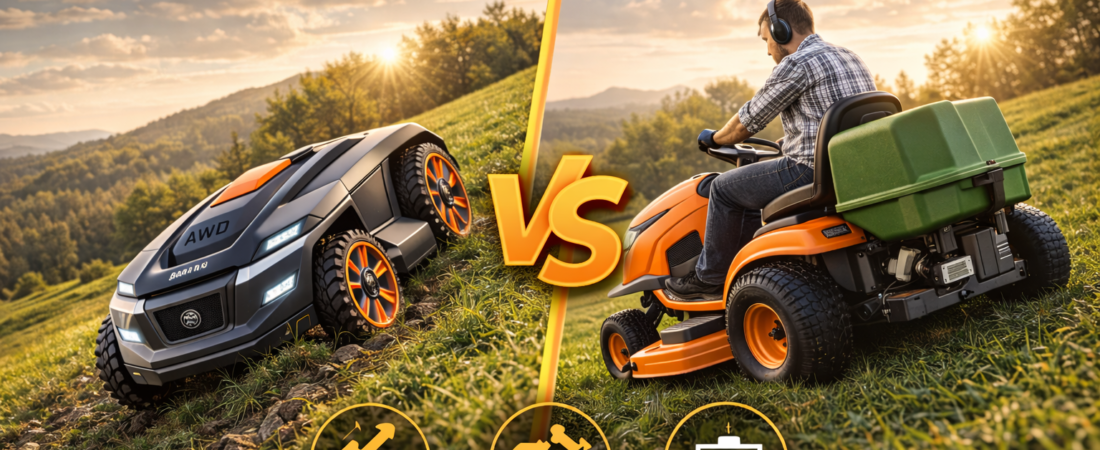
If you have a sloped yard, choosing between a robot mower vs riding mower for hills isn’t just about price — it’s about time, safety, and what your weekends are actually worth to you.
Both machines cut grass. That’s where the similarity ends. One requires you to show up, climb on, navigate a hillside for 2–3 hours, and do it all again next week. The other maps your property once, learns your terrain, and handles the job on its own — every day, without you.
This guide cuts through the marketing on both sides and gives you the real comparison: upfront cost, long-term expense, slope performance, safety, and the honest answer to which option fits your specific yard.
| Robot Mower | Riding Mower | |
|---|---|---|
| Operation | Fully automated | Manual |
| Frequency | Daily | Weekly |
| Upfront cost | Higher | Lower |
| Ongoing effort | None | 1–3 hrs/week |
| Slope safety | High | Moderate |
 [Jump to the Best Option for Your Yard → Affiliate Link]
Robot Mower vs Riding Mower: Quick Answer
Not everyone needs to read 2,000 words to make this decision. Here’s the short version.
Choose a robot mower if:
- You want your mowing handled automatically, without scheduling your weekend around it
- You value time savings and low ongoing effort over upfront cost
- Your yard has moderate to serious slopes where riding safely is a concern
- You’re comfortable with a brief initial app-based setup
Choose a riding mower if:
- Your terrain is extremely rough or irregular beyond what robot mowers handle
- You prefer a single fast session over daily autonomous mowing
- You have specific mowing preferences that require manual control
- Your budget is firmly under $1,500 with no room to stretch
For most homeowners dealing with sloped terrain, the robot mower vs riding mower for hills comparison tilts clearly toward automation — but the full picture is worth understanding.
[See which option fits your yard below → Affiliate Link]
True Cost: Robot Mower vs Riding Mower
Upfront Investment
| Type | Typical Cost Range |
|---|---|
| Robot mower (slope-capable) | $1,000–$5,000 |
| Riding mower | $1,500–$4,000 |
The upfront costs overlap more than most people expect. A capable riding mower for hilly terrain — one with the torque, traction, and stability to handle slopes safely — runs $2,500–$4,000. A premium AWD robot mower capable of the same terrain sits in the $2,500–$3,500 range. The gap is smaller than the sticker shock suggests.
Where the comparison really separates is in what happens after the purchase.
Ongoing Costs
Robot mower annual costs:
- Electricity: roughly $15–$30 per year depending on usage
- Blade replacement: $20–$60 annually
- Occasional cleaning and firmware updates: minimal
- Total typical annual cost: $50–$100
Riding mower annual costs:
- Gasoline: $150–$400 per season depending on yard size
- Oil changes and engine maintenance: $100–$200 annually
- Belt, blade, and filter replacements: $100–$300 per year
- Repairs and unexpected maintenance: $200–$500+ over time
- Total typical annual cost: $550–$1,400
3-Year Total Cost of Ownership
| Robot Mower | Riding Mower | |
|---|---|---|
| Upfront | $2,999 | $2,500 |
| Year 1 running costs | $75 | $700 |
| Year 2 running costs | $75 | $800 |
| Year 3 running costs | $75 | $900 |
| 3-Year Total | ~$3,224 | ~$4,900 |
Over three years, the robot mower vs riding mower for hills cost comparison consistently favors automation. The robot mower starts more expensive and ends significantly cheaper. By year two, most buyers have passed the break-even point. By year five, the savings gap is substantial.
And this calculation doesn’t include the value of the time you stop spending pushing a machine up a hill in July heat.
Which One Saves You More Time?
This is where the comparison stops being about money and starts being about how you actually want to live.
The Riding Mower Reality
A riding mower on a sloped property isn’t a quick task. You’re looking at 1–3 hours per session on anything over half an acre with meaningful elevation. That means planning around the weather, scheduling the time, physically operating heavy equipment on terrain that requires concentration, and doing it again the following week. Every week. For seven or eight months of the growing season.
Over a full season, that’s 30–50 hours of active time spent mowing. On a hilly property, a significant portion of that time involves managing a machine that doesn’t always want to go where you’re pointing it.
The Robot Mower Reality
Setup takes a few hours the first time — boundary mapping, zone configuration, schedule programming. After that, the mower handles itself. It runs daily or on whatever schedule you set, mowing a portion of the property each cycle rather than trying to do everything at once. You check on it occasionally. You don’t think about it most days.
Your active time investment after setup: close to zero per week.
A robot mower doesn’t just cut grass — it gives you your weekends back. For anyone who has spent years dreading the Saturday mowing block, that’s not a minor upgrade. It’s a fundamental change in how you use your free time.
[See the best robot mowers for hilly yards → ]
Robot Mower vs Riding Mower on Slopes
This is the section that matters most for anyone with a genuinely sloped property, because slope performance is where the robot mower vs riding mower for hills conversation gets serious.
Robot Mower Slope Performance
Modern slope-capable robot mowers handle 25–80% grades depending on the model. Entry-level machines max out around 20–25%, but premium AWD and 4×4 models from brands like Mammotion, Kress, and Husqvarna push into 70–84% territory. Wire-free navigation systems map your terrain precisely and learn the most efficient paths — including how to handle steep sections without lateral slipping.
Critically, robot mowers mow frequently and lightly. Because they run daily rather than weekly, grass is always short, which means the machine never battles overgrown turf on a hill. That consistent approach actually improves cut quality on slopes compared to the weekly deep-cut cycle of a riding mower.
Riding Mower Slope Performance
Riding mowers on hills are effective — up to a point. Zero-turn mowers, which are popular for their maneuverability, are actually poorly suited to slopes because the drive configuration creates tipping risk on lateral traverses. Traditional garden tractors handle hills more safely but still require skill, caution, and careful attention to wet conditions.
Most riding mower manufacturers recommend against slopes above 15 degrees (roughly 27%). In practice, many homeowners operate them on steeper terrain — but the injury statistics for riding mower tip-overs and rollover accidents are significant. The U.S. Consumer Product Safety Commission reports thousands of riding mower injuries annually, with slope-related incidents a leading factor.
For anyone weighing robot mower vs riding mower for hills specifically from a safety standpoint, that context matters.
Which Is Easier to Use?
Setup and Learning Curve
The riding mower wins on day-one simplicity. You sit down, start the engine, and mow. There’s no app, no mapping, no configuration. If you want to mow right now, a riding mower lets you do that.
Robot mowers require an upfront investment. Boundary mapping on a complex sloped property takes 1–3 hours. Zone configuration, schedule setup, and initial test runs add another session. For buyers who are not comfortable with app-based tech, this can feel like a barrier.
But here’s the framing that matters: you do that setup once. After that, the robot mower is easier every single day for the rest of its life. The riding mower is easy on day one and equally demanding every session thereafter.
Robot mowers are harder to start — but easier forever after.
Day-to-Day Operation
| Robot Mower | Riding Mower | |
|---|---|---|
| Weekly time required | ~0 hours | 1–3 hours |
| Physical demand | None | Moderate to high |
| Weather dependency | Low (auto-schedules) | High (manual timing) |
| Supervision needed | Minimal | Constant |
Maintenance: Robot Mower vs Riding Mower
Robot Mower Maintenance
Robot mowers are mechanically simple. The primary consumable is blades — small razor-style blades that need replacing every 4–8 weeks depending on usage. Occasional cleaning to remove grass buildup from the undercarriage takes 10 minutes. Software updates happen automatically or via app. There’s no engine, no fuel system, no belts, and no oil.
Annual maintenance time: roughly 2–4 hours total.
Riding Mower Maintenance
Riding mowers are internal combustion machines, which means they carry all the complexity that comes with that. Oil changes every 50 hours of use. Air filter replacement. Spark plug inspection. Fuel stabilizer if stored over winter. Belt inspection and replacement. Blade sharpening or swaps. Deck cleaning. Battery maintenance on electric start systems.
For a well-used machine on a demanding property, maintenance is a recurring seasonal obligation — not a one-time task.
The robot mower vs riding mower for hills maintenance comparison isn’t close. Robots win on simplicity, time, and cost.
Side-by-Side Comparison
| Feature | Robot Mower | Riding Mower |
|---|---|---|
| Weekly effort | None after setup | 1–3 hours |
| Slope safety | High (AWD models) | Moderate — tip risk on steep grades |
| Long-term cost | Lower | Higher |
| Setup | Medium (1–3 hrs once) | Easy (instant) |
| Ongoing maintenance | Low | High |
| Cut consistency | Daily / even | Weekly / variable |
| Weather flexibility | High (auto-reschedules) | Low (manual timing) |
| Physical demand | None | Moderate to high |
[Compare top-rated robot mowers for hills → ]
Which One Should YOU Choose?
Personalized Recommendations
If you value time and want automation: Robot mower. This is the clearest use case — you want the lawn handled without being involved. Every day, without you. That’s what robot mowers do.
If you want manual control or prefer a single fast session: Riding mower. Some people genuinely enjoy mowing, prefer to control exactly how the job gets done, or find the single-session approach more satisfying than daily autonomous cycles. That’s a valid preference.
If your yard has significant slopes above 25%: Robot mower, specifically an AWD model. The combination of slope safety, consistent performance, and not needing to physically manage equipment on steep terrain is a strong case.
If your property is very large (2+ acres) with varied terrain: This is the nuanced scenario. Robot mowers cover large acreage through daily incremental mowing — high-capacity models handle up to 2.5 acres. Riding mowers complete large properties in a single session. If turnaround speed matters more than effort, a riding mower has an edge on large open terrain. If effort is the issue, a high-capacity robot mower is the better long-term investment.
The robot mower vs riding mower for hills decision ultimately comes down to one question: do you want to be involved in mowing your lawn, or do you want it to handle itself?
Who Should NOT Buy a Robot Mower
In the interest of honest advice, robot mowers aren’t the right answer for everyone dealing with hills.
If your terrain is extremely rough — deep ruts, large rocks, severe drop-offs, or drainage features that create impassable barriers — even AWD robot mowers will struggle. Terrain that’s difficult for a person to walk across comfortably often exceeds what current residential robot mowers handle reliably.
If budget is a hard constraint below $1,000, the slope-capable models on this list are out of reach. Buying a cheap robot mower for demanding terrain produces the exact frustrating experience that gives the category a bad reputation — a machine that gets stuck, misses sections, and never quite finishes the job.
If you’re genuinely opposed to any tech setup or app-based management, the initial configuration process will feel like more trouble than it’s worth. These machines reward users who engage with the setup and spend time getting the mapping right. If that sounds unappealing from the start, a riding mower may be the more practical choice regardless of long-term benefits.
Ready to Stop Mowing Your Lawn the Hard Way?
The robot mower vs riding mower for hills comparison doesn’t have a universal winner — but for most homeowners with sloped properties, real hills, and limited time, the answer points clearly in one direction. Lower long-term cost. Zero weekly effort after setup. Better slope safety. Consistent daily results.
If you want your time back, you’re tired of managing a hillside every weekend, and you’re ready for a machine that works while you don’t — the models below are where to start.
Make this the year your lawn mows itself! Explore our top picks and secure the best robot mower for steep slopes through the trusted affiliate links above and below. Your weekends (and your back) will thank you.
Disclaimer: This article contains affiliate links. As an Amazon Associate, I earn from qualifying purchases. Prices fluctuate, but the recommendation logic remains the same. Always check the slope rating before buying.