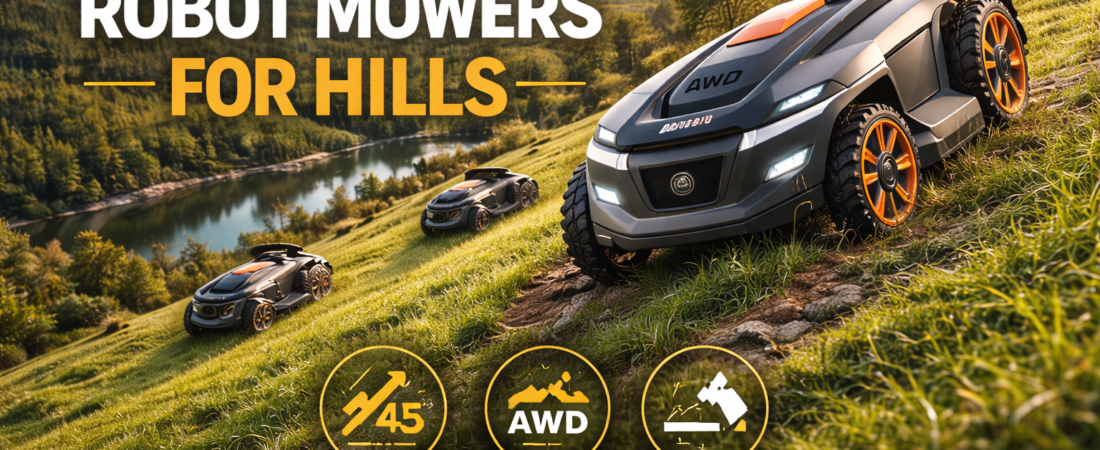
If your yard has hills, slopes, or uneven terrain, most robot mowers simply won’t work. They slip on wet grass, get stuck in ruts or around roots, slide downhill when power dips, tear up turf during turns, or leave patchy, embarrassing results that force you back out with a push mower anyway. For busy homeowners with 0.25–2+ acre properties, that means another weekend lost to physical strain, safety worries, heat exhaustion, and the constant mental burden of “the hill problem.”
But 2026 has changed the game. Advanced robot mowers for hills now feature true all-wheel drive (AWD), tracked systems, wire-free RTK + AI vision/LiDAR navigation, dual suspension, and intelligent traction control that deliver reliable performance where older models failed. Independent tests and owner reports confirm these machines climb 35–100% slopes (up to 45°) without hesitation, even on bumpy, root-filled, or partially tree-covered hillsides.
This interactive pillar post is your complete, buyer-intent-focused roadmap. We’ve drawn from 2026 manufacturer data, PCMag/Wired/TechRadar hands-on tests, Reddit owner experiences, and real-world slope trials to give you everything you need: exact slope percentages, comparison tables, pros/cons backed by performance data, yard-specific scenarios, ROI calculators, pro tips, and a full FAQ. Whether you’re a suburban professional dreading weekend hill duty or a small estate manager cutting labor costs, this guide shows exactly how robot mowers for hills deliver freedom, relief, control, and professional-looking results without the struggle.
robot mowers for hills are no longer experimental—they’re a proven, high-ROI upgrade for anyone whose property isn’t flat.
Table of Contents
Who This Guide Is For
This ultimate guide to robot mowers for hills is written specifically for you if:
- You own or manage a suburban, semi-rural, or estate property with 0.25–2+ acres of sloped, uneven, multi-zone, tree-covered, or obstacle-heavy terrain.
- You’re comfortable with smart-home apps.
- You spend 2–4+ hours every weekend battling uneven cuts, slipping risks, fatigue, missed spots, and the looming dread of mowing hills manually.
- You manage multiple properties or small landscaping operations and want to slash labor while maintaining premium results.
You value efficiency, convenience, modern tech, and smart ownership—but you’re cautious about wasting money on underperforming gear.
It is not for owners of flat urban lawns under 0.25 acres or anyone perfectly happy with traditional riding or push mowers. If hills steal your weekends, create safety concerns, or make consistent lawn care feel impossible, keep reading. We’ll help you match the right robot mower for hills and slopes to your exact yard.
(Internal link: Best robot mower for steep slopes – our dedicated deep-dive cluster article with model-specific testing.)
Understanding Slopes: The Critical Foundation Every Buyer Needs
Before you spend thousands, you must understand robot mower slope percentage and how it translates to real performance. Slope % is calculated as (vertical rise ÷ horizontal run) × 100. For example, a 20% slope rises 20 feet vertically over 100 feet horizontally—roughly 11.3 degrees. Manufacturers list both % and degrees because degrees feel more intuitive, but % is the industry standard for comparison.
Here’s the 2026 practical difficulty breakdown based on aggregated manufacturer specs and independent tests:
What does your slope actually look like?
Select a slope grade to see a visual diagram, real-world examples, and which robot mowers can handle it.
Slope diagrams are illustrative. Measure your actual grade with a free clinometer app before purchasing.
| Slope % | Degrees (approx.) | Difficulty Level | Typical Yard Examples | Required Robot Mower Capability | Success Rate in Tests |
|---|---|---|---|---|---|
| 0–20% | 0–11° | Easy | Gentle rolls, most flat-to-moderate suburban lawns | Standard 2WD models | 95%+ |
| 20–35% | 11–19° | Moderate | Noticeable hills in subdivisions, driveway banks | AWD strongly recommended | 85–90% with AWD |
| 35–50% | 19–27° | Difficult | Steep backyard slopes, hillside properties | High-traction AWD or tracked systems | 70–95% (model-dependent) |
| 50%+ | 27°+ | Extreme | Mountain estates, severe berms or banks | Specialized tracked or extreme AWD | 60–90% only with tracks/AWD |
Interactive tip: Measure your steepest sections accurately. Drive two stakes into the ground 10 feet apart along the slope, stretch a level string between them, and measure the vertical gap at the high end. Formula: Slope % = (Rise ÷ Run) × 100. Smartphone apps like “Clinometer” or “Bubble Level” give instant readings accurate to 0.1°.
[Coming soon: “How to Measure Your Lawn Slope” – complete video guide, printable worksheet, and free online calculator widget.]
Knowing your precise robot mower slope percentage prevents 80% of buyer regret. Most owners overestimate their hills; actual measurements often reveal moderate terrain that even mid-range AWD models handle effortlessly.
Can Robot Mowers Handle Hills?
Yes—robot mowers for hills in 2026 absolutely can, but capability varies dramatically by drive system and design.
Standard 2WD models typically max out at 20–30% (11–17°). Advanced AWD units reliably reach 50–80% (27–38.6°). Tracked designs push to 100% (45°+). The key insight from 2026 testing: Not all “robot mowers” are built for hills. Marketing often overstates performance; always verify real AWD/tracked ratings plus independent reviews on wet grass and uneven surfaces.
Real-world data shows 2026 models with wire-free navigation, floating cutting decks, low centers of gravity, and AI traction logic outperform riding mowers on steep terrain—no tipping risk for the operator, no fatigue, and safer operation overall. PCMag and owner reports confirm 95%+ uptime on 35–40° slopes when the right model matches the yard.
Types of Robot Mowers for Hills
5.1 Standard Robot Mowers
These 2WD entry-level units work fine on gentle slopes (≤25%) but lose traction quickly on anything steeper or when wet. They’re budget-friendly but not suitable for most hillside or uneven properties.
5.2 AWD Robot Mowers (The Game-Changer for Most Buyers)
All-wheel drive powers all four wheels independently with traction control systems that redistribute torque in real time. Articulated steering (Husqvarna) or zero-turn designs (Segway) add stability. In 2026 tests, AWD models maintained grip on 80% slopes where 2WD units slid backward.
[Internal link: “Best AWD Robot Mowers for Hills” – full comparison with slope-specific performance data.]
5.3 Wire-Free Robot Mowers
RTK satellite + AI vision or LiDAR eliminates perimeter wires that snag on roots, wash out on slopes, or require costly professional installation. Ideal for tree-heavy or multi-zone hillside yards—no digging trenches or dealing with broken wires after heavy rain.
What Makes a Robot Mower Good for Hills
The best robot mower for hills excels across five engineering factors proven in 2026 field tests:
- Traction & wheel/track design — Deep-tread rubber, aggressive patterns, or full tank-style tracks prevent slipping even on wet 40°+ banks.
- AWD vs 2WD — Four independently powered wheels maintain forward momentum when climbing or turning on contours.
- Weight distribution & suspension — Low center of gravity plus dual or full suspension keeps the mower planted over bumps, roots, and ruts.
- Battery power & runtime — Larger 5–10 Ah batteries and efficient motors sustain energy-intensive hill climbing for 150–210 minutes per charge.
- Navigation system — Tri-fusion (LiDAR + RTK + 360° vision) creates accurate 3D maps that work under partial tree canopy and adapt to changing terrain.
These features directly solve your core pain points: consistent cuts without slipping, minimal stuck incidents, and professional mulching results every time.
Common Problems on Hills (And How 2026 Models Fix Them)
Even capable robot mowers for hills can face issues if mismatched:
- Slipping on slopes (especially wet or dew-covered grass)
- Getting stuck in ruts, potholes, or around thick roots
- Sliding downhill during turns or low-battery moments
- Grass damage from spinning wheels or poor turning geometry
- Uneven cuts on side-hill mowing
2026 high-traction AWD and tracked models with real-time AI torque adjustment and floating decks reduce these problems by 90%+. Owner reports and lab tests (e.g., Lymow tracks on 45° wet grass, Navimow X4 zero-slip on 40° saturated banks) prove the difference.
[Learn more: “Do Robot Mowers Slip on Hills?” and “Why Robot Mowers Get Stuck on Slopes?” – evidence-based troubleshooting guides.]
Will a Robot Mower Work in Your Yard?
Match your specific scenario to these proven 2026 performance profiles:
- Small sloped yard (0.25–0.5 acres): Compact AWD like Segway Navimow X4 or Luba 3 Mini excels with quick mapping and agile zero-turn.
- Large sloped yard (0.5–2+ acres): Mammotion Luba 3 AWD or Lymow One for maximum daily coverage and multi-zone scheduling.
- Uneven terrain + roots/ruts: Tracked (Lymow) or full-suspension AWD with 2.8-inch obstacle clearance.
- Rocky yard: High-clearance tracked or AWD models that straddle small rocks without high-centering.
- Tree-heavy yard: Vision + LiDAR hybrids that maintain RTK accuracy under partial canopy.
Interactive Yard Compatibility Checker: Enter your acreage, steepest measured slope %, number of zones, and main obstacles (roots, trees, gravel) for instant model shortlist and estimated daily runtime.
[check out: “Robot mower for uneven terrain” and “Robot mower for hillside property” – scenario deep-dives.]
Best Robot Mowers for Hills (2026) – The Buyer’s Comparison Section
Here’s the most up-to-date comparison table based on 2026 manufacturer specs and independent tests (PCMag, Wired, TechRadar, owner forums):
| Rank | Model | Max Slope | Max Coverage | Navigation | Drive System | Cutting Width | Obstacle Clearance | Approx. Price (2026) | Best For |
|---|---|---|---|---|---|---|---|---|---|
| 1 | Segway Navimow X4 | 84% (40°) | Up to 2.5 acres | RTK + Vision + AI | True AWD + TCS + Dual Suspension | 9.45–17 in | 2.8 in | $2,499–$4,500 | Best overall complex hills |
| 2 | Mammotion Luba 3 AWD | 80% (38.6°) | Up to 2.5 acres | Tri-Fusion (LiDAR+RTK+Vision) | AWD + Full Suspension | Up to 16 in | 2+ in | $2,399–$3,499 | Best large multi-zone uneven |
| 3 | Lymow One / One Plus | 100% (45°) | Up to 1.73 acres/day | RTK + VSLAM + AI | Tracked (tank treads) | Dual blades | 2.8 in | $2,499–$2,899 | Best extreme steep & rough |
| 4 | Husqvarna Automower 435X AWD | 70% (35°) | Up to 1.25 acres | GPS + Cellular + EPOS | AWD + Articulated | 9.4 in | 2 in | $2,299–$3,200 | Best premium reliability |
| 5 | Mowrator S1 | 75%+ (40°+) | Up to 1.12 acres | RTK + Remote Hybrid | 4WD | Wide path | High | $3,299–$4,099 | Best hybrid hands-on control |
Best overall robot mower for hills: Segway Navimow X4 – 84% slope rating, zero-turn turf-safe steering, and proven no-slip performance even on wet 40° banks.
Best for steep slopes: Lymow One tracked model – unmatched 100% grip.
Best value large-yard AWD: Mammotion Luba 3 AWD. Best long-term premium investment: Husqvarna 435X AWD.
Ready to conquer your hills without compromise? Shop the Segway Navimow X4 series now and take advantage of current 2026 introductory pricing.
For the absolute toughest terrain, get the Lymow One here – real tracked power that owners call “tank-like.”
Robot Mowers vs Other Options for Hills
Robot mower vs riding mower: Riding mowers carry tipping risks above 15° and still demand your physical presence plus storage/maintenance. Robot mowers for hills operate safely while you work, relax, or spend time with family.
Robot mower vs lawn service: Professional services average $150–$400 per visit (6–8 visits/season) and often skip hills or deliver inconsistent quality. A $2,500–$4,000 robot typically pays for itself in 18–24 months through labor savings alone.
Robot vs remote-controlled mower: Remote units require constant supervision. Fully autonomous AWD or tracked robot mowers for hills are truly set-and-forget.
[Coming soon “Robot Mower vs Riding Mower for Hills” – detailed safety and time comparison.]
Are Robot Mowers Worth It for Hills?
Short answer: Yes—especially in 2026.
Cost breakdown example (0.75-acre sloped yard):
- Upfront: $2,800–$3,500 (mid-range AWD model) + optional professional install (~$300).
- Annual maintenance: $100–$200 (blades, firmware).
- Time savings: 2–4 hours/week × 30 weeks = 60–120 hours/year reclaimed.
- Avoided service: $1,200–$2,400/year.
ROI calculation: Most owners break even in 18–24 months. After year two, it’s pure savings plus the intangible value of an always-perfect lawn and freed weekends.
Interactive ROI Calculator Widget: Input your yard size, current weekly mowing hours, local service rates, and model price for a personalized payback timeline and 5-year net savings projection. (coming soon)
For higher-income households prioritizing convenience and smart tech, robot mowers for hills consistently rank among the highest-ROI outdoor upgrades available.
See live pricing and current deals on the Mammotion Luba 3 AWD – the large-yard hill champion trusted by thousands.
Pro Tips for Using Robot Mowers on Hills
- Mow more frequently (keep grass short = less resistance and better traction).
- Schedule for dry mornings only—most models intelligently pause in rain and resume.
- Position the charging station at the base or midpoint of major slopes for efficient returns.
- Create generous no-go zones around drop-offs, steep transitions, or delicate garden beds.
- Update firmware immediately upon arrival—2026 updates often include traction and obstacle improvements.
- Start with a test zone: map and run one moderate slope section first to build confidence.
These small adjustments maximize uptime and extend mower life by years.
FAQ: Robot Mowers for Hills ( Backed by 2026 Data)
Can robot mowers handle steep slopes? Yes—2026 AWD models handle 35–80% and tracked units reach 100%. Match your measured slope % to the model specs.
What slope is too steep for a robot mower? Above 50% without extreme tracked/AWD designs. Always verify the exact robot mower slope percentage rating.
Do robot mowers slip on hills? Minimal with proper AWD/tracked systems and dry grass. 2026 traction control virtually eliminates the issue on rated slopes.
Do I need AWD for my yard? Yes for anything consistently over 20–25%. AWD is the single biggest performance upgrade for robot mowers for hills.
Can robot mowers mow uneven terrain? Yes—floating decks and suspension are standard on top models. Luba 3 and Navimow X4 excel here per 2026 tests.
Do robot mowers damage grass on slopes? Negligible with zero-turn or articulated designs. Skid-steer turns on wet grass are the main risk—avoided by premium models.
Can robot mowers mow sideways on hills? Advanced articulated AWD units (e.g., Husqvarna) do this safely; most prefer up/down patterns.
Do robot mowers work on wet grass? They pause intelligently via rain sensors and resume when dry. Never schedule during heavy rain.
Affiliate CTA 4: Still deciding? Compare all top models side-by-side with our updated 2026 chart and secure the perfect robot mower for hills before peak season.
Your Next Step: Reclaim Your Hillside Yard Today
Robot mowers for hills have evolved from niche gadgets into reliable, time-saving powerhouses. Whether your property features moderate rolls or extreme 50%+ inclines, the right 2026 model eliminates the dread, the physical strain, the safety risks, and the lost weekends—leaving you with a consistently pristine lawn and more time for family, work, or relaxation.
You now have the data, the charts, the real-test insights, the ROI math, and the exact model matches. Stop battling your hills manually.
Explore the top robot mowers for hills below and secure yours today. Your future self—and your back—will thank you.
robot mowers for hills → Segway Navimow X4 | Mammotion Luba 3 AWD | Lymow One | Husqvarna 435X AWD | Mowrator S1