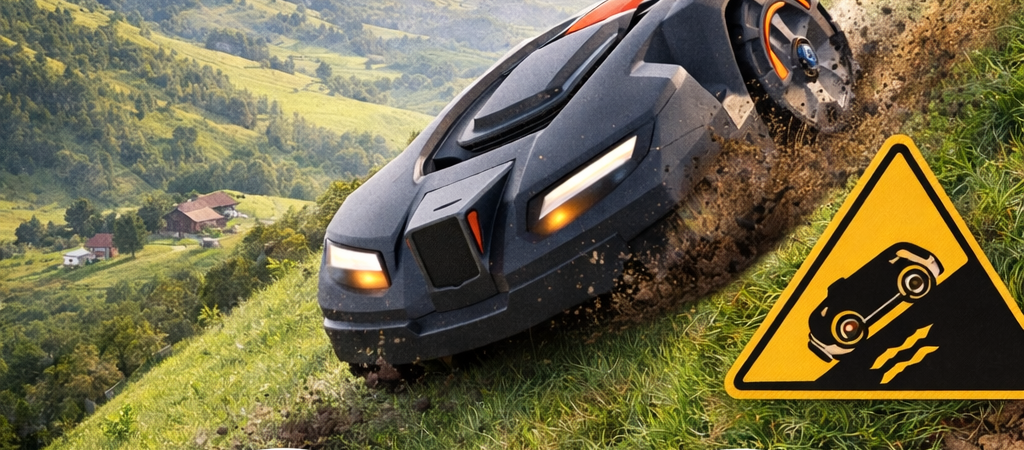
The “Slip-and-Slide” Reality Check
You spent a significant amount of money on a robot mower to reclaim your weekends. You envisioned a perfectly manicured hillside while you sipped coffee on the porch. Instead, you’re looking at a robot mower slipping down your backyard hill, carving muddy “burn marks” into your turf, or—worse—finding it stuck in a flower bed because it slid right past its boundary wire.
If your yard has any degree of incline, slipping isn’t just a nuisance; it’s a threat to your lawn’s health and the machine’s longevity. But here is the good news: Slipping is a physics problem, and physics has solutions.
In this guide, we’re going deep into the mechanics of traction, the “boundary traps” that cause 90% of failures, and the exact hardware and software fixes that will keep your mower glued to the grass.
Check out our FREE Robot Mower yard compatibility tool
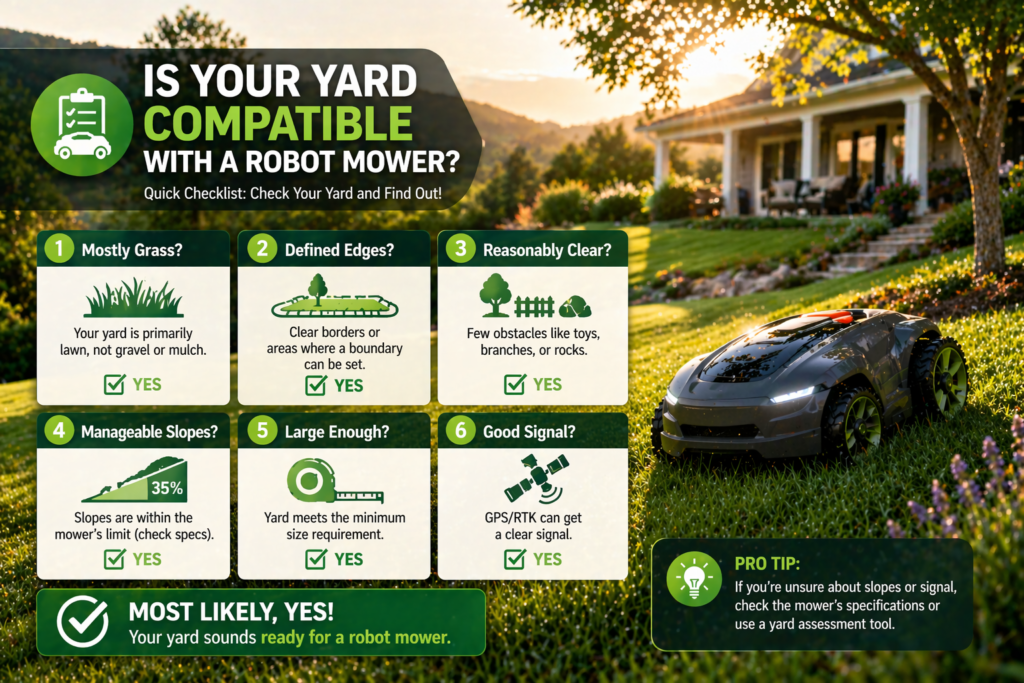
Select the option that best describes each aspect of your yard. Your compatibility score updates instantly as you go.
 Why Your Robot Mower is Slipping: The 3 Root Causes
Before you can fix it, you have to understand why it’s happening. Based on 2026 field data and user reports from enthusiasts, slipping usually boils down to three specific failures.
1. The “Boundary Stop” Trap
This is the most common cause of a robot mower slipping. Most mowers are rated to climb, say, a 40% slope. However, they can usually only handle about 15% at the boundary. When the mower reaches the wire at the bottom of a hill, it must stop, reverse, and turn. On an incline, gravity often overcomes the static friction of the tires, causing the mower to “drift” out of bounds before the motors can engage in reverse.
2. Weight Distribution & The “Light Nose”
On standard Rear-Wheel Drive (RWD) models, the heavy battery and drive motors sit in the back. As the mower climbs, the center of gravity shifts even further back. This makes the front wheels “light.” If the front end bounces or hits a thick tuft of grass, the drive wheels lose their “bite” and begin to spin in place, digging a hole in your lawn.
3. The “Mud Slick” Effect
Robot mower tires have lugs designed to grip soil. However, in damp conditions, these gaps fill with mud and wet clippings. Once the tread is “packed,” the tire effectively becomes a smooth racing slick. Without an open tread, robot mower slipping becomes inevitable, even on gentle grades.
Phase 1: The “No-Cost” Fixes (Settings & Maintenance)
Before you buy new parts, try these adjustments to improve your mower’s “hill IQ.”
Adjust Your Mowing Pattern
If your mower supports systematic mowing (like most 2026 RTK-GPS models), set the pattern to diagonal (45 degrees) or perpendicular to the slope. Driving straight up and down is the hardest task for a motor. Mowing at an angle reduces the “climb” intensity and helps the mower maintain a consistent speed.
Optimize for Dryness
Traction on grass drops by nearly 30% when damp. Use your app’s rain sensor or schedule your mowing for mid-afternoon. If your mower is slipping, it’s often because it’s trying to battle morning dew on a 30% grade.
Clean Your Wheels (Seriously)
Check your wheels once a week. If they are packed with mud, the mower will slip. Many high-end brands now offer Wheel Brush Kits that sit against the tire and constantly scrape off debris while the mower moves. If your model doesn’t have them, a quick scrub with a stiff brush can work wonders.
Phase 2: Hardware Upgrades (The Traction Revolution)
If settings aren’t enough, it’s time to look at mechanical intervention. In 2026, there are more “aftermarket” traction solutions than ever before.
1. Terrain Kits & Heavy-Duty Wheels
Many manufacturers offer official Terrain Kits. These typically include:
- Heavier wheels: Adding weight to the drive axle increases “downforce,” forcing the lugs deeper into the soil.
- Coarser Tread: Deep, aggressive rubber lugs that resist clogging.
2. Stainless Steel Wheel Spikes
For extreme hills, “crampons” are the answer. You can now purchase stainless steel spiked rings that bolt directly onto the side of your existing wheels. These spikes bite through the grass and into the dirt, providing mechanical grip that rubber alone can’t match. This is the ultimate fix for robot mower slipping on steep backyard hills.
3. Grass Reinforcement Mesh
If your mower always slips in the same corner or transition area, the grass there is likely dead or thin. You can install plastic grass reinforcement mesh. You pin it to the ground, and the grass grows through it. The mower’s wheels grip the plastic grid instead of the slippery mud, allowing the turf to recover while providing 100% traction.
Phase 3: The “Installation” Fix (The 1.5-Meter Rule)
Sometimes the mower isn’t the problem—the “invisible fence” is. If your mower is sliding out of bounds at the bottom of a hill, you need to relocate your boundary.
The Pro Strategy:
Maintain at least 1.5 meters (5 feet) of flat ground between the bottom of a steep slope and your boundary wire. This gives the mower a “safety runway” to slow down and execute its turn on level ground where it has maximum grip. If your yard doesn’t have that space, consider installing a physical barrier (like a 6-inch timber or stone edge) so the mower physically cannot slide into the street or pool.
The Ultimate Solution: Moving to AWD or Tracked Systems
If you are constantly battling robot mower slipping and your yard looks like a mud pit, you may simply have the wrong tool for the job. In 2026, two technologies have virtually “solved” the slipping problem for high-end estate owners.
All-Wheel Drive (AWD)
Units like the Husqvarna 435X or the Mammotion LUBA 2/3 power all four wheels. Because the weight is distributed across four drive points, the mower doesn’t have to “push” itself up a hill; it “climbs” it. Even if two wheels lose traction on a wet patch, the other two keep the machine moving.
Check out our deep dive into the best AWD Robot Mowers
Tracked Tread Systems
The newest innovation in 2026 is the Tracked Robot Mower (like the Lymow One Plus). By using continuous treads (like a tank) instead of wheels, these machines distribute their weight over a much larger surface area. This provides a massive 40% reduction in ground pressure, meaning they don’t dig holes and they almost never slip, even on 45-degree (100% grade) slopes.
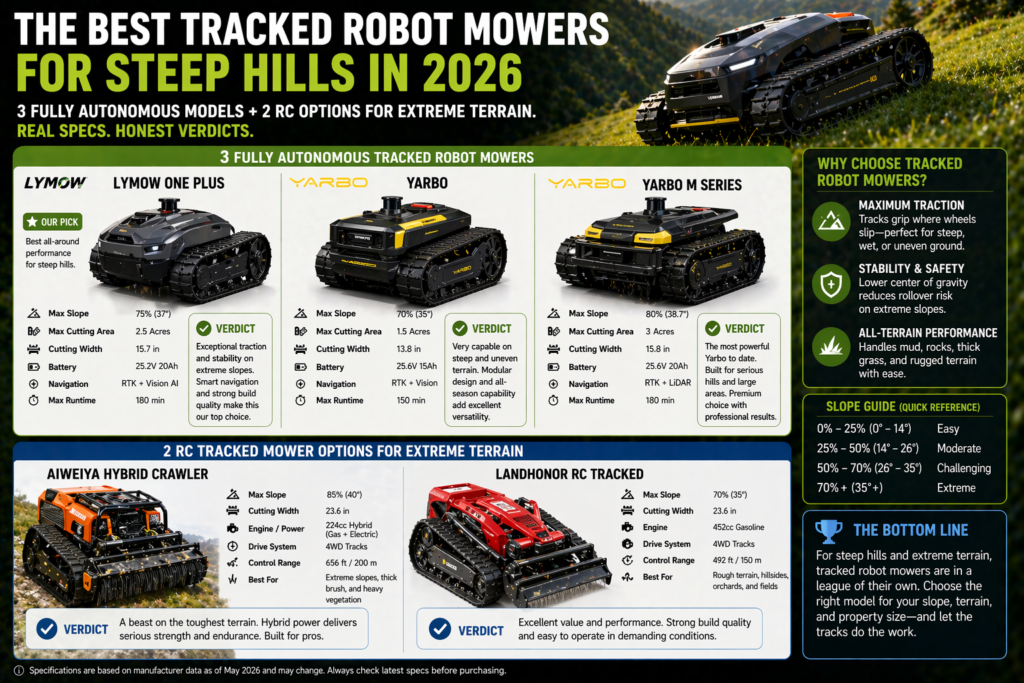
Summary: Your Slipping Solution Checklist
| If your mower is… | Try this fix: |
| Sliding out of the boundary | Move wire 5ft back or install a physical 6-inch barrier. |
| Spinning in one specific spot | Lay down plastic grass reinforcement mesh/grids. |
| Losing grip when damp | Install a Wheel Brush Kit and only mow after 12 PM. |
| “Tearing” the grass on turns | Upgrade to AWD or install Wheel Spikes. |
| Failing on a “Mountain” | Switch to a Tracked System or Articulated AWD. |
 Conclusion: Take Control of Your Terrain
A robot mower slipping isn’t a sign that robot mowers don’t work; it’s a sign that your mower needs a little help with the laws of gravity. By optimizing your boundary placement, keeping your wheels clean, or upgrading to a high-traction spiked wheel kit, you can transform your “problem hill” into a manicured asset.
Don’t let your investment slide away. Fix the traction, and get back to enjoying your weekend.
Want to compare which Robot Mower may solve your slipping issues? Check out our Free Robot Mower Head to Head comparison Tool.
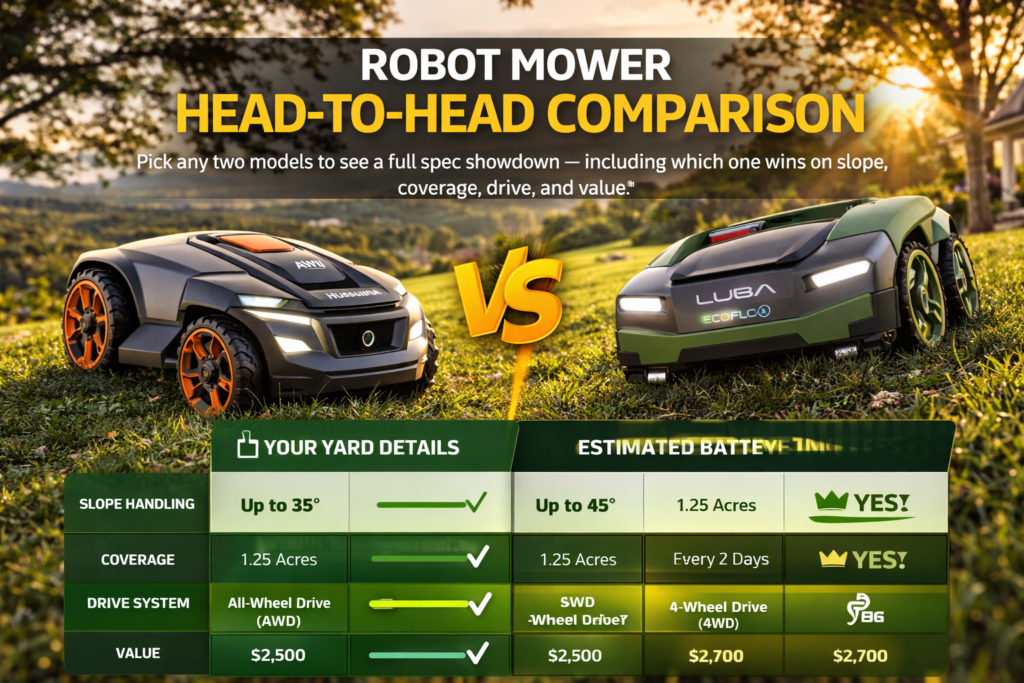
Make this the year your lawn mows itself! Explore our top picks and secure the best robot mower for steep slopes through the trusted affiliate links above and below. Your weekends (and your back) will thank you.
Disclaimer: This article contains affiliate links. As an Amazon Associate, I earn from qualifying purchases. Prices fluctuate, but the recommendation logic remains the same. Always check the slope rating before buying.
 [Shop Top-Rated Terrain Kits and Wheel Spikes]