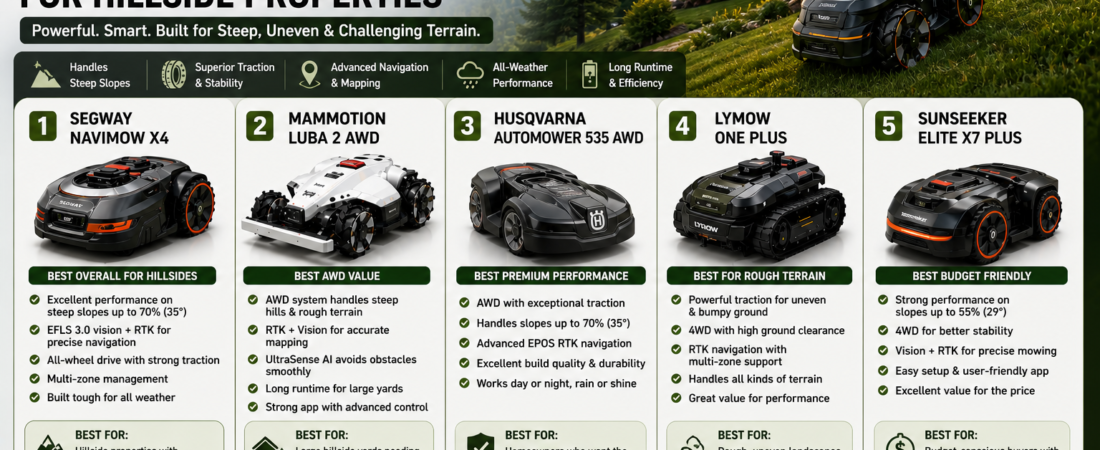
You know the dread. It’s Saturday morning, the sun is already climbing, and your lawn is waiting—those slopes that get steeper every year, the uneven patches where your push mower slips, the hours of sweating and straining just to keep your property from looking neglected. If you’re searching for reliable robot mowers for hillside properties, you’re not looking for a gimmick. You want your weekends back. You want consistent, clean cuts without the physical toll. And you want the confidence that you invested wisely in technology that actually works on terrain that traditional mowers struggle to handle.
The good news? In 2026, all-wheel-drive navigation, RTK-GNSS positioning, and AI-powered obstacle detection have transformed what autonomous mowers can do. The latest models handle slopes up to 45 degrees, navigate complex multi-zone layouts without perimeter wires, and run quietly enough that your neighbors won’t even know they’re working. The challenge is choosing the right machine for your specific hillside.
This guide breaks down exactly what matters when evaluating robot mowers for hillside properties—and reveals the five models that actually deliver on steep, uneven terrain.
Why Standard Robot Mowers Fail on Hillsides
Most entry-level robotic mowers are designed for flat, suburban lots with gentle rolling terrain. Their small wheels, rear-wheel-drive layouts, and basic boundary-wire navigation work fine on 10–15 degree slopes. But introduce a 30-degree grade, damp morning grass, or a tree root crossing the incline, and they slip, stall, or miss entire sections.
The physics are simple: climbing draws significantly more battery power than flat mowing, and downhill momentum makes stopping and turning difficult. Without independent wheel power and advanced traction control, standard units slide toward garden beds, lose their positioning, or simply abort the job and beep for help. Worse, installing boundary wire on steep banks is physically difficult and often results in breaks that leave your mower lost.
If your property has genuine slopes—not just gentle undulations—you need specialized hardware. Here’s what separates capable hill climbers from flat-land pretenders.
What to Look for in Robot Mowers for Hillside Properties
Not all robot mowers for hillside properties are created equal. Before you spend thousands, verify these specifications against your actual terrain.
Slope Rating (The Non-Negotiable Number)
Manufacturers list slope capability as either a percentage or degrees. A 70% grade equals roughly 35 degrees. Standard mowers top out at 20–25 degrees. For hillside properties, look for 30 degrees minimum, with 35–40 degrees offering meaningful headroom. Always choose a model rated at least 5 degrees steeper than your maximum slope—wet grass reduces effective traction significantly.
Drive System and Traction
All-wheel drive (AWD) or four-wheel drive (4WD) is essential for grades above 25 degrees. Independent wheel motors maintain grip even when one wheel loses contact with uneven ground. For extreme terrain, tracked systems distribute weight across a larger surface area, reducing ground pressure by approximately 40% compared to wheeled designs and preventing turf damage on soft soil.
Navigation Without Boundary Wires
Laying physical wire on steep slopes is frustrating and failure-prone. Modern robot mowers for hillside properties use RTK-GNSS satellite positioning (centimeter-level accuracy), VSLAM visual mapping, or LiDAR to create virtual boundaries. Wire-free systems are particularly valuable on hillsides where erosion, animal activity, or ground shifting can damage buried wire.
Battery and Runtime
Hill climbing consumes 30–40% more power than flat mowing. A mower rated for 2.5 acres on flat ground may cover considerably less on sloped terrain. Look for lithium iron phosphate (LiFePO₄) batteries rated for 2,000+ cycles—they last longer under the heavy load that hills demand.
Weather Resistance
Hillsides stay wet longer than flat lawns due to drainage patterns and reduced sun exposure. An IPX5 or IPX6 water resistance rating ensures your mower handles damp grass and light rain without internal damage.
Quick Comparison: Top Robot Mowers for Hillside Properties
Here’s how the leading robot mowers for hillside properties stack up on the specs that matter most for sloped terrain.
Table
| Model | Max Slope | Coverage | Drive System | Navigation | Best For | Price Tier |
|---|---|---|---|---|---|---|
| Segway Navimow X4 | 40° (84%) | Up to 1.5 acres | AWD | Tri-frequency RTK + 360° AI Vision | Steep slopes, complex layouts | $$$$ |
| Mammotion LUBA 2 AWD | 38.6° (80%) | Up to 2.5 acres | AWD | RTK-GNSS + UltraSense AI Vision | Large properties, multi-zone | $$$$ |
| Husqvarna Automower 535 AWD | 35° (70%) | Up to 0.9 acres | AWD + pivoting rear | GPS-assisted + AIM Technology | Professional reliability | $$$$$ |
| Lymow One Plus | 45° (100%) | Up to 1.73 acres/day | Tracked 4WD | RTK + VSLAM | Extreme terrain, wet hills | $$$$ |
| Sunseeker Elite X7 Plus | 35° (70%) | Up to 1.48 acres | AWD | AONavi (RTK + VSLAM) + Vision AI | Smart navigation, wire-free | $$$$ |
Price key: $$$$ = Premium ($2,000–3,500); $$$$ = Professional ($3,500+)
Ready to stop battling your hillside every weekend?Check current pricing and availability on the Segway Navimow X4 — the steepest-rated AWD mower in our lineup.
The 5 Best Robot Mowers for Hillside Properties
1. Segway Navimow X4 — Best for Steep Slopes
For homeowners researching robot mowers for hillside properties with severe grades, the Segway Navimow X4 stands out as the most capable wheeled option available in 2026. Its all-wheel-drive system handles slopes up to 40 degrees (84% grade)—a threshold that exceeds most residential hillside properties.
What makes the X4 exceptional isn’t just raw climbing power. The patented Xero-Turn™ system switches between zero-turn and Ackermann steering, allowing the mower to execute 180-degree turns on slopes without sliding or tearing turf. Combined with a dual suspension system and a 5:5 balanced center of gravity, it maintains stability where other units tip or drift.
The adaptive blade system automatically floats over uneven ground, preventing the scalping and turf tearing common on hillside mowing. With tri-frequency RTK positioning and 360-degree AI vision, it navigates without boundary wires and maintains centimeter-level accuracy even under partial tree cover.
Key Specs:
- Slope: Up to 40° (84%)
- Coverage: Up to 1.5 acres
- Noise: ~60 dB
- Weather: Rain sensors + IPX5-rated
See the latest Segway Navimow X4 deals and customer reviews here
2. Mammotion LUBA 2 AWD — Best for Large Hillside Properties
Among robot mowers for hillside properties covering large acreage, the Mammotion LUBA 2 AWD delivers an unmatched combination of slope capability and coverage area. Rated for slopes up to 38.6 degrees and lawns up to 2.5 acres (10,000 m²), it’s built for estate properties and semi-rural homes where distance matters as much as incline.
The wire-free RTK-GNSS navigation supports up to 100 mowing zones, letting you program different schedules for the steep front hillside, the flat backyard, and the side clearing. Its 15.7-inch dual cutting disc covers ground efficiently, while UltraSense AI Vision detects obstacles in real time without requiring physical boundary installation.
For property managers and estate owners who need one machine to handle varied terrain across a large footprint, the LUBA 2’s zone flexibility and massive coverage make it a practical workhorse.
Key Specs:
- Slope: Up to 38.6° (80%)
- Coverage: Up to 2.5 acres
- Zones: Up to 100
- Connectivity: 4G + app control
Check Mammotion LUBA 2 AWD pricing and zone setup guides here
3. Husqvarna Automower 535 AWD — Best Professional-Grade Reliability
When professionals recommend robot mowers for hillside properties that must run season after season without drama, the Husqvarna Automower 535 AWD remains the benchmark. This is the same brand that pioneered autonomous mowing decades ago, and the 535 AWD applies that experience to serious slopes.
The pivoting rear body is the standout feature—it allows the mower to flex with the terrain, maintaining blade contact and traction as the ground shifts beneath it. While its 35-degree slope rating and 0.9-acre coverage are more conservative than some competitors, Husqvarna’s build quality, dealer network, and Fleet Services remote management platform make it the safest choice for commercial properties and high-end residential estates.
GPS-assisted navigation with AIM Technology optimizes mowing patterns to reduce overlap, and integrated theft protection via GPS geofencing provides peace of mind on larger, less visible properties.
Key Specs:
- Slope: Up to 35° (70%)
- Coverage: Up to 0.9 acres
- Drive: AWD with pivoting rear chassis
- Management: Husqvarna Fleet Services compatible
View Husqvarna Automower 535 AWD professional packages and installation options here
4. Lymow One Plus — Best for Extreme Terrain
If your terrain demands extreme capability, robot mowers for hillside properties don’t get more rugged than the Lymow One Plus. While most competitors use wheels, the Lymow employs continuous tracked treads that conquer slopes up to 45 degrees (100% grade)—a rating that outperforms every wheeled consumer mower on the market.
The tracked system distributes the 35.6kg weight across a larger surface area, maintaining grip on wet grass, loose soil, and even gravel transitions where wheeled units slip. A 70mm obstacle-crossing height lets it traverse exposed roots and garden hoses, while the IPX6 waterproof rating handles the damp conditions common on shaded hillsides.
Powered by a LiFePO₄ battery rated for 2,000 cycles, the Lymow is built for the long haul. It covers approximately 0.57 acres per charge and up to 1.73 acres per day, making it suitable for large sloped properties that require multiple daily cycles.
Key Specs:
- Slope: Up to 45° (100%)
- Coverage: Up to 1.73 acres/day
- Drive: Tracked 4WD
- Obstacle Crossing: 70mm (2.8 inches)
Explore Lymow One Plus tracked mower specs and hill-climbing videos here
5. Sunseeker Elite X7 Plus — Best Smart Navigation
For tech-forward buyers comparing robot mowers for hillside properties, the Sunseeker Elite X7 Plus offers the most sophisticated navigation stack in its class. The AONavi system combines RTK-GNSS, VSLAM 2.0, and Vision AI 2.0 to maintain centimeter-level positioning even under dense tree cover or near structures that confuse lesser systems.
The dual floating cutting discs keep blade height consistent as the chassis tilts with the terrain, and the independent front suspension prevents scalping on uneven hillsides. Vision AI detects over 200 obstacle types, from garden tools to pets, and the mower operates at just 60 dB—quiet enough for nighttime schedules without disturbing neighbors.
With wire-free mapping and day/night operation capability, the X7 Plus suits homeowners who want a fully autonomous, set-and-forget experience on moderately sloped properties.
Key Specs:
- Slope: Up to 35° (70%)
- Coverage: Up to 1.48 acres
- Navigation: AONavi (RTK + VSLAM 2.0) + Vision AI 2.0
- Cutting: Dual floating discs, 35cm width
Compare Sunseeker Elite X7 models and check wire-free setup options here
Pros and Cons at a Glance
Table
| Model | Pros | Cons |
|---|---|---|
| Segway Navimow X4 | 40° slope rating (highest AWD); Xero-Turn™ prevents sliding on turns; dual suspension; adaptive floating blades eliminate scalping; wire-free setup | Premium price point; initial RTK antenna setup requires careful placement |
| Mammotion LUBA 2 AWD | Massive 2.5-acre coverage; 100 programmable zones; 38.6° slope capability; no boundary wires; 4G connectivity | Large physical footprint; RTK initialization needs clear sky access during mapping |
| Husqvarna Automower 535 AWD | Proven 20+ year brand reliability; pivoting rear body maintains ground contact; Fleet Services for multi-unit management; excellent theft protection | Limited to 0.9 acres; requires boundary wire installation; highest price in category |
| Lymow One Plus | Extreme 45° slope rating; tracked treads grip wet/loose terrain; IPX6 waterproof; 70mm obstacle clearance; LiFePO₄ battery (2,000 cycles) | Heaviest unit at 35.6kg; continuous tracks may mark soft turf during wet conditions |
| Sunseeker Elite X7 Plus | Most advanced navigation (RTK+VSLAM+Vision AI); dual floating discs prevent uneven cuts; 60 dB ultra-quiet; day/night autonomous operation | Newer brand with smaller dealer/service network; 35° limit excludes extreme grades |
Which Robot Mower Is Right for Your Hillside Property?
Choosing between these robot mowers for hillside properties depends on your specific terrain, acreage, and tolerance for setup complexity.
- Your steepest slope exceeds 35 degrees? The Lymow One Plus is your only consumer option with tracked reliability. For slightly less extreme grades, the Segway Navimow X4 offers the best wheeled performance at 40 degrees.
- You manage 1.5+ acres with mixed flat and sloped zones? The Mammotion LUBA 2 AWD’s 100-zone flexibility and 2.5-acre coverage make it the clear choice for large, complex layouts.
- You prioritize decades of proven reliability and professional support? The Husqvarna Automower 535 AWD costs more and covers less, but its dealer network and build quality are unmatched.
- You want the smartest, most autonomous experience with minimal intervention? The Sunseeker Elite X7 Plus packs the most AI-driven navigation intelligence into a quiet, wire-free package.
Still deciding? Compare all models side-by-side with current pricing here
Installation Tips for Hillside Robot Mowers
Even the best machine underperforms with poor setup. Follow these guidelines to maximize your investment:
Measure your actual slopes. Most homeowners underestimate their terrain by 10–15 degrees. Use a smartphone inclinometer app on multiple sections of your steepest grade, and measure on the path the mower will actually travel—not just the general hill face.
Account for wet conditions. A slope rated at 35 degrees in dry conditions may effectively become 30 degrees on damp grass. Always buy 5–10 degrees of headroom above your measurement.
Plan charging station placement. Position the dock on flat, stable ground with good sky visibility for RTK antennas. Avoid placing stations at the bottom of hills where water pools.
Map during optimal conditions. For wire-free models, perform initial boundary mapping on a clear day with strong satellite visibility. Tree cover and cloud density can temporarily reduce RTK accuracy during setup.
Schedule strategically. On hillside properties, program mowing during mid-morning hours when dew has evaporated but afternoon heat hasn’t peaked. This maximizes traction and minimizes battery strain.
Final Verdict: Investing in Robot Mowers for Hillside Properties
Your hillside isn’t getting flatter, and your weekends aren’t getting longer. Investing in quality robot mowers for hillside properties isn’t about buying a gadget—it’s about reclaiming 2–4 hours every weekend, eliminating the physical strain and safety risks of slope mowing, and enjoying a consistently maintained lawn without the mental burden.
The five models above represent the current state of the art for sloped terrain in 2026. Whether you need extreme slope capability, estate-sized coverage, or professional-grade reliability, there is a machine that matches your property and your priorities.
The real question isn’t whether autonomous mowing works on hills. It does. The question is how many more weekends you’re willing to spend pushing a mower uphill before you let technology handle the climb.
Frequently Asked Questions
Can robot mowers handle wet grass on hills?
Most robot mowers for hillside properties can manage damp grass, but wet slopes significantly reduce traction. Models with AWD/4WD and deep-tread or tracked systems perform best in damp conditions. Look for IPX5 or IPX6 water resistance ratings, and avoid scheduling mowing during active rain. Many premium models include rain sensors that automatically return the mower to its dock when precipitation starts.
[Check out Do Robot Mowers Work on Slopes with Wet Grass? The Honest Answer]
How steep is too steep for robot mowers?
Standard consumer mowers top out at 20–25 degrees. Advanced AWD models handle 30–38 degrees. The steepest-rated consumer models, like the Lymow One Plus with tracked treads, reach 45 degrees. Anything beyond 45 degrees generally requires commercial-grade equipment or alternative landscaping solutions. Always verify your actual slope measurement before purchasing.
[Check out What Slope Is Too Steep for Robot Mowers? (The Brutal Honesty Guide)]
Do hillside robot mowers need boundary wires?
Not anymore. The best robot mowers for hillside properties now use RTK-GNSS, VSLAM visual mapping, or LiDAR to create virtual boundaries. Wire-free navigation is particularly valuable on hillsides, where installing and maintaining physical boundary wire is difficult and prone to damage from erosion or ground movement.
[check out 5 Best Wire-Free Robot Mowers for Hills (Smart RTK Tech That Actually Handles Hills)]
Will a robot mower save money compared to a landscaping service?
For properties over 0.25 acres with regular mowing needs, a robot mower typically pays for itself within 2–3 years compared to weekly professional landscaping services. Beyond cost savings, the value of reclaimed personal time and eliminated physical strain is significant for homeowners aged 35–65 managing sloped terrain.
[ Check out Robot Mower vs Lawn Service Cost: Is a Robot Mower Worth It in 2026?]
Can robot mowers work on uneven ground with holes and tree roots?
Yes, if you choose the right model. Look for obstacle-crossing heights of 50mm or greater and suspension systems that keep the cutting deck level. The Lymow One Plus handles 70mm obstacles, while the Segway Navimow X4’s dual suspension adapts to uneven ground in real time. Vision AI systems also detect and navigate around protruding roots and holes before contact.
Make this the year your lawn mows itself! Explore our top picks and secure the best robot mower for steep slopes through the trusted affiliate links above and below. Your weekends (and your back) will thank you.
Disclaimer: This article contains affiliate links. As an Amazon Associate, I earn from qualifying purchases. Prices fluctuate, but the recommendation logic remains the same. Always check the slope rating before buying.