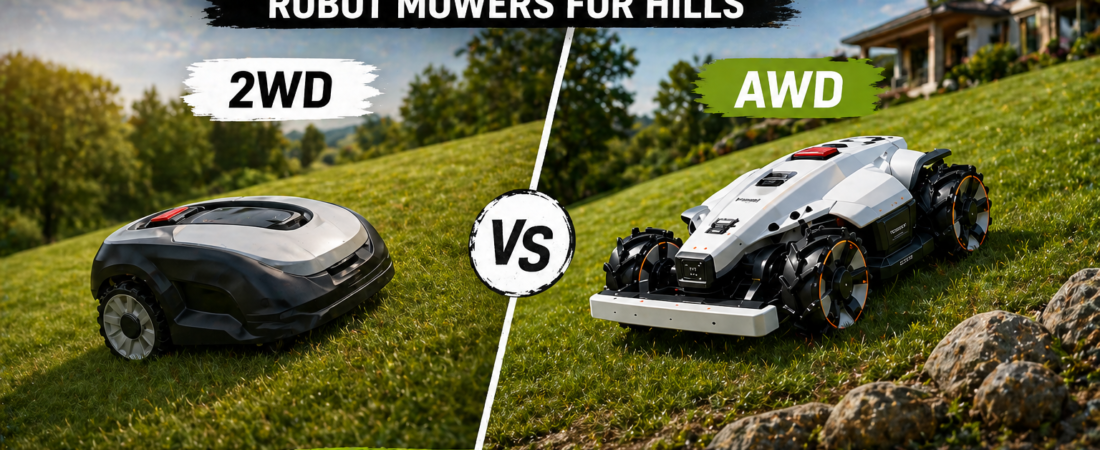
If you’re managing a 0.25-acre property or larger with rolling grades, uneven terrain, or mature landscaping, traditional mowing isn’t just a chore—it’s a weekend hostage situation. The mental load, physical strain, and inconsistent results add up fast. Heat exhaustion, unpredictable weather windows, and the constant negotiation between family time and lawn maintenance create a cycle that drains both energy and focus. That’s why so many high-value homeowners, small property managers, and boutique landscapers are upgrading to autonomous cutting systems. But when you’re staring down a steep backyard, terraced garden, or multi-zone estate, the purchasing decision quickly narrows to one critical comparison: 2WD vs AWD/4WD robot mowers for hilly terrain. The wrong choice means wasted capital, constant troubleshooting, and more time spent rescuing a stranded mower than actually enjoying your yard.
The Reality of Slope Mowing: Why 2WD Models Struggle
Most entry-level robot mowers rely on rear-wheel drive to keep manufacturing costs down and maximize battery runtime. On flat, manicured suburban lawns, that architecture is perfectly adequate. On inclines, however, the limitations become glaringly obvious within a single mowing cycle. When evaluating 2WD vs AWD/4WD robot mowers for hilly terrain, you’re really asking how well a machine can manage weight distribution, friction coefficients, and torque delivery when gravity actively works against it.
The Physics of Traction on Lightweight Autonomous Units
Robot mowers are intentionally lightweight, typically ranging from 8 to 18 kilograms. This design philosophy reduces soil compaction, minimizes turf damage, and extends battery life. But lightweight + steep grade = minimal normal force pressing the drive tires into the ground. Traction is a simple equation: friction multiplied by downward pressure. When that pressure drops below a critical threshold, the rear tires break loose. The result isn’t just visible wheel spin; it’s erratic navigation, uneven cutting paths, and repeated anti-collision triggers as the unit struggles to maintain its programmed line.
Real-World Symptoms of Traction Loss
Users consistently report three failure modes on slopes exceeding 25% (roughly 14 degrees). First, lateral drift: the mower slides sideways instead of tracking straight, creating striped or scalped patches. Second, pattern degradation: GPS or boundary-guided systems misread positional data after a slip, causing missed sections, redundant passes, or complete boundary wire collisions. Third, motor and battery strain: the rear axle works overtime to regain forward momentum, draining power reserves 20–30% faster and accelerating uneven tire wear. For time-poor homeowners who schedule mowing around work and family commitments, these aren’t minor software quirks—they’re operational dealbreakers.
AWD/4WD Robot Mowers: The Engineering Advantage
All-wheel drive isn’t a premium marketing label; it’s a fundamental shift in power distribution and terrain adaptation. When you compare 2WD vs AWD/4WD robot mowers for hilly terrain, the difference comes down to contact patch utilization. AWD systems split torque across four wheels, ensuring that if one axle loses grip, the opposite or perpendicular wheels compensate instantly. This isn’t about brute force—it’s about continuous momentum management.
How Dual-Axle Torque Distribution Changes the Game
Premium hill-capable models use independent rear and front motors, often paired with electronic differential logic or micro-gearing. This means torque isn’t just sent forward blindly; it’s actively modulated based on real-time load, wheel speed variance, and incline angle. On damp morning grass, clay-heavy soil, or recently aerated turf, an AWD unit maintains forward progression without the hunting behavior typical of 2WD counterparts. You get consistent coverage, straighter navigation lines, and significantly reduced thermal stress on internal components. The system simply has more pathways to transfer power into the ground.
Traction Control Meets Smart Navigation
Modern AWD mowers don’t just mechanically conquer inclines. They pair physical grip with intelligent software ecosystems. RTK-GPS, lidar mapping, and AI pathfinding work together to calculate optimal approach angles, mow parallel to contour lines when terrain allows, and reduce unnecessary steep ascents. When slip is detected, onboard processors instantly throttle back, adjust individual wheel speeds, and re-engage smoothly. This closed-loop feedback architecture is what separates premium estate-grade cutters from budget lawn gadgets. Understanding the mechanics behind 2WD vs AWD/4WD robot mowers for hilly terrain reveals why software alone cannot compensate for a lack of mechanical grip.
2WD vs AWD/4WD Robot Mowers for Hilly Terrain — Quick Comparison Table
| Feature | 2WD Robot Mowers | AWD / 4WD Robot Mowers |
|---|---|---|
| Best For | Flat to moderate lawns | Steep hills, uneven terrain, complex yards |
| Recommended Slope (Dry) | 15–25% reliable | 30–50% reliable |
| Recommended Slope (Wet) | Often struggles | 25–35% reliable |
| Traction on Hills | Lower grip, more slipping | Strong grip, better climbing |
| Performance on Wet Grass | Poor to fair | Good to very good |
| Lateral Sliding | Common on side slopes | Much less common |
| Navigation Accuracy on Slopes | Can drift after slip | More stable path tracking |
| Battery Efficiency on Hills | Lower (works harder) | Better due to smoother traction |
| Intervention Needed | More rescue trips | Minimal babysitting |
| Tire Upgrades Help? | Yes, significantly | Helpful but less necessary |
| Price Range | Lower upfront cost | 25–60% higher cost |
| Long-Term ROI | Good for simple lawns | Best for difficult properties |
| Maintenance Stress | More wheel wear on hills | Lower strain when used properly |
| Ideal Yard Size | 0.25–0.5 acre moderate yards | 0.5–2+ acre hilly properties |
| Best Buyer Type | Budget-focused homeowner | Time-poor premium homeowner |
The Head-to-Head Breakdown: Claimed Specs vs. Field Performance
Manufacturers routinely print bold slope percentages on spec sheets and packaging. A 70% or 80% grade claim sounds impressive on paper—until you factor in real-world variables like dew, rainfall, thatch depth, and soil composition. When serious buyers research 2WD vs AWD/4WD robot mowers for hilly terrain, they need reality-checked performance data, not laboratory best-case scenarios.
Slope Capability: Lab Numbers vs. Actual Conditions
Based on aggregated independent field tests, long-term user reports from specialized lawn forums, and verified terrain trials, 2WD models typically perform reliably up to 15–25% slope in completely dry conditions. Past that threshold, slip frequency increases exponentially, and navigation errors compound. AWD units consistently handle 30–50% dry slopes and 25–35% wet terrain without manual intervention. The performance gap widens dramatically on properties with uneven grading, soft topsoil, or mixed sun/shade microclimates that dry at different rates.
Wet Grass, Clay, and Thatch: The Hidden Variables
No drivetrain defeats basic physics. Saturated turf reduces the coefficient of friction by 40–70%. If your property features heavy clay, poor surface drainage, or dense thatch layers exceeding half an inch, even premium AWD units will experience diminished traction. The intelligent approach isn’t to chase the highest advertised slope rating—it’s to prepare the terrain first. Core aeration, targeted drainage improvements, and strategic boundary wire placement dramatically expand your mower’s effective working zone and reduce slip events regardless of drive configuration.
Cost, Maintenance, and Long-Term ROI
AWD commands a 25–60% price premium over comparable 2WD models. That upfront investment translates directly into fewer intervention runs, extended drivetrain component life, and reliable operation during shoulder seasons when grass is longer and soil is softer. For property managers or homeowners who value predictable results over weekend experimentation, the return on investment is measured in reclaimed hours, not just hardware specifications. When analyzing 2WD vs AWD/4WD robot mowers for hilly terrain, factor in the hidden costs of troubleshooting: fuel for manual rescue mowers, replacement blades from collision stress, and the intangible value of uninterrupted free time.
Proven Fixes & Workarounds If You’re Not Ready to Upgrade
Not every buyer is prepared to replace a functioning unit immediately. If your current mower struggles on grades, understanding the operational differences between 2WD vs AWD/4WD robot mowers for hilly terrain helps you apply targeted, cost-effective modifications before committing to a full hardware upgrade.
Tire Swaps, Strategic Ballast, and Contour Routing
Factory-installed tires are engineered for quiet operation, low rolling resistance, and flat lawns. Swapping to aggressive, deep-lug aftermarket or OEM all-terrain tires can improve hill grip by 30–40%. Some users add 1–2 kilograms of strategic ballast over the drive axle to increase normal force, though this practice voids most manufacturer warranties and increases long-term motor load. More impactful is boundary wire optimization: routing the perimeter along natural contour lines rather than across the steepest gradients reduces the mower’s angle of attack and minimizes slip vectors. Mowing perpendicular to the slope, rather than directly up and down, dramatically improves cut uniformity and reduces lateral drift.
Scheduling Discipline, RTK Calibration, and Firmware
Schedule mowing exclusively when grass is dry. This single operational adjustment reduces slip events by 60–80% across all drive types. Ensure your RTK base station or virtual boundary anchor sits on stable, interference-free ground away from metal fencing or large tree canopies. Poor satellite calibration causes positional drift, forcing the unit to take inefficient, unnecessarily steep routes. Finally, keep firmware updated. Leading brands routinely deploy traction algorithms, slope-mode optimizations, and navigation smoothing patches that enhance real-world hill performance without requiring new hardware.
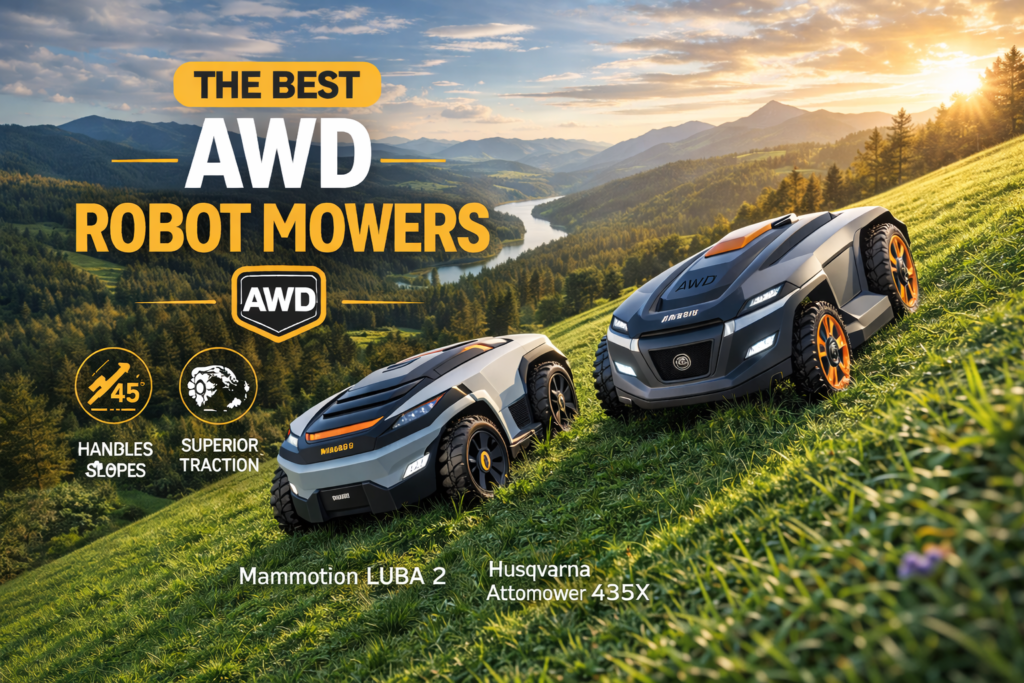
If you would like the lists of our best AWD drive models click below.
Which Drive Type Actually Matches Your Property?
| If Your Yard Has… | Best Choice |
|---|---|
| Gentle slopes under 20% | 2WD |
| Steep hills over 20% | AWD |
| Wet morning grass often | AWD |
| Uneven / bumpy lawn | AWD |
| Tight budget + simple lawn | 2WD |
| Large multi-zone property | AWD |
Choosing between drivetrain configurations isn’t about chasing premium features—it’s about terrain math and lifestyle priorities. The decision matrix for 2WD vs AWD/4WD robot mowers for hilly terrain depends on acreage, grade consistency, surface composition, and how you value your discretionary time.
The 0.25–0.5 Acre Moderate Slope Zone
If your property features gentle, consistent grades under 20%, well-drained soil, and minimal elevation changes between zones, a quality 2WD model paired with precise navigation delivers excellent, reliable results. You’ll preserve upfront capital while maintaining clean cuts and predictable scheduling. In this scenario, focus your investment on software accuracy, boundary setup, and cutting width rather than drivetrain complexity.
The 0.5–2+ Acre Steep or Multi-Zone Estate
Rolling lawns, terraced landscapes, tree-heavy canopies that retain moisture, or properties with mixed microclimates demand AWD architecture. Uneven terrain creates localized soft spots, and multi-zone routing inherently increases the likelihood of steep approach angles. AWD eliminates guesswork, maintains coverage uniformity, and operates predictably across varying moisture conditions. For estate managers, small landscaping operators, or busy homeowners who refuse to babysit equipment, reliability isn’t a luxury—it’s an operational necessity.
Top Field-Tested Picks
Recommended Models Mentioned in the Article
| Model | Drive Type | Best Use Case | Key Advantage |
|---|---|---|---|
| Husqvarna Automower 450XH | AWD | Steep estates | Reliability + dealer support |
| Husqvarna Automower 550 EVO | AWD | Commercial / large hills | Enterprise-grade performance |
| Mammotion LUBA 2 AWD | AWD | Complex layouts | RTK wire-free precision |
| Worx Landroid Vision | 2WD | Moderate slopes | Budget-friendly option |
Based on independent terrain testing, long-term reliability tracking, and transparent engineering documentation, these models consistently outperform their class when evaluating 2WD vs AWD/4WD robot mowers for hilly terrain.
- Husqvarna Automower 450XH / 550 EVO: Purpose-built AWD with electronic slope management and adaptive torque distribution. Real-world performance peaks at 45–55% dry slopes and 30–35% wet. Features premium weather sealing, dealer-supported service networks, and enterprise-grade app scheduling. Best suited for estates, steep topography, and users who demand zero-intervention reliability.
- Mammotion LUBA 2 AWD: Combines dual-motor torque with RTK navigation and omnidirectional wheel control. Excels at maintaining pattern retention on inclines without boundary wire constraints. Ideal for tech-forward homeowners who prioritize GPS precision, custom zoning, and automated scheduling across complex layouts.
- Worx Landroid S/Vision (with Off-Road Kit): Proven 2WD platform that performs exceptionally well on moderate slopes under 25% when equipped with manufacturer-approved traction tires. Offers budget-conscious flexibility for time-poor buyers willing to adjust scheduling on damp days or implement contour-based boundary routing.
See our Side by side comparison of the Husqvarna Automower vs Mammotion LUBA 2
The Final Decision: Engineering, Efficiency, and Your Weekend
The promise of autonomous lawn care isn’t just about cutting grass—it’s about buying back your time, eliminating weekend dread, and maintaining a pristine property without physical strain or mental overhead. When the terrain gets complicated, the debate over 2WD vs AWD/4WD robot mowers for hilly terrain resolves into a simple, actionable principle: match the drivetrain to the grade. For gentle slopes and predictable soil, 2WD delivers efficiency. For anything steeper, wetter, or less uniform, AWD isn’t a luxury upgrade—it’s operational insurance.
Smart property owners don’t gamble with topography. They audit slope percentages, evaluate surface drainage, and choose systems engineered for consistency rather than marketing claims. The right autonomous mower doesn’t just maintain turf; it operates silently, navigates intelligently, and returns to its charging station while you focus on work, family, or simply sitting outside without a chore looming over your schedule.
If your yard features inclines over 20%, frequent morning dew, uneven micro-terrain, or multi-zone complexity, bypassing the upgrade cycle and moving directly to AWD saves money long-term. Fewer rescue trips, reduced battery degradation, zero collision stress, and consistent cutting quality compound into measurable ROI. Understanding the real-world dynamics of 2WD vs AWD/4WD robot mowers for hilly terrain ensures you invest once, maintain predictably, and scale your yard care alongside your lifestyle—not against it.
Your property shouldn’t dictate your weekend. Choose the architecture engineered for your topography, implement proven setup strategies, and let modern automation deliver the relief you’ve been investing in. The future of landscape maintenance isn’t about working harder on inclines. It’s about owning smarter.
Make this the year your lawn mows itself! Explore our top picks and secure the best robot mower for steep slopes through the trusted affiliate links above and below. Your weekends (and your back) will thank you.
Disclaimer: This article contains affiliate links. As an Amazon Associate, I earn from qualifying purchases. Prices fluctuate, but the recommendation logic remains the same. Always check the slope rating before buying.