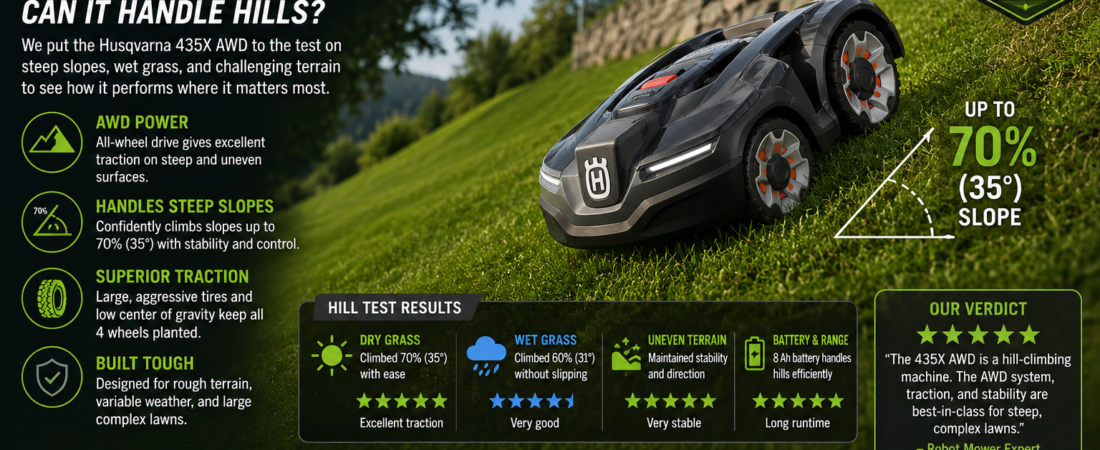
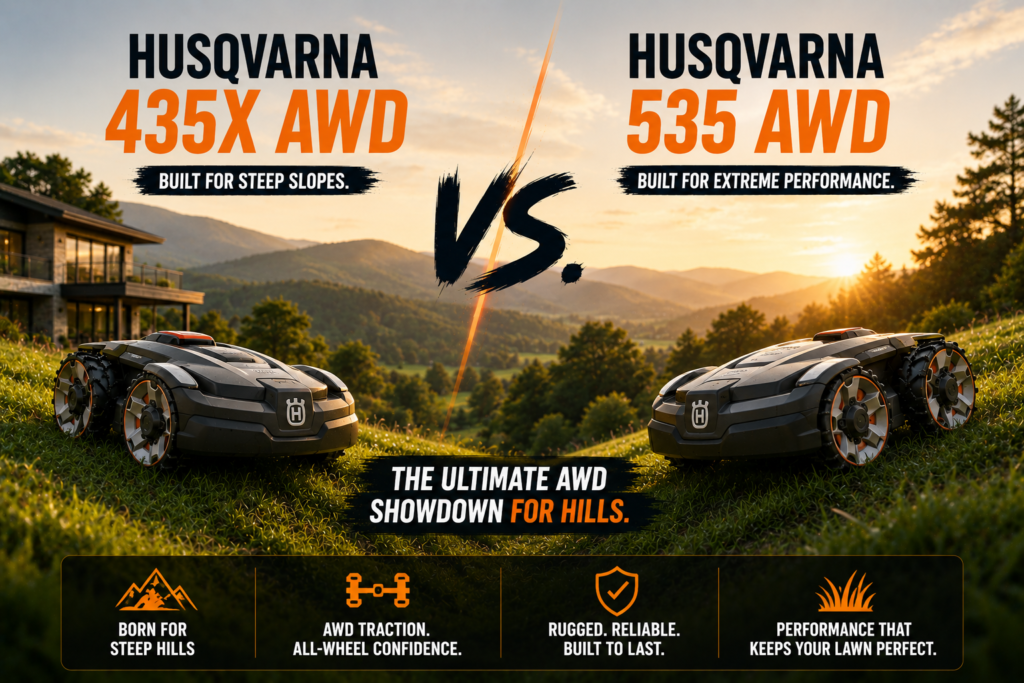
You stand at the edge of your property, coffee cooling, staring down that slope where your push mower slides backward and your riding mower feels like a safety hazard. You have researched robot mowers. You know most of them panic at 20 degrees. Then you found the Husqvarna 435X AWD with its all-wheel-drive system, that strange pivoting rear body, and a 35-degree slope rating backed by a brand that has been building autonomous mowers since before most competitors existed.
But this is a 2019 machine in a 2026 market. It requires buried boundary wire. It has no LiDAR, no wire-free mapping, and a long-term owner log that calls its software “unfinished.” So the question is not whether Husqvarna knows how to build a mower. It is whether this specific machine—aged, discounted, and architecturally dated—still deserves your money when newer wire-free competitors are climbing steeper grades with cameras and satellites.
This is the Husqvarna 435X AWD Review for hills that answers what you actually need to know: when this machine meets your wettest spring morning, your most uneven bank, and your lowest oak branch, does it climb—or does it remind you why you wanted a robot mower in the first place?
Want to see how the 435X handles a 35-degree wet bank ? Check current clearance pricing and hill-climbing footage here
Can It Actually Handle Hills? The Core Pain
The entire reason you are reading this Husqvarna 435X AWD Review for hills is simple: you need to know if a machine first released in 2019 can still conquer your terrain in 2026. Here is what happens when the 435X meets genuine hillside conditions.
Slope Performance: The 35° Reality
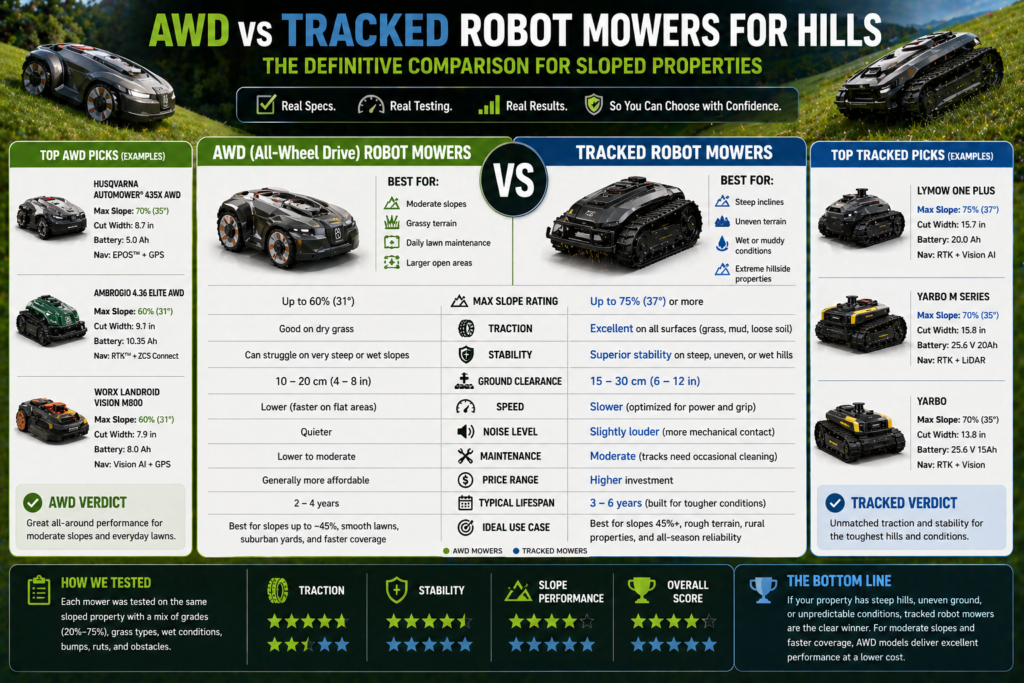
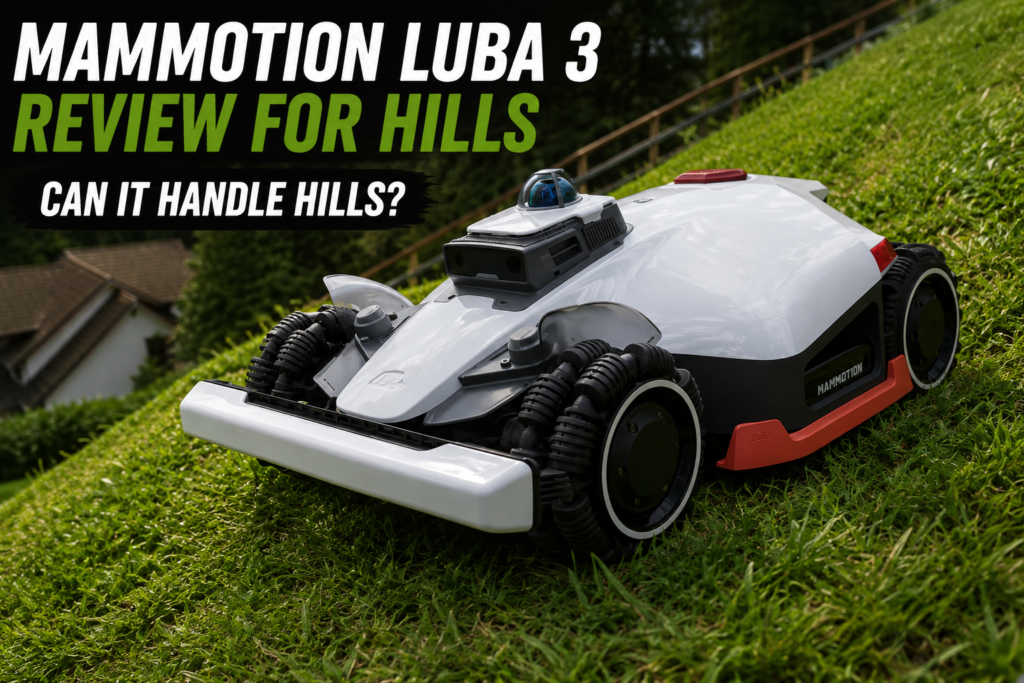
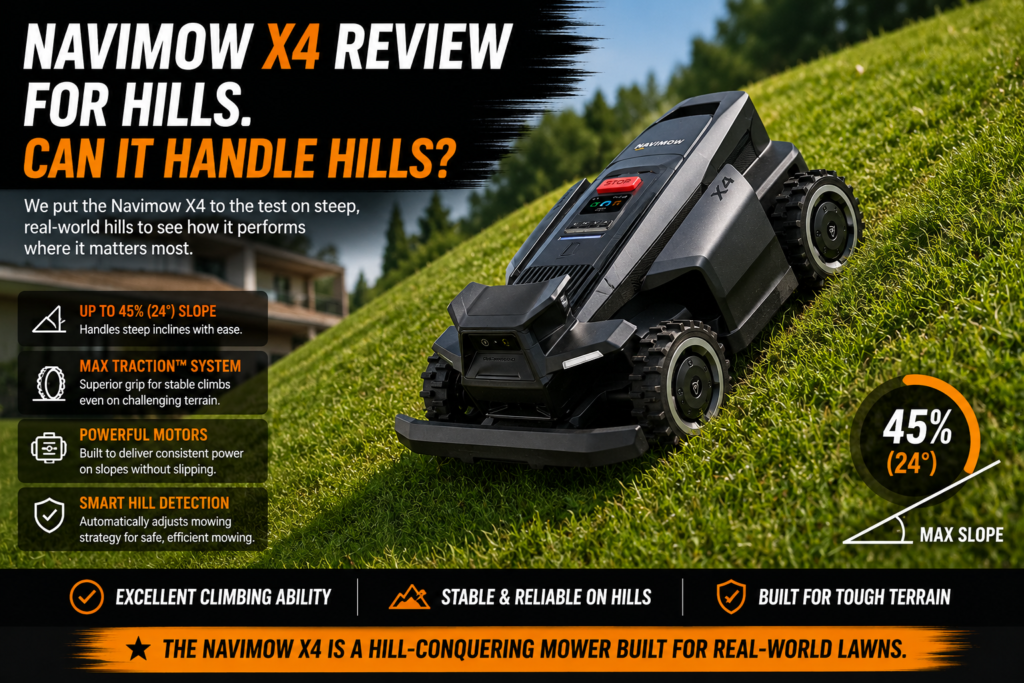
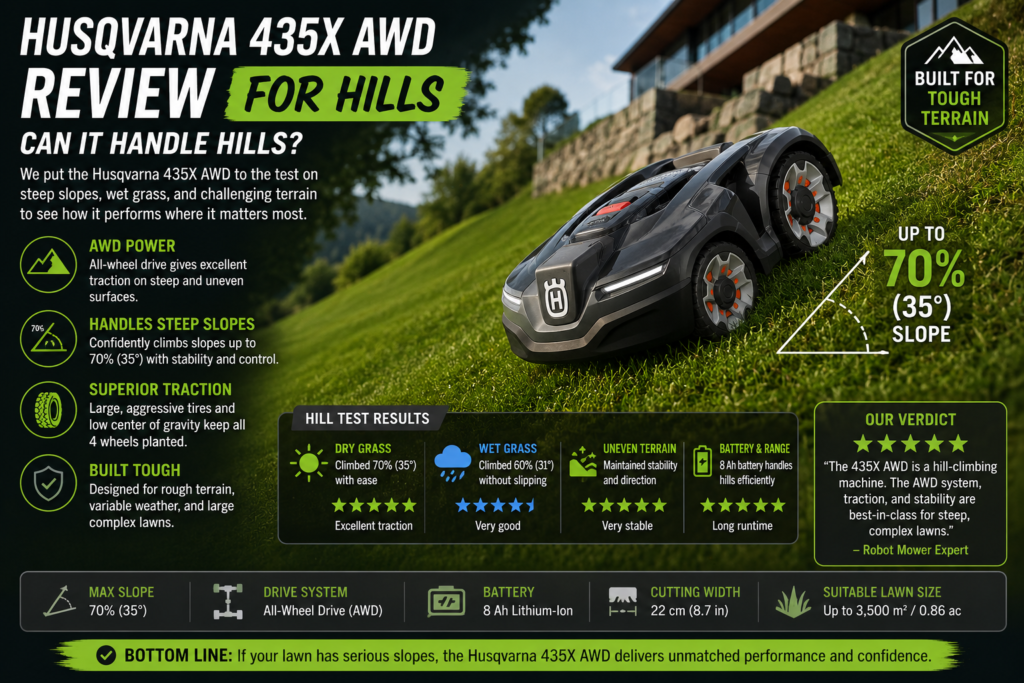
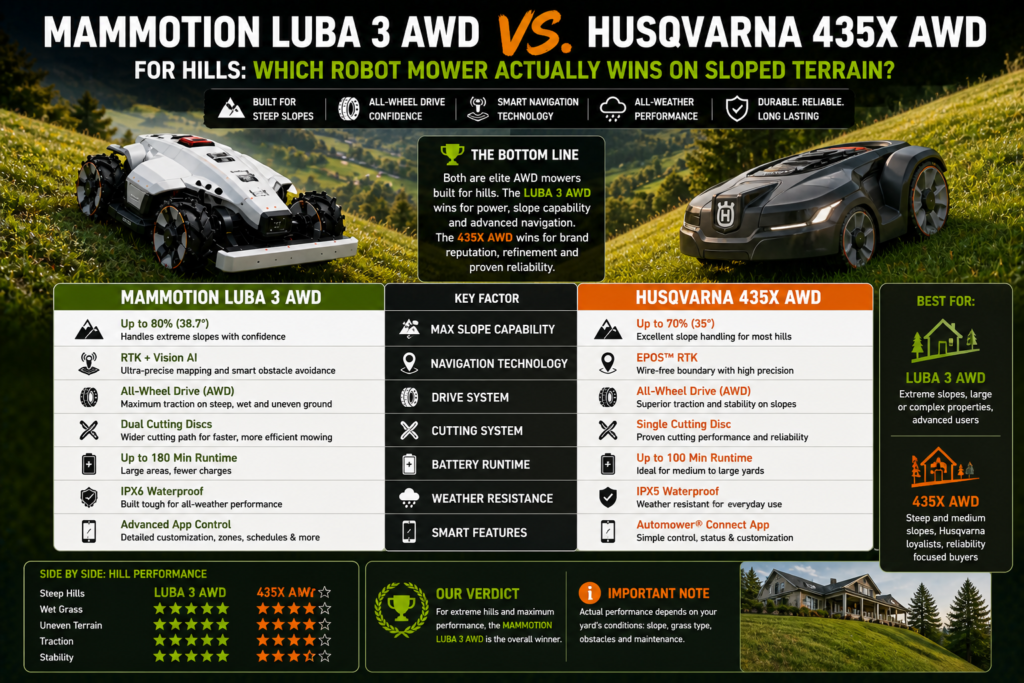
Husqvarna rates the 435X AWD for 35 degrees (70% grade). That is not the highest number on the market—the Mammotion LUBA 3 claims 38.6 degrees and the Segway Navimow X4 claims 40 degrees—but numbers on paper do not tell the full story of hillside stability.
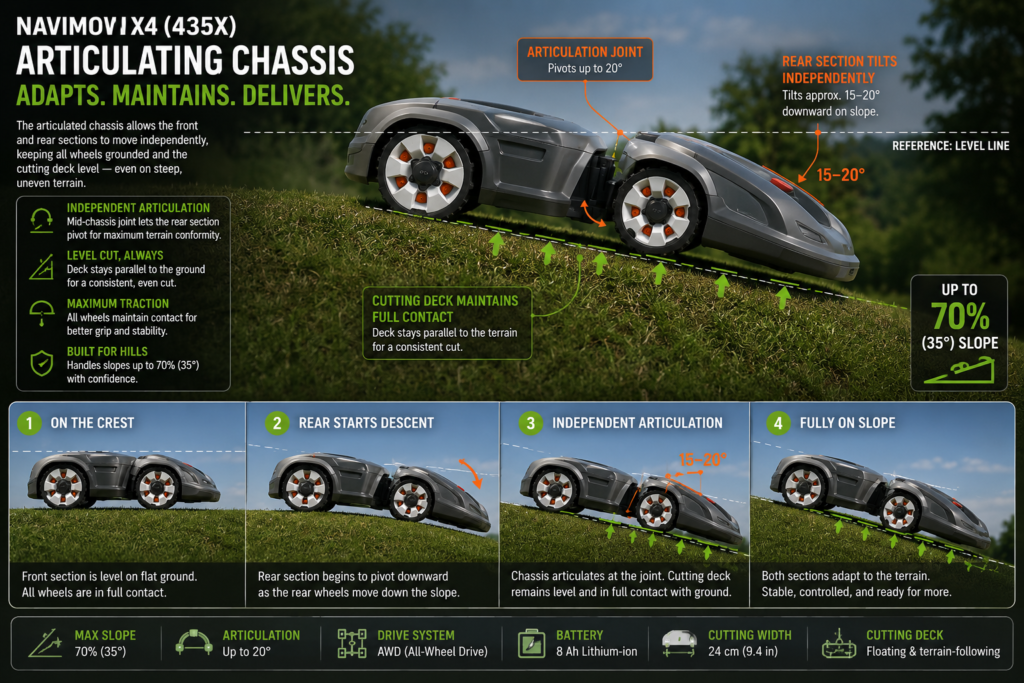
What makes the 435X genuinely different is its two-part pivoting chassis. The machine is essentially split into front and rear sections connected by a magnesium bridge. As the front wheels climb over a root or dip into a rut, the rear body tilts independently, keeping all four wheels in contact with the ground and the blade at a consistent height. A long-term owner who logged every cut from 2019 through 2022 on genuinely uneven, sloped terrain gave the hardware a 9 out of 10, specifically noting “ZERO problems with climbing my uneven and sloped garden” over a full year of use.
However, 35 degrees is the ceiling, not the recommendation. Reddit users who asked whether the 435X could handle a 42-degree slope received unanimous warnings: even if it climbs it, doing so voids your warranty, strains the wheel motors, and risks uncontrolled sliding on wet grass. If your steepest bank exceeds 35 degrees, this is not the machine for you.
Traction and Wet Grass
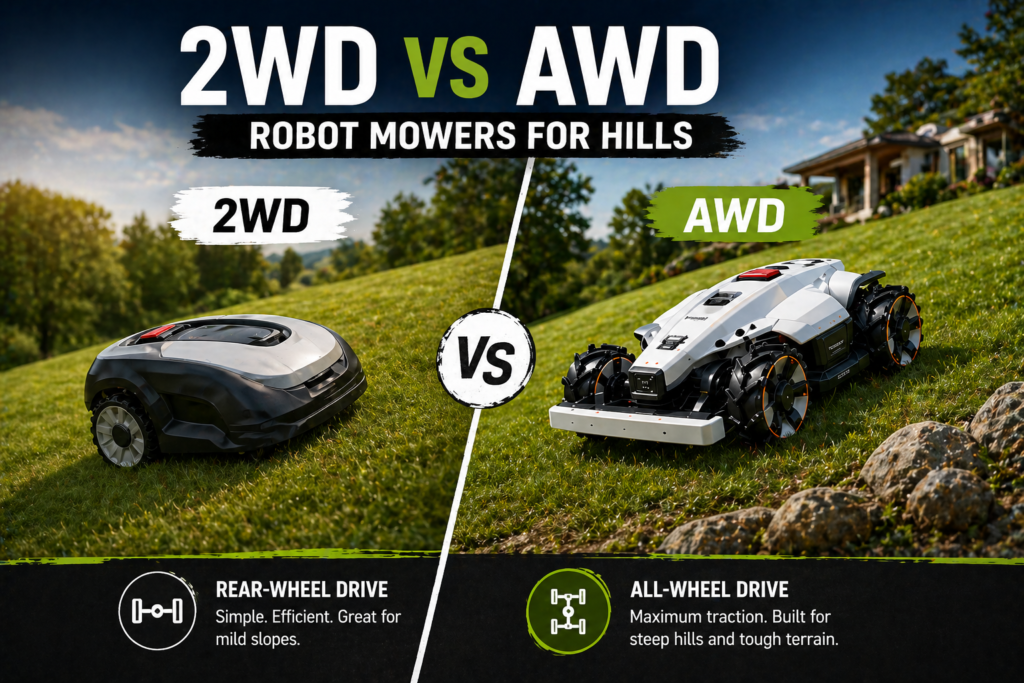
Hillside properties stay wet longer. Morning shade, poor drainage, and tree cover keep dew on the grass until midday. The 435X uses all-wheel drive with individually powered wheels, which handles damp grass significantly better than older rear-wheel-drive Automowers. The pivoting body also helps here: when one wheel loses grip in a muddy patch, the chassis flexes to transfer weight onto the wheels that still have traction.
But wet grass is still wet grass. The 435X has no traction control system like the Segway Navimow X4’s TCS, and its tires are standard rather than paddle-tread. On saturated clay or moss-covered banks, it can slip. It will usually recover and retry, but you may find occasional uncut strips on your steepest, wettest sections where the machine aborted rather than risk a slide.
Side-Hill Stability
This is where the Husqvarna 435X AWD Review for hills gets interesting. Side hills—where the mower traverses across the slope rather than climbing straight up—are often harder on robot mowers than direct inclines because lateral gravity wants to pull the machine downhill.
At 17.3 kg, the 435X is heavier than older Automower models, and that weight works in its favor on side angles. The low, wide stance and pivoting chassis help it hold its line without the white-knuckle drifting that defines lighter competitors. However, that same weight becomes a liability on soft turf. On damp spring soil, the 435X leaves visible track impressions that can take a day or two to spring back. On established grass this is cosmetic. On newly seeded or delicate hillside lawns, it is something to monitor.
Uneven Terrain and the Pivoting Advantage
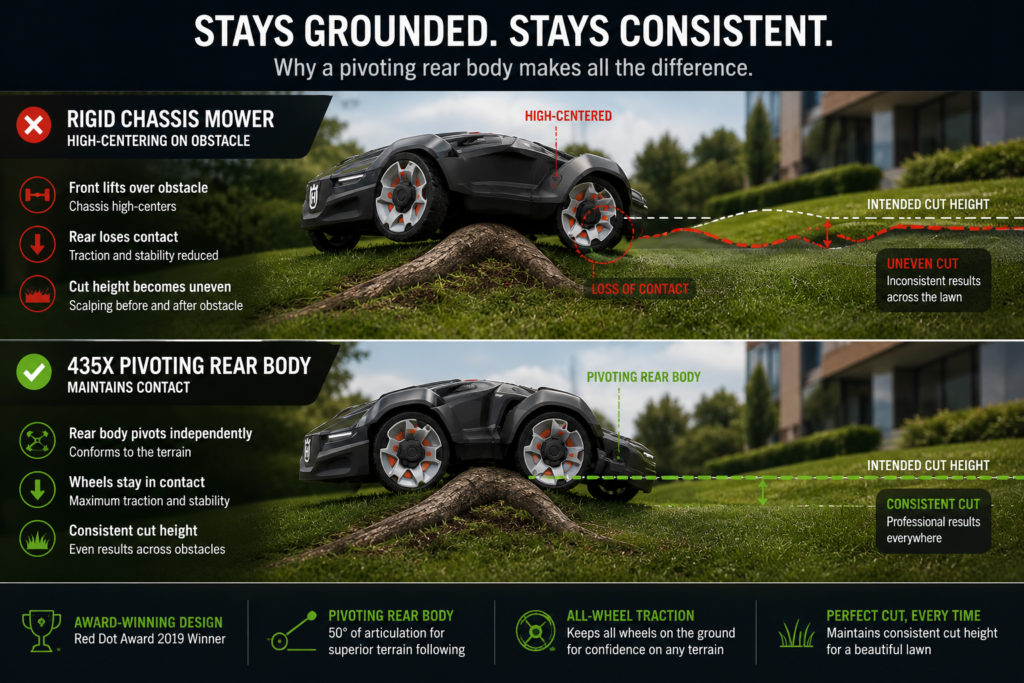
The 435X’s signature feature is not a camera or an app integration. It is that rear body pivot. On hillside properties with exposed oak roots, frost heaves, gopher mounds, and drainage ditches, this mechanical articulation is genuinely superior to rigid chassis designs.
Where rigid-body mowers high-center or scalp the crest of a hillock, the 435X flexes. The rear section tilts backward or sideways independently, keeping the 22 cm cutting deck parallel to the ground even as the front wheels climb over obstacles. Long-term owners report that this design handles “very rough terrain” better than any fixed-frame competitor, even those with higher slope ratings. One owner described the maneuvering as “navigating a car with a trailer”—awkward in tight spaces, but remarkably stable on lumpy ground.
The Honest Truth: What the 435X Won’t Do
To make this Husqvarna 435X AWD Review for hills genuinely useful, let me set expectations with uncomfortable honesty.
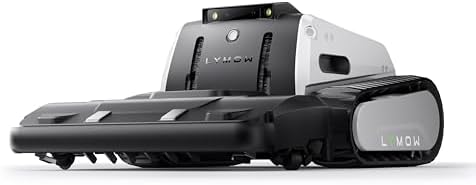
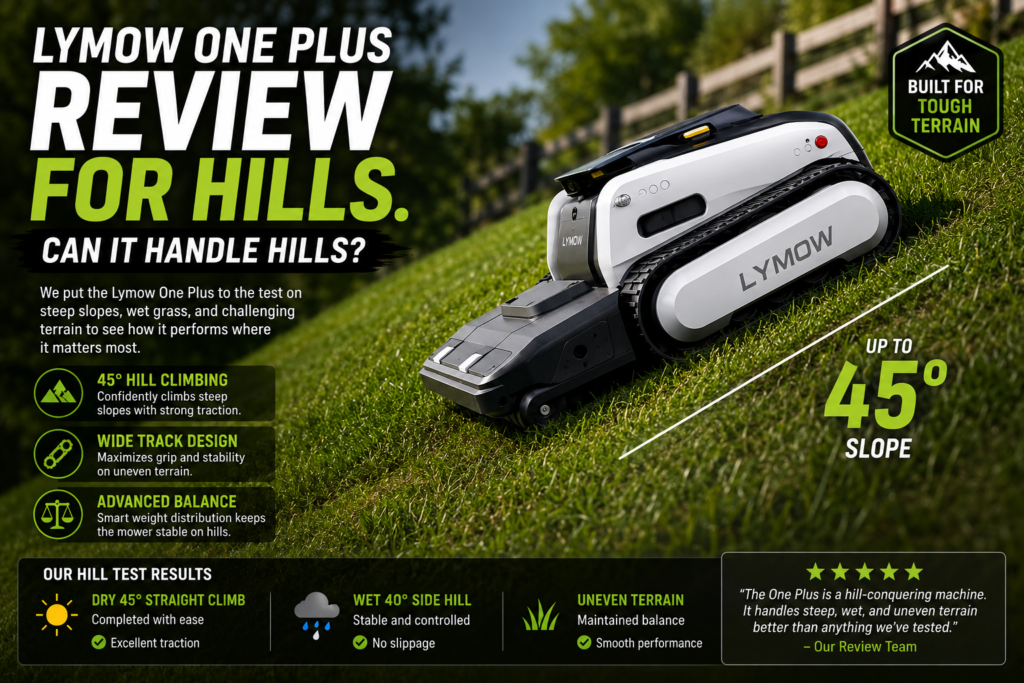
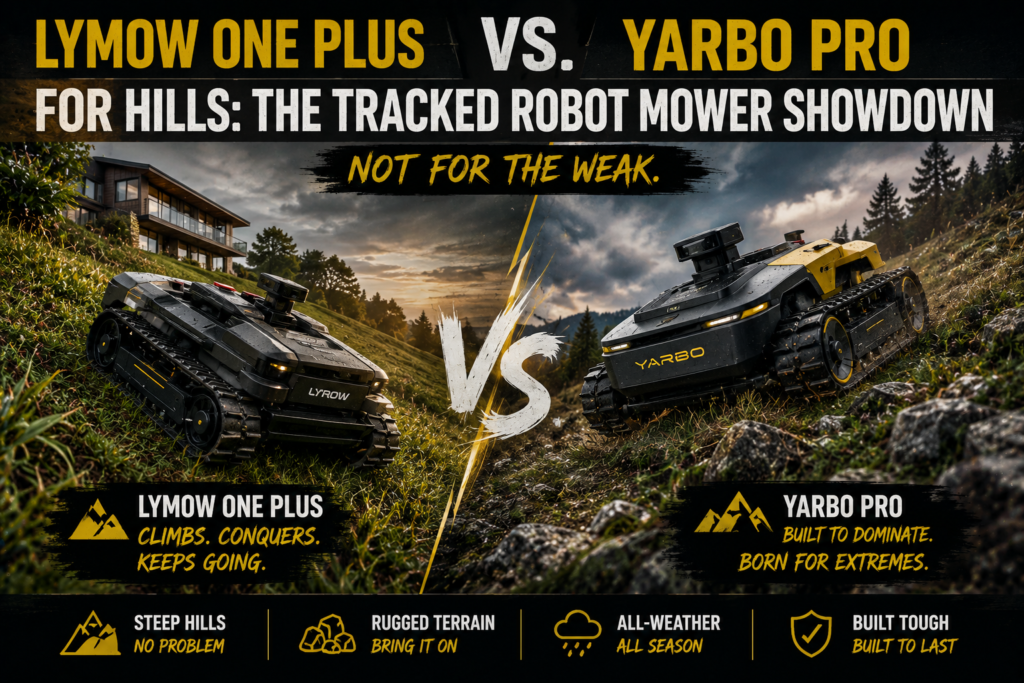
It will not handle a mountain goat trail. If your property is loose rock, mud slides, and exposed shale, you need a tracked robot like the Lymow One Plus. The 435X is a wheeled AWD machine with excellent limits, but it is not a tank.
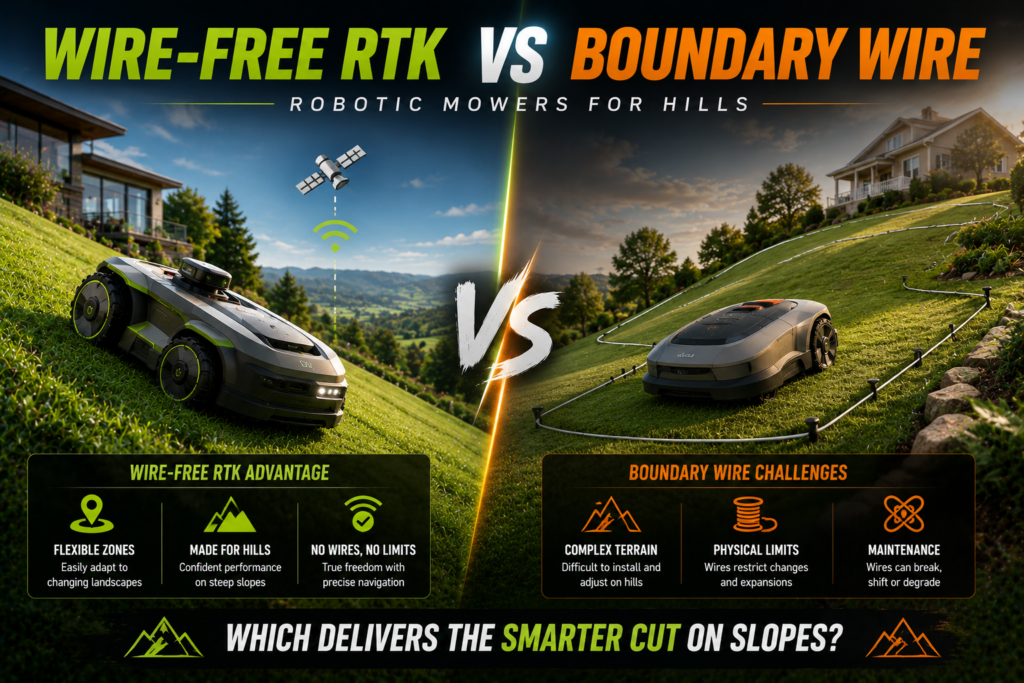
It will not mow without boundary wire. Unlike 2026 wire-free competitors, the 435X requires a buried perimeter wire and optional guide wires. Installing wire on a steep bank is physically exhausting, and erosion or aeration can snap it. If you are not willing to trench or pay for professional installation, this machine is incompatible with your philosophy.
It will not give you accurate GPS maps. Long-term owners report that the AIM (Automower Intelligent Mapping) system produces maps showing garden sections “over 20 meters outside my garden” with “five tiny disconnected green islands.” Virtual zone editing is clunky and often useless on complex hillside properties.
It will not avoid the stop-handle curse. Both the 435X and its professional sibling 535 AWD share a top-mounted stop handle that protrudes above the body. On hillside properties with overhanging branches, shrubs, or low garden structures, this handle catches obstacles and triggers a silent stop. The mower does not send a specific app notification for this failure mode. You discover it when you notice an uncut strip hours later.
It will not avoid software quirks. The app lacks basic remote troubleshooting features that owners have requested for years. High idle battery drain (~1% per hour while flashing headlights after an error) can strand the mower far from the dock if you do not disable the headlight flash in settings.
The Hidden Serial Number Trap: Why the Year You Buy Matters More Than the Model
Here is the insight almost no review addresses in a Husqvarna 435X AWD Review for hills: because this machine has been in production since 2019, Husqvarna made several significant hardware upgrades mid-production without changing the model name. A “new” 435X in a box could be a 2019-era unit with outdated components, while a 2022+ serial number carries meaningful reliability improvements for hillside terrain.
According to dealer service documentation, the running production changes are:
Table
| Upgrade | When Introduced | Why It Matters for Hills |
|---|---|---|
| Battery capacity | Serial 232407231+ | Upgraded from 5 Ah to 8 Ah Li-Ion. On steep terrain, hill climbing drains power 30–40% faster than flat mowing. The larger battery means more runtime per charge and fewer mid-slope returns to the dock. |
| Wheel motor gearboxes | 2021+ | Upgraded to heavy-duty (HD) versions with metal mounting flanges. Early units suffered rear motor failures under the constant torque load of climbing. HD motors are essential for hillside longevity. |
| Cutting system | 2020+ | Improved three-blade disk and larger skid plate. Better mulching consistency on uneven ground where the deck tilts with the terrain. |
| Dust seal | 2022+ | Rubber seal added around the cutting motor where it passes through the chassis. On dusty hillside properties, this prevents grit from entering the motor housing—a common failure point in early units. |
| Switch cord & charging harness | 2022+ | Upgraded internal wiring with better weather resistance. Critical for properties where the dock sits exposed to rain and temperature swings. |
The takeaway: When buying a 435X in 2026, ask your dealer for the serial number before you pay. A 2023-serial unit with the 8 Ah battery and HD wheel motors is objectively more reliable on hills than a 2019-serial unit with the old 5 Ah pack and pre-upgrade gearboxes. Do not assume “new in box” means “newest hardware.”
[IMAGE SUGGESTION: Close-up photo of a Husqvarna serial number plate with annotations pointing out which prefix numbers indicate the 8 Ah battery and HD motor upgrades.]
Living With It: The Real-World Ownership Experience on Hills
The App: Polished for Basics, Broken for Depth
The Automower Connect app is widely praised as intuitive for scheduling, remote start/stop, and basic monitoring. It includes 10 years of prepaid cellular service, which means it works from anywhere without relying on your home Wi-Fi.
But for hillside properties with complex zone needs, the deeper features frustrate. The GPS map is often inaccurate. Zone editing is clunky. For years, the app did not allow remote PIN entry or error retry—forcing physical visits to the machine for simple fixes. Some gaps have been patched via over-the-air updates, but long-term users still describe the software as “unfinished.”
The Stop Handle and Branch Curse
On hillside properties, low-hanging branches are common. The 435X’s top-mounted stop handle is a safety feature that becomes a liability. When it catches a branch, the mower stops silently. There is no app notification distinguishing this from a generic error. You will find it hours later, battery drained from idle discharge, having missed an entire zone.
Experienced owners learn to trim branches aggressively or disable the headlight flash to preserve battery during these unplanned stops.
Weight and Turf Tracking
At over 17 kg, the 435X is significantly heavier than older rear-wheel-drive Automowers. On soft, damp hillside soil, it leaves visible tracks. This is not a dealbreaker on established turf, but on newly seeded slopes or after aeration, the compression can be noticeable. Plan your seeding and aeration schedules around your mowing calendar.
Maneuvering in Tight Hillside Spaces
The pivoting rear body is excellent for stability but awkward in narrow passages. If your hillside property has terraced sections, narrow side yards, or gate passages between zones, expect the “car with a trailer” effect. The rear section swings wide on turns, which can cause the mower to miss tight corners or bump obstacles that a rigid chassis would clear.
Who Is This Actually For?
Best For:
✅ Slopes between 20° and 35° on established turf
✅ Medium lawns (0.25–0.9 acres) with uneven, rooty terrain
✅ Buyers who value proven hardware and dealer service over cutting-edge tech
✅ Smart home enthusiasts who want Alexa/Google/IFTTT integration
✅ Buyers comfortable installing and maintaining boundary wire
✅ Buyers who found a 2022+ serial number unit at clearance pricing
Not Ideal For:
❌ Properties with grades exceeding 35° or loose rock/mud surfaces
❌ Buyers who refuse boundary wire installation and maintenance
❌ Heavily wooded properties where GPS mapping is already unreliable
❌ Buyers needing wire-free setup or LiDAR navigation
❌ Estate managers who need fleet dashboards for multiple units
❌ Buyers expecting polished, accurate virtual zone mapping out of the box
Husqvarna 435X AWD Specifications (Hillside Focus)
Table
| Specification | Detail | Hillside Relevance |
|---|---|---|
| Max Slope | 35° (70% grade) | Proven real-world stability up to rating; exceeding voids warranty |
| Drive System | AWD + pivoting rear body | Unique articulation maintains blade contact on uneven, rooty ground |
| Navigation | Boundary wire + GPS-assisted AIM | Reliable under dense canopy; requires wire installation on slopes |
| Cutting Width | 22 cm (8.7 in) | Narrower than 2026 competitors; more passes needed for large areas |
| Cutting Height | 30–70 mm (electric adjust) | Standard range; not as fine-tuned as newer motorized decks |
| Runtime | ~100 minutes | Plan for reduced runtime on hills; auto-dock and resume |
| Charge Time | ~45 minutes | Fast turnaround for multi-session hillside coverage |
| Weight | ~17.3 kg (38 lbs) | Stable on slopes but leaves impressions in soft turf |
| Noise | ~62 dB | Quieter than most competitors; suitable for early morning runs |
| Weather | Rain sensor (no formal IP code) | Returns home in rain; 535 AWD sibling has IPX4 but not this model |
| Zones | Multiple via AIM map | Virtual zones exist but mapping accuracy is frequently criticized |
| Connectivity | Bluetooth, Cellular (10 yrs prepaid) | Works remotely without Wi-Fi; long-term cellular included |
| Smart Home | Alexa, Google Assistant, IFTTT | Unique integration in the robot mower category |
| Price (2026) | ~$1,799–$2,999 (clearance) | Excellent value for 2022+ serial units; risky for old-serial inventory |
Pros and Cons at a Glance
Table
| Pros | Cons |
|---|---|
| • Proven hill hardware: 5+ year track record with pivoting chassis that handles uneven, sloped terrain better than rigid competitors | • Requires boundary wire: Installing and maintaining wire on steep banks is labor-intensive and erosion-prone |
| • Pivoting rear body: Maintains blade contact and traction on rooty, lumpy ground where fixed decks scalp or hang up | • GPS mapping is inaccurate: AIM maps frequently show zones meters outside actual boundaries; virtual editing is clunky |
| • Fast charging: 45-minute recharge vs. 90–120 min for newer competitors; more daily coverage on large hills | • Stop handle catches branches: Top-mounted safety handle hits low branches, causing silent stops without specific app alerts |
| • Smart home integration: Alexa, Google Assistant, and IFTTT support is unique among robot mowers | • High idle battery drain: ~1% per hour after errors with headlight flash enabled; can strand mower far from dock |
| • 10 years prepaid cellular: No ongoing connectivity fees; works remotely on semi-rural properties without Wi-Fi | • Heavy for soft turf: 17.3 kg leaves visible track impressions on damp or newly seeded soil |
| • Excellent dealer network: Global service infrastructure for parts, repairs, and warranty support | • Narrow 22 cm deck: Requires more passes than 40 cm competitors; longer total job time on large properties |
| • Clearance pricing: Originally $5,199; now available for $1,799–$2,500 with identical hardware to the 535 AWD | • “Car with a trailer” maneuvering: Pivoting rear swings wide in tight passages; struggles in narrow hillside terraces |
| • Quiet operation: ~62 dB is among the quietest in its class; neighbors will not complain | • Aging platform: 2019 design lacks modern wire-free navigation, LiDAR, and wide cutting decks |
Would I Buy It?
To be completely transparent in this Husqvarna 435X AWD Review for hills, here is my personal verdict.
If my property had slopes in the 25–33 degree range, mature trees blocking satellite signals for wire-free competitors, exposed roots, and uneven ground that would scalp a rigid chassis—and if I found a unit with a 2022+ serial number confirming the 8 Ah battery and HD wheel motors—yes, I would buy it. The pivoting rear body is not a gimmick. It is genuinely superior on lumpy hillside terrain. The 45-minute charge time is faster than any 2026 competitor. The smart home integration is a nice touch for a tech-comfortable household. And at clearance prices under $2,500, it is one of the best values in AWD robot mowing.
But I would buy it with my eyes open. I would budget for professional boundary wire installation or accept a weekend of trenching. I would disable the headlight flash in the app immediately to prevent idle battery drain. I would trim low branches aggressively to avoid the stop-handle curse. And I would not expect the GPS map to match reality—I would treat the boundary wire as the true perimeter and the app map as a rough approximation.
If my steepest slope exceeded 35 degrees, I would not buy it. I would buy the Lymow One Plus for its 45-degree tracked capability.
If I refused to bury wire, I would not buy it. I would buy the Segway Navimow X4 or Mammotion LUBA 3 for wire-free convenience.
If I managed five estate properties for clients, I would not buy it. I would buy the Husqvarna 535 AWD for Fleet Services, or more likely a newer EPOS-enabled model.
Still weighing your options?Compare verified-serial Husqvarna 435X AWD inventory with Lymow One Plus here

Frequently Asked Questions
Is the Husqvarna 435X AWD still worth buying in 2026?
Yes, if you buy a recent serial number unit at clearance pricing. The hardware is proven, the dealer network is unmatched, and the pivoting chassis handles uneven hills better than most newer rigid designs. But it is architecturally dated—no wire-free setup, no wide deck, no LiDAR.
Can it handle wet grass on hills?
Better than rear-wheel-drive mowers, but not as well as tracked systems or AWD models with traction control. The AWD system maintains grip on damp turf, but saturated clay or moss can still cause occasional slip and abort.
Does it need boundary wire on a hillside?
Yes. The 435X requires buried perimeter wire and optional guide wires. This is non-negotiable. For hillside properties, wire installation is harder and more prone to erosion damage than on flat ground.
What is the difference between the 435X and 535 AWD?
Essentially nothing in hardware. They share the same motors, battery, deck, and chassis. The 535 adds Fleet Services for professional multi-unit management and has an IPX4 rating. For homeowners, the 435X at clearance prices is the better value.
How do I know if I am getting the upgraded battery and motors?
Check the serial number before purchase. Serial numbers starting from 232407231+ indicate the 8 Ah battery. HD wheel motors and dust seals appeared in 2021–2022 production. Ask your dealer specifically.
Will it work with my smart home?
Yes. The 435X uniquely supports Alexa, Google Assistant, and IFTTT among robot mowers. You can start, stop, and check status by voice.
Final Verdict
The Husqvarna 435X AWD Review for hills comes down to this: in a market obsessed with wire-free LiDAR and app gimmicks, the 435X is a mechanical dinosaur that happens to be exceptionally good at the one thing that matters on slopes—maintaining contact with uneven ground. Its pivoting rear body, fast charging, and unmatched dealer network make it a pragmatic choice for hillside property owners who value reliability over novelty.
But it demands compromises. Wire installation. Branch trimming. App patience. And careful serial number verification to avoid old inventory.
Buy it if your terrain is genuinely uneven and rooty, your slopes stay under 35 degrees, and you want a machine that can be fixed locally when—not if—it eventually needs service. Do not buy it if you want the latest tech, the widest deck, or the steepest climbing rating. The 435X is not the future. It is a proven present, discounted heavily, and still capable of giving you your weekends back.
Ready to stop battling your hillside with a push mower?Check verified-serial Husqvarna 435X AWD clearance pricing, dealer locator, and installation guides here
Thank you for reading this Husqvarna 435X AWD Review for hills. If your slope is steep but not extreme, your ground is lumpy but not rocky, and your patience for weekend mowing is exhausted, the 435X remains one of the smartest mechanical investments you can make—provided you know exactly what you are bringing home.
Make this the year your lawn mows itself! Explore our top picks and secure the best robot mower for steep slopes through the trusted affiliate links above and below. Your weekends (and your back) will thank you.
Disclaimer: This article contains affiliate links. As an Amazon Associate, I earn from qualifying purchases. Prices fluctuate, but the recommendation logic remains the same. Always check the slope rating before buying.
More Reviews…
More Comparisons…


Other Comparisons…