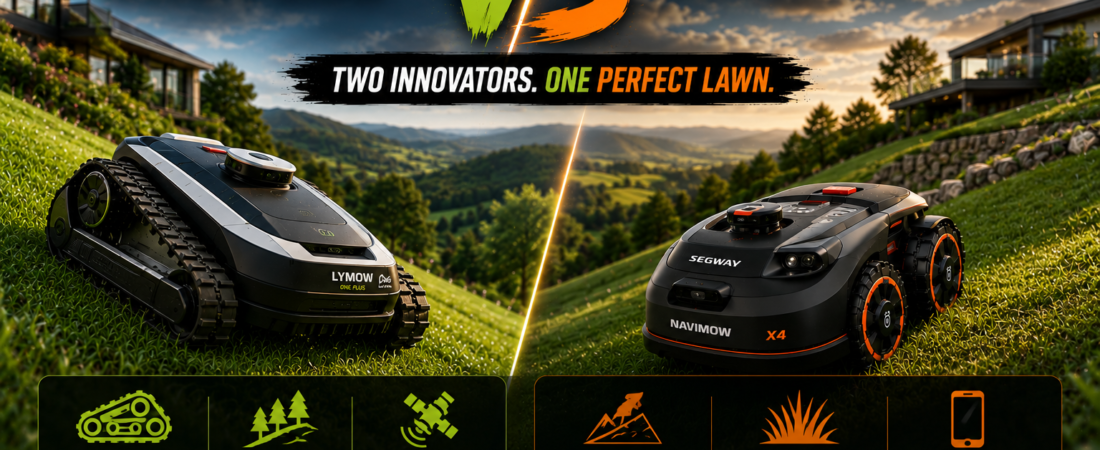
For the time-poor homeowner staring out at a steep, uneven lawn, the appeal of a robotic mower isn’t just automation—it’s liberation. You aren’t looking for a gadget that merely shuffles across a putting-green-flat yard. You need a machine that clings to inclines, avoids disaster at the tree line, and delivers that estate-quality stripe without you risking a slip or a sunburn.
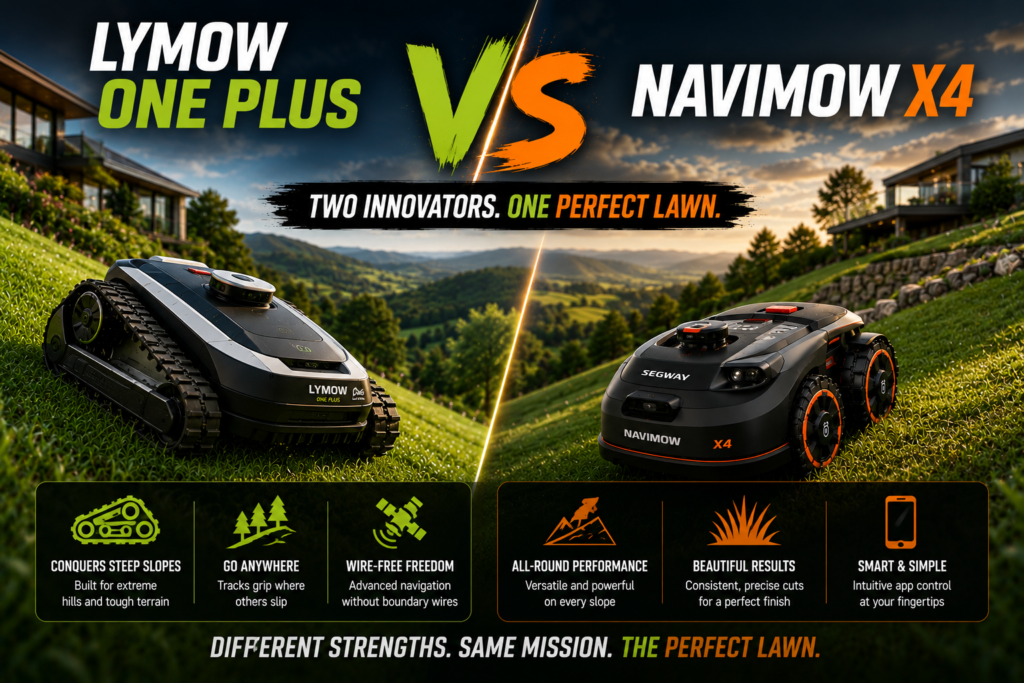
This is where the Lymow One Plus vs Navimow X4 debate becomes critical. Freshly launched and constantly updated, these two flagship models represent the cutting edge of autonomous terrain handling, but they attack the problem of hills from radically different engineering angles.
If you are managing 0.25 to 2+ acres of sloped, multi-zone, or obstacle-heavy property, choosing wrong isn’t just a waste of money—it means continuing to battle inconsistent cuts and the mental burden of weekend mowing. We’ve dug deep into the specs, real-world tests, and forum discussions to deliver a comparison that goes far beyond the sales brochure. Let’s settle the Lymow One Plus vs Navimow X4 matchup for hills once and for all.
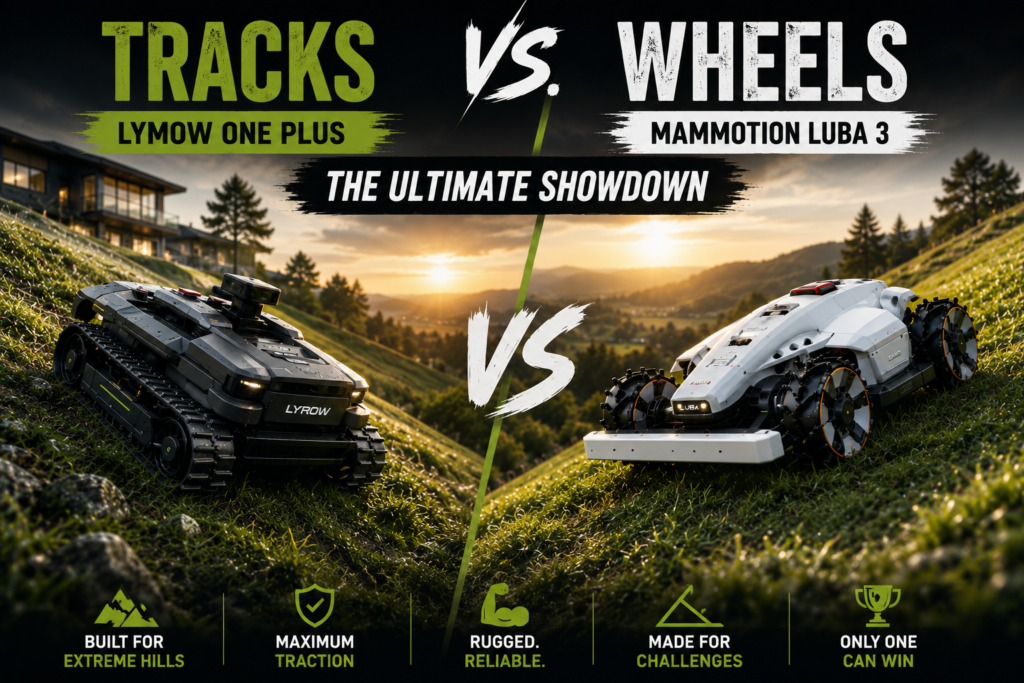
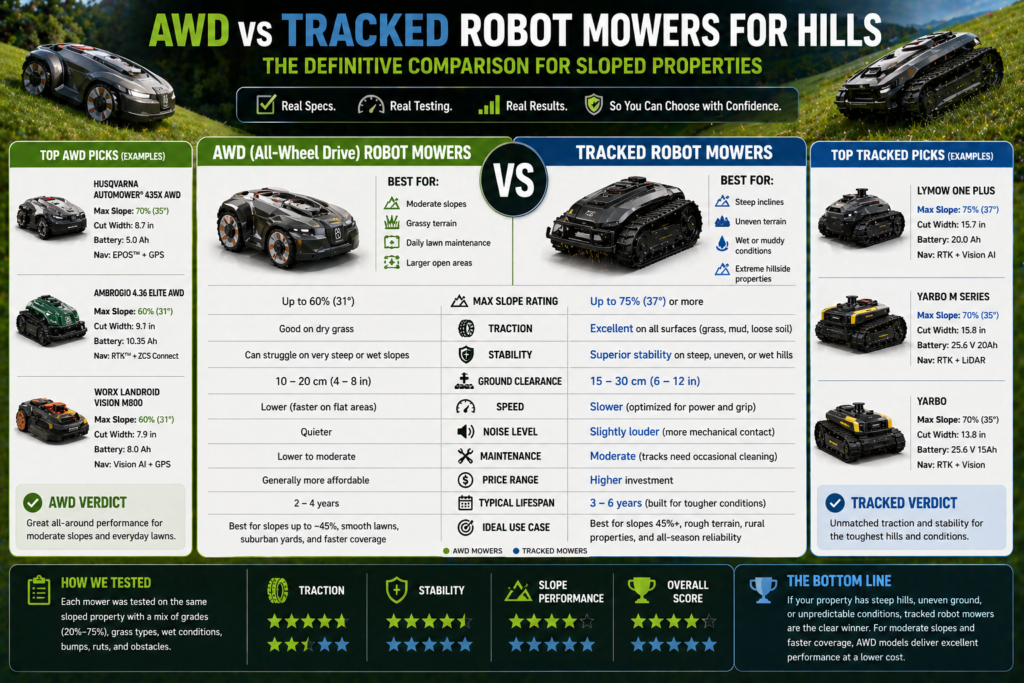
The Engineering Philosophy: Tracks vs. All-Wheel Drive
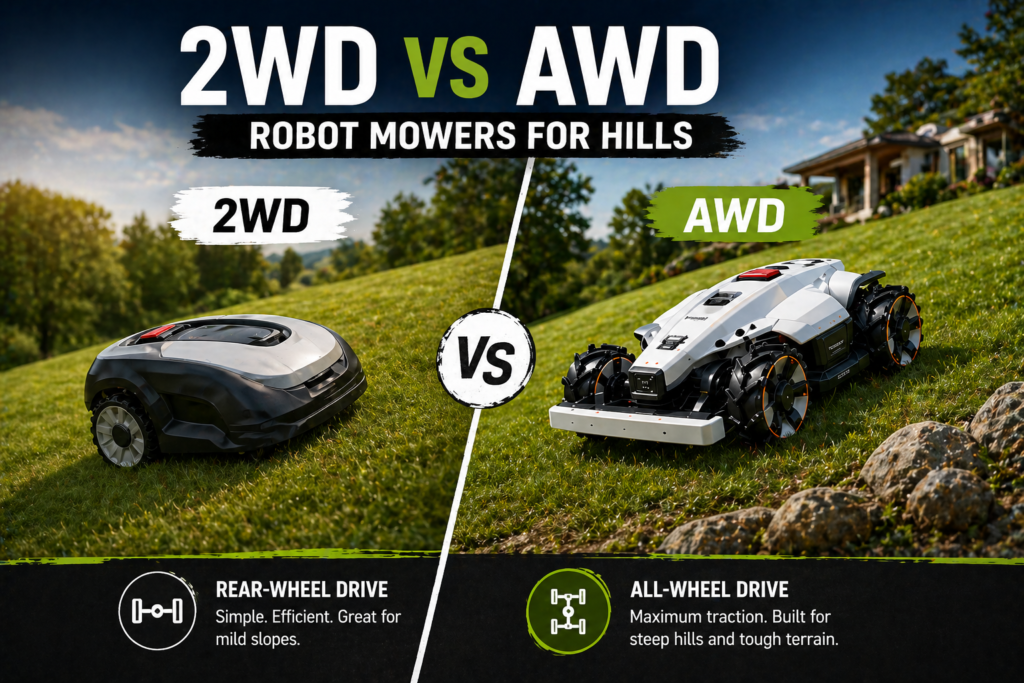
To understand how these machines handle hills, you must look beneath the shell. The foundational difference in the Lymow One Plus vs Navimow X4 comparison is the drive system, and it dictates performance on wet grass, loose soil, and sharp inclines.
Lymow One Plus: The “Tank” Approach
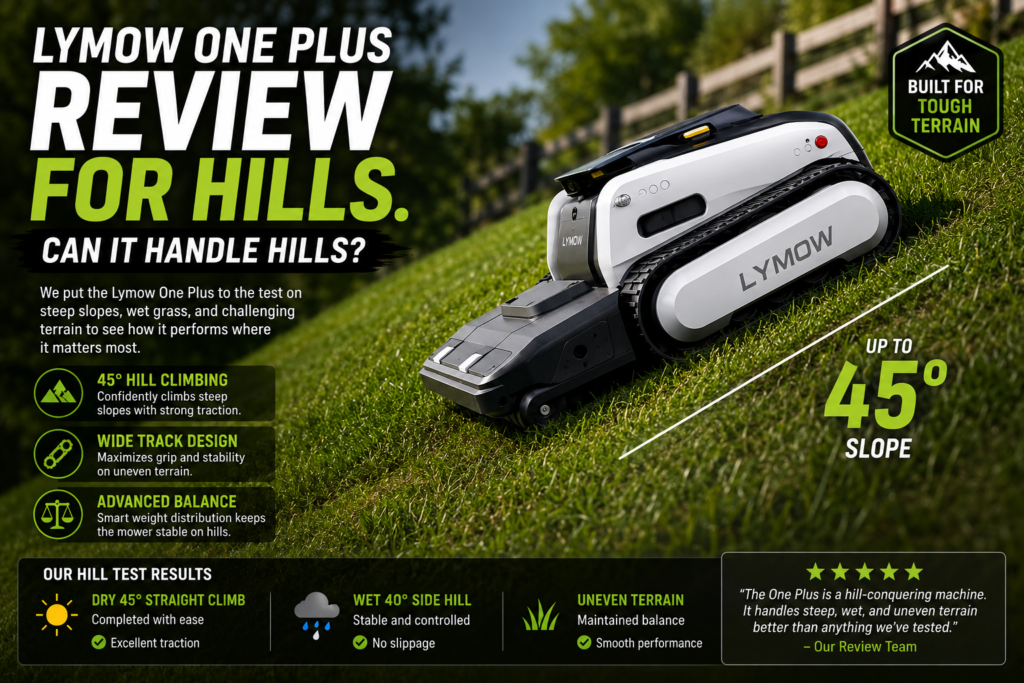
The Lymow One Plus utilizes a tracked drive system, often described by reviewers as “tank treads” . This isn’t a cosmetic choice. The continuous track distributes the machine’s substantial 78 lbs weight over a larger surface area. On a hill, this physics advantage is massive. A tracked system increases traction by maintaining constant ground contact, preventing the “scalping” effect where spinning wheels dig into the turf . This makes it exceptionally stable on uneven terrain, gravel, and roots where a wheeled bot would lose grip .
Navimow X4: The Automotive Performance
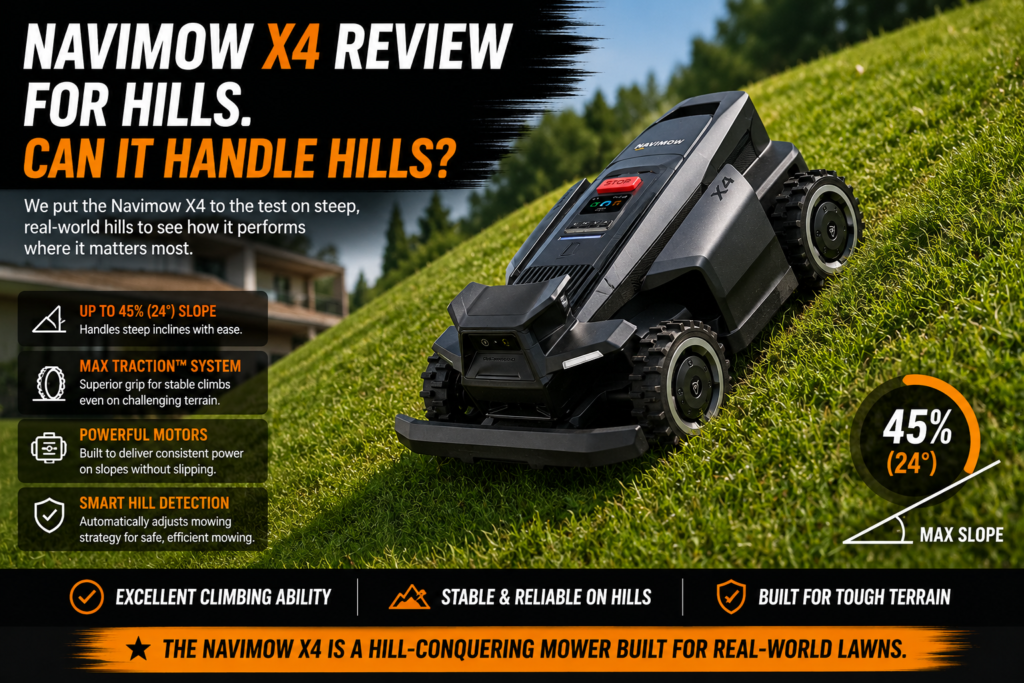
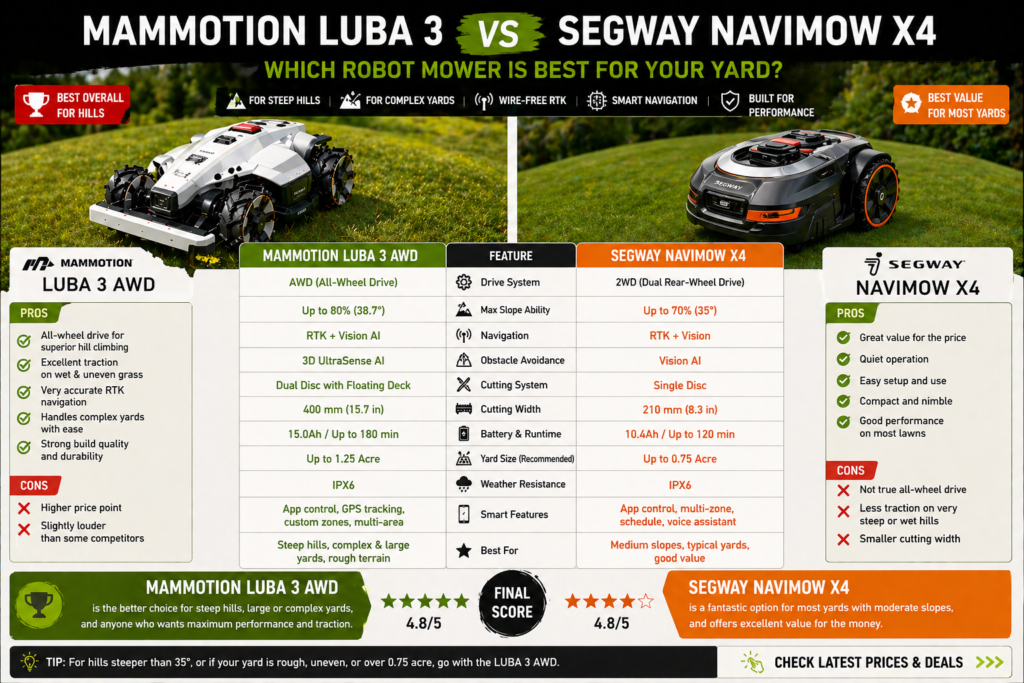
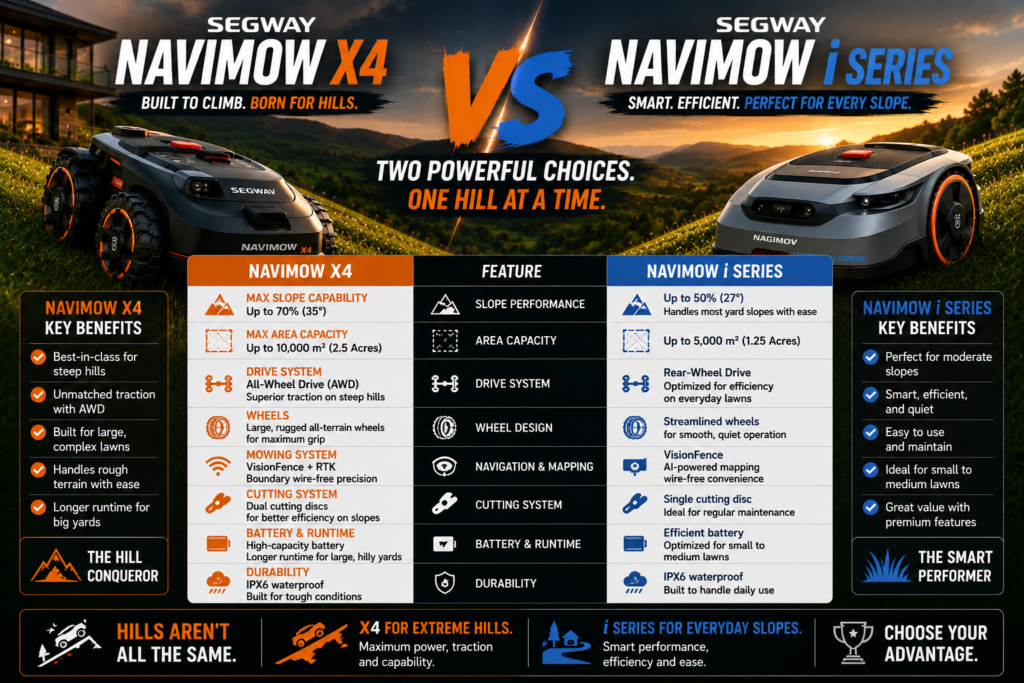
Segway’s Navimow X4 takes a page from high-end off-road vehicles with its Xero-Turn All-Wheel Drive (AWD) system. It features four-wheel drive combined with dual suspensions and a Traction Control System (TCS) that dynamically adjusts torque to prevent slipping . While it lacks the continuous tread of the Lymow, the independent front-wheel steering motors allow for “zero-turn” maneuvers without tearing the grass—crucial for the bottom of a slope where tight turns are required .
Head-to-Head: Slope Capability and Obstacle Clearance
When analyzing Lymow One Plus vs Navimow X4 for a hilly property, slope angle and the ability to clear obstacles are your non-negotiables.
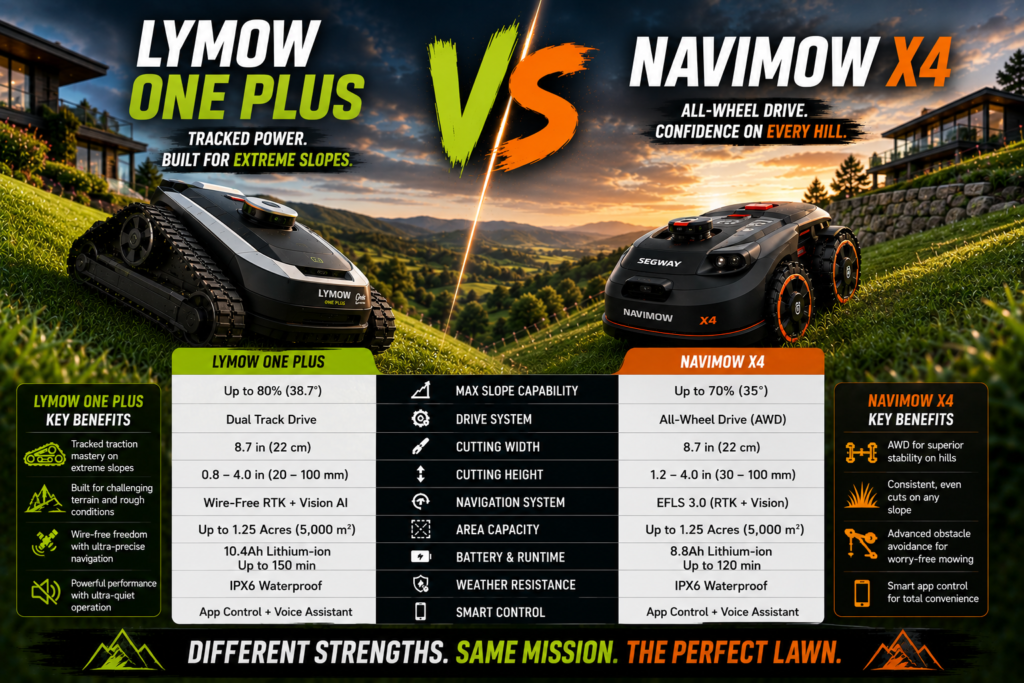
| Capability | Lymow One Plus | Navimow X4 |
|---|---|---|
| Max Slope | 100% (45°) | 84% (40°) |
| Drive System | High-torque Track Drive | AWD with Dual Suspension |
| Obstacle Clearance | 2.8 inches (70mm) | 2.8 inches (70mm) |
| Turf Safety on Turns | Good (wide tracks) | Excellent (zero-turn AWD) |
Interpreting the Degrees: The Lymow One Plus’s 45° grade limit is a 5-degree advantage over the Navimow X4’s 40°. While 5 degrees might sound minor on paper, in landscaping terms, it represents a wall-like incline versus a very steep embankment. If your property features a drainage embankment or a true “no-go zone” hill, the Lymow’s tracked footprint provides a safety margin that the wheeled Navimow might find challenging . Both, however, clear 2.8-inch vertical obstacles equally, ensuring they can navigate exposed roots or sidewalk edges without high-centering .
Navigation in the Real World: Under Trees and Through Zones
Battling a hill is one thing; navigating a complex, tree-covered slope without losing signal is another. Here, the Lymow One Plus vs Navimow X4 decision hinges on how they see the world.
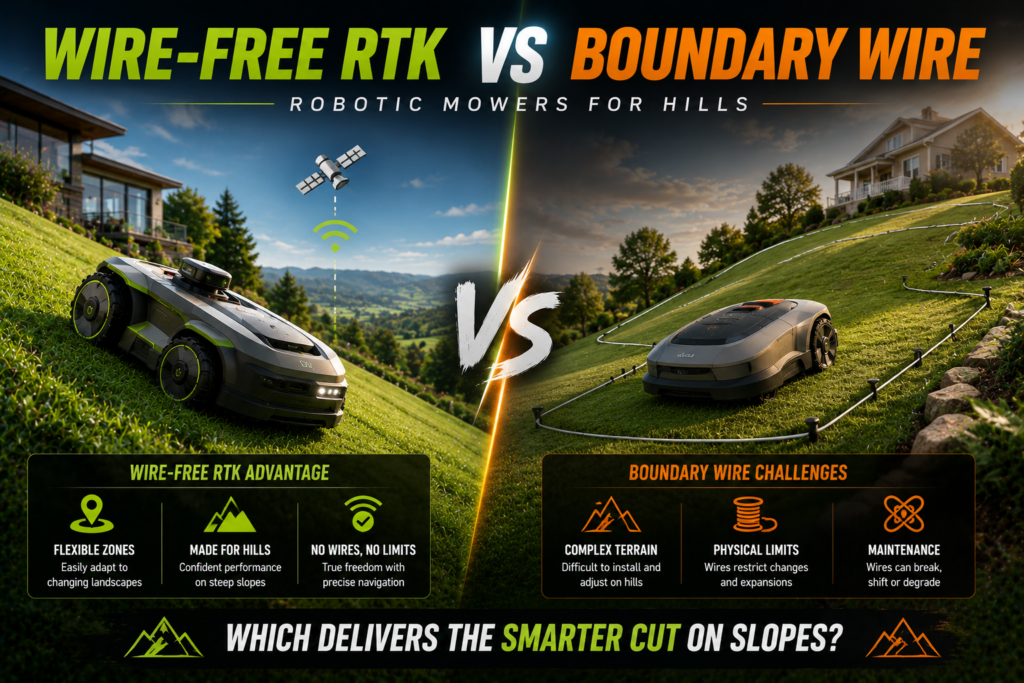
The Lymow One Plus relies on a “LySee 2.0” system fusing RTK satellite positioning with VSLAM (visual mapping) and AI vision . Crucially, it requires a physical RTK antenna to be installed on your property. For an estate manager, this provides centimeter-level accuracy and works completely independently of cellular signals, which can be spotty in semi-rural areas. The AI system is trained to handle thousands of object scenarios, which reduces the chances of it getting stuck on a fallen branch on a blind slope .
The Navimow X4, however, introduces a major generational shift: it features onboard triple-frequency network RTK, free for life, eliminating the need for the physical antenna station entirely . For the time-poor homeowner, this means a “drop and mow” setup. It also fuses this with 360° VSLAM. The X4’s 360° AI VisionFence is a standout for hills, as it can detect moving animals or people crossing its path, preventing accidents even if the mower is tilted at an odd angle .
Cut Quality on Slopes: The Real Definition of “Done”
A mower that conquers a hill but leaves an ugly cut isn’t solving your problem. On slopes, grass tends to lie flat. Traditional small-disc mowers often fail to lift it, resulting in missed strips that you have to redo by hand.
The Lymow One Plus attacks this with brute force. Its LyCut 2.0 system uses two real rotary blades made of SK5 steel, spinning at up to 6,000 RPM within a 16-inch wide deck . Reviewer Doc discovered that this specific blade configuration creates real “lift and cut” airflow—a cyclone effect usually found only in gas-powered mowers—to stand the grass up before slicing it . This floating deck automatically adjusts to terrain contours, preventing the “scalped” high marks you often see on ridges.
The Navimow X4 counters with the MowMentum system, a dual-disc setup powered by dual 180-watt motors with 12 thickened blades . Segway engineered this specifically for “no missed grass” edges on thick varieties like St. Augustine. While the Lymow relies on airflow physics, the Navimow uses sheer motor power and a smart cutting algorithm to maintain blade speed under load. Both will deliver a reel-mower-quality finish on slopes, but the Lymow’s heavier steel blades hold a sharpening edge longer in sandy or rough conditions .
What Other Reviews Won’t Tell You
Most spec-sheet comparisons stop at the numbers. But after fielding insights from reddit threads and video reviews like “How to with Doc,” here is the unvarnished truth about the Lymow One Plus vs Navimow X4 ownership experience.
The “Wet Grass” Variable: If you live in a humid region with dew-heavy mornings, the traction difference becomes critical. The Lymow’s tracks provide vastly superior lateral hold on wet, slippery grass compared to the Navimow’s tires, even with electronic traction control. A sliding mower on a slope is a disaster; the Lymow’s 35 kg heft holds it down .
The Clogging Issue: Doc’s testing revealed that in thick, wet St. Augustine or similar grasses, the Lymow One Plus’s side-discharge port can occasionally clog . This is because the mower blasts through so much material. He provides a simple warranty-voiding fix (removing a flap and a small bar), which immediately solves the issue. The Navimow, with its multiple smaller blades, tends to mulch the clippings finer, which reduces clogging risk but returns nutrients to the soil less uniformly if you aren’t bagging.
Battery Safety and Longevity: The Lymow uses a LiFePO4 (Lithium Iron Phosphate) battery rated for 2,000+ cycles . This is a cell chemistry that tolerates heat better and is far less prone to thermal runaway than standard Li-ion. For a property manager parking equipment in a hot outdoor shed, LiFePO4 is a significant safety and durability upsell .
Lymow One Plus vs Navimow X4: Pros and Cons
To help you weigh the Lymow One Plus vs Navimow X4 differences instantly, here is a breakdown based on the needs of a hill-heavy property owner.
| Model | Pros | Cons |
|---|---|---|
| Lymow One Plus |  Tracks conquer 45° wet hills effortlessly Steel rotary blades offer true “lift” cutting 2,000-cycle LiFePO4 battery Massive 1.73-acre daily coverage 80+ zone management Tracks conquer 45° wet hills effortlessly Steel rotary blades offer true “lift” cutting 2,000-cycle LiFePO4 battery Massive 1.73-acre daily coverage 80+ zone management |  Heavy (78 lbs) can cause ruts on delicate lawns Requires physical RTK antenna setup Side discharge may clog in extreme wet Louder than typical robotic mowers Heavy (78 lbs) can cause ruts on delicate lawns Requires physical RTK antenna setup Side discharge may clog in extreme wet Louder than typical robotic mowers |
| Navimow X4 | “Drop and mow”—no antenna required Turf-safe AWD zero-turn agility 360° AI VisionFence for obstacle safety Ultra-sleek app and smart home integration 3x efficiency vs. competitors | Slips on loose soil/wet grass more easily than tracks Max slope 40° vs. 45° Tiny razor blades lack strong airflow Higher upfront cost for top-tier X450 |
Making the Smart Upgrade: The Verdict
When it comes to the Lymow One Plus vs Navimow X4 decision for hills, cut through the marketing and look at your land’s personality.
Choose the Lymow One Plus if…
Your “hill” is more of a wilderness edge buried under some tree canopy, with loose dirt, stubborn roots, and a steepness that makes you nervous to stand on. The tracked drive and steel blades are a workhorse solution for semi-rural estates where the terrain is unforgiving, and Wi-Fi isn’t the only priority. It’s the proactive buyer’s choice for the absolute maximum mechanical grip .
Choose the Navimow X4 if…
Your property is grand and sweeping, with intricately designed landscape zones connected by sloped corridors. The tech-forward, antenna-free setup and the TCS-controlled AWD are perfect for the smart homeowner who loves a clean app interface and wants a system that integrates seamlessly with a Google Home or Alexa routine .
Ready to Take Back Your Weekends?
If the dread of mowing has loomed over your free time for too long, both of these machines represent freedom. The key is matching the drive system to your specific definition of “steep.”
For those ready to invest in the sheer mechanical grip and robust cutting power of the tracked beast, you can check the latest pricing and availability for the [Lymow One Plus here] – it’s a favorite for those who demand maximum slope security.
Alternatively, if agile, smart mapping and a true antenna-free luxury experience sound like your smart home upgrade, the [Navimow X4 is available here] – it’s the top-tier pick for beautifully designed, complex estates that need gentle, automated care.
Stop letting the hill win. Upgrade this week, and let the robots fight gravity for you.
Make this the year your lawn mows itself! Explore our top picks and secure the best robot mower for steep slopes through the trusted affiliate links above and below. Your weekends (and your back) will thank you.
Disclaimer: This article contains affiliate links. As an Amazon Associate, I earn from qualifying purchases. Prices fluctuate, but the recommendation logic remains the same. Always check the slope rating before buying.
More Comparisons…

Other Comparisons…

More Reviews…