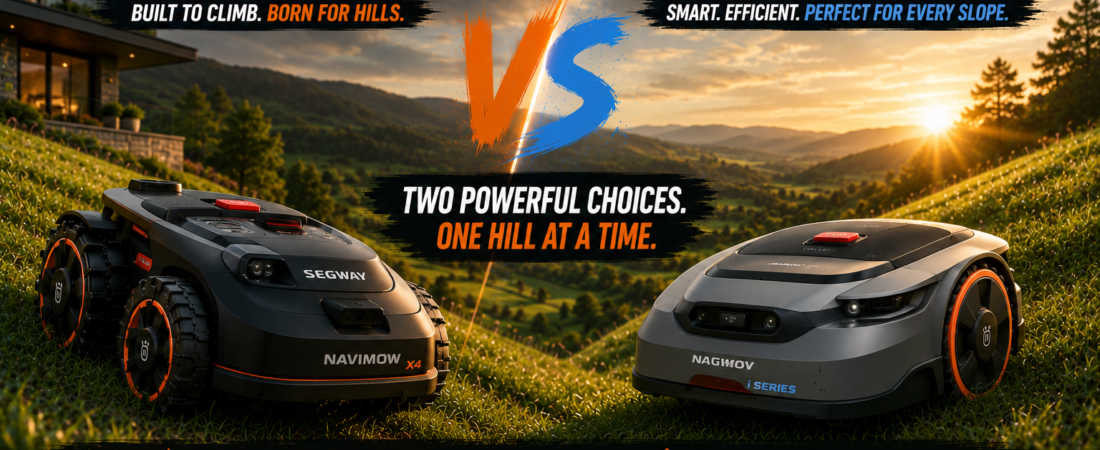
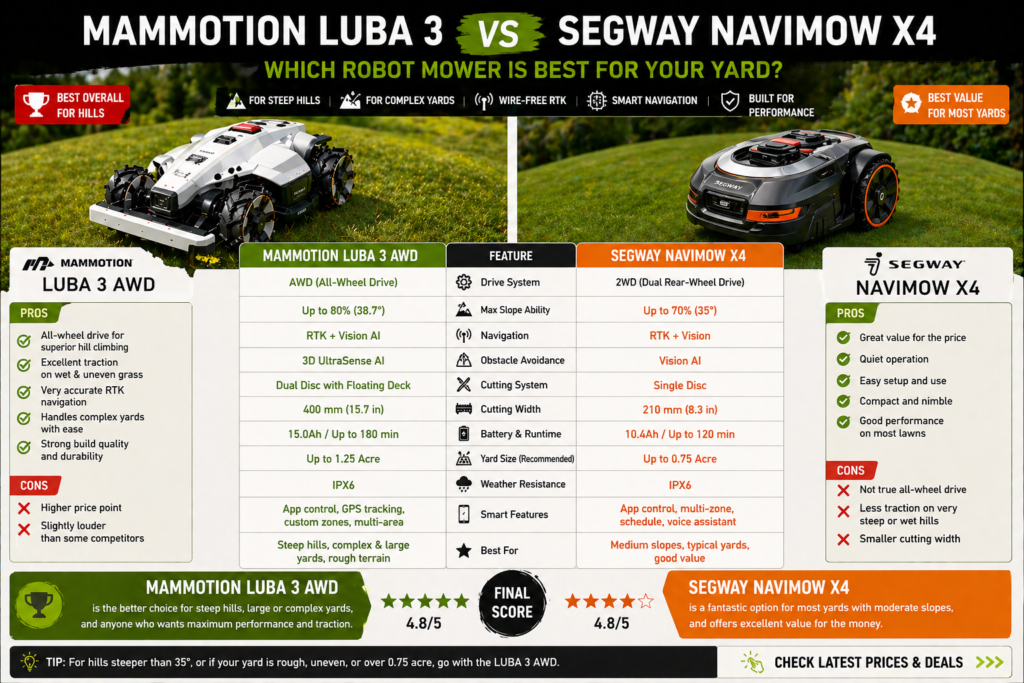
If your weekends are eaten by mowing steep, tree‑filled, or awkward yards, you’re not alone. This detailed comparison — Segway Navimow X4 vs Navimow i Series — is written for busy homeowners and small landscapers who need a reliable, low‑maintenance solution for 0.25–2+ acre properties. I’ll walk you through the real differences that matter on hills: traction, navigation, mapping, safety, maintenance, and total cost of ownership. By the end you’ll know which model is the smarter buy for your terrain and lifestyle.
Quick verdict
- Choose the Segway Navimow X4 if you have steep slopes, large acreage, or a lot of obstacles and want the most capable, heavy‑duty robot mower available.
- Choose the Navimow i Series if you have a smaller to medium yard, want a lower upfront cost, and prefer a lighter, simpler machine that still handles moderate slopes and tree cover.
This article goes beyond specs: you’ll get real‑world tradeoffs, setup tips for hills, and lesser‑covered considerations other blogs miss.
Who this comparison is for
- Homeowners with 0.25–2+ acre yards, slopes, and trees
- Estate managers and small landscapers who want to reduce labor costs
- People comfortable with app‑based smart devices and occasional tech setup
- Buyers who value time savings, safety, and consistent results
How hills change the buying rules
Hills introduce three core problems for robot mowers:
- Traction and torque — wheels slip on steep or wet slopes.
- Navigation stability — GPS drift and canopy interference make mapping unreliable.
- Safety and recovery — a stuck mower on a slope is a hazard and a maintenance headache.
When comparing Segway Navimow X4 vs Navimow i Series, focus on how each model addresses these three issues.
Head‑to‑head: what matters on slopes
Traction and drive system
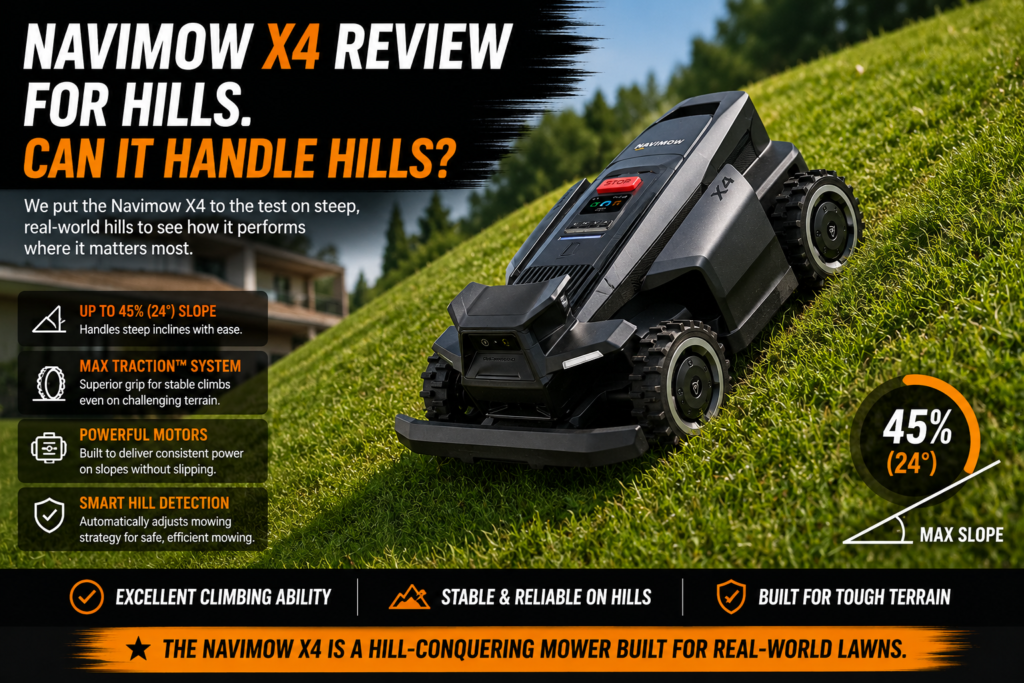
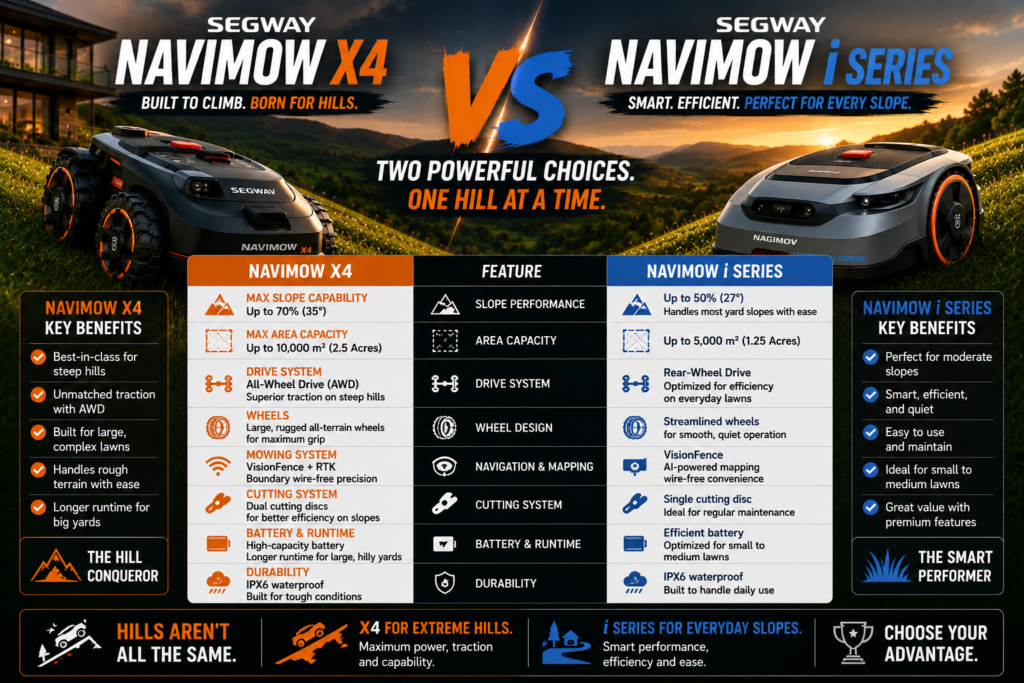
- X4: True all‑wheel drive (AWD) with independent wheel motors and a low‑center‑of‑gravity chassis. AWD gives superior grip on roots, wet grass, and steep pitches.
- i Series: Mostly front‑drive or single‑motor designs in entry models; some i Series variants offer AWD or improved traction but generally less torque than the X4.
Slope capability (realistic expectations)
- X4: Engineered for steep terrain; marketed slope ratings are high and real‑world users report confident climbs on aggressive grades.
- i Series: Handles gentle to moderate slopes well; steep, continuous grades will push it to its limits.
Navigation and mapping
- X4: Uses advanced RTK/vision fusion and automated mapping routines designed for large, complex properties. Better at maintaining position under partial canopy.
- i Series: RTK + vision on many models; excellent for small to medium yards but can be more sensitive to dense canopy and GPS dropouts.
Obstacle handling
- X4: Larger footprint, more robust sensors, and stronger motors let it push through light debris and navigate around trunks and roots.
- i Series: Agile and compact, better for narrow corridors and tight garden beds; may need more manual intervention in obstacle‑heavy zones.
Table 1 — Quick comparison (practical buyer view)
| Attribute | Segway Navimow X4 | Navimow i Series |
|---|---|---|
| Drive | True AWD, independent motors | FWD or AWD variants (model dependent) |
| Best yard size | 0.5–2+ acres | 0.25–1 acre |
| Slope handling | Excellent (steep grades) | Good (gentle–moderate slopes) |
| Navigation | RTK + 360° vision / VSLAM | RTK + vision; some LiDAR variants |
| Obstacle handling | Robust, higher clearance | Agile, compact for tight spaces |
| Setup complexity | Moderate to advanced | Easy to moderate |
| Weight / footprint | Heavier, wider | Lighter, narrower |
| Price range | Premium | Budget to midrange |
Two things most reviews miss (and why they matter)
1. Gate and corridor planning
Large AWD mowers like the X4 are wider and heavier. If your yard has narrow gates or tight corridors, you’ll either need to measure carefully or plan alternate access. Many buyers assume “bigger = better” without checking gate width; that’s a costly mistake.
Actionable tip: Measure every gate and corridor before buying. If your narrowest opening is under the mower’s width plus 6–8 inches for clearance, the i Series may be the only practical choice.
2. Recovery and serviceability on slopes
A mower that can climb is only useful if you can recover it when it gets stuck. The X4’s heavier weight makes manual recovery harder; the i Series is easier to lift and move. Also consider whether local service technicians are available for heavier models.
Actionable tip: Plan a recovery strategy (rope, winch point, or accessible path) and check local service options before purchase.
Table 2 — Technical tradeoffs (deeper look)
| Factor | Why it matters on hills | X4 advantage | i Series advantage |
|---|---|---|---|
| Motor torque | Prevents wheel spin on steep, wet slopes | Higher torque for sustained climbs | Lower torque but efficient for short slopes |
| Center of gravity | Affects tipping risk on side slopes | Low CG reduces tip risk | Lighter, but higher CG on some models |
| Sensor redundancy | Keeps mapping stable under canopy | More sensors and fusion algorithms | Simpler sensor stacks; less redundancy |
| Deck clearance | Avoids catching on roots | Higher clearance on X4 | Lower deck better for manicured lawns |
| Weight | Traction vs recovery difficulty | Better traction; harder to recover | Easier to recover; less traction in mud |
Pros and cons
Segway Navimow X4 — Pros
- Superior slope performance and traction on steep grades.
- Robust navigation for large, complex properties.
- Better obstacle negotiation and higher deck clearance.
- Designed for heavy use — ideal for estate owners and landscapers.
Segway Navimow X4 — Cons
- Higher upfront cost and potentially higher maintenance costs.
- Larger footprint may not fit through narrow gates.
- Heavier to recover if it gets stuck on a slope.
- More complex setup for optimal RTK/vision performance.
Navimow i Series — Pros
- Lower price point and excellent value for small–medium yards.
- Compact and lightweight — easier to store and recover.
- Simple setup for most homeowners.
- Great for tight spaces and narrow corridors.
Navimow i Series — Cons
- Less torque and traction on steep, continuous slopes.
- More sensitive to dense canopy unless you choose LiDAR/advanced variants.
- May require more manual intervention in obstacle‑heavy yards.
Real‑world setup tips for hills (what other articles skip)
- Anchor the base station on firm ground. Soft soil or mulch can tilt the dock and confuse RTK/charging alignment.
- Create gentle approach ramps. If your mower must cross a steep lip or step, build a small ramp to reduce wheel slip.
- Use traction strips in problem zones. Narrow strips of coarse rubber or textured matting help wheels bite on wet grass.
- Map in stages. For large or complex yards, run mapping passes zone by zone rather than one big auto‑map. This reduces mapping errors and speeds up learning.
- Plan recovery points. Install a few accessible “rescue” paths where you can safely retrieve the mower without carrying it uphill.
Maintenance and long‑term costs
- X4: Expect higher initial cost but lower labor if it replaces commercial mowing. Budget for heavier‑duty tires, occasional sensor calibration, and professional service if needed.
- i Series: Lower parts cost and easier DIY maintenance; may need more frequent manual rescues or boundary tweaks in difficult terrain.
Tip: Factor in the value of your time. If a robot mower saves you 3–4 hours every weekend, the payback period shortens quickly — especially for higher‑income homeowners who value time over upfront cost.
Safety and insurance considerations
- Check local regulations and your homeowner’s insurance policy for robotic equipment on slopes. Some insurers require safe storage and documented maintenance for devices operating unsupervised on steep terrain.
- Use geofencing and no‑go zones in the app to keep the mower away from drop‑offs, ponds, or play areas.
Final recommendation: match your yard to the right model
- If your property has sustained steep slopes, exposed roots, and acreage >0.5 acres: Segway Navimow X4 is the safer, more capable choice. It’s engineered for heavy use and will reduce manual labor dramatically.
- If your yard is 0.25–1 acre, has moderate slopes, narrow gates, or you prefer a lower cost of entry: Navimow i Series delivers excellent value and easier handling.
For large, hilly properties (X4): Ready to stop dreading weekend mowing? If your yard has steep slopes, roots, or multi‑acre sections, the Segway Navimow X4 is built to handle it. Click here to compare current prices, warranty options, and local dealers — and get a special setup checklist to make installation painless. [Compare X4 deals now →]
For compact, smart value (i Series): Want a smart mower that fits through your gate and won’t break the bank? The Navimow i Series is perfect for busy homeowners with small to medium yards. Click to see the latest discounts, read verified owner reviews, and grab a free buyer’s guide for slope setup. [Shop Navimow i Series deals →]
Closing: which one will give you your weekends back?
When you weigh Segway Navimow X4 vs Navimow i Series, the decision comes down to terrain, access, and how much of your weekend you want back. The X4 is the heavy lifter — ideal for steep, obstacle‑filled estates. The i Series is the nimble, budget‑friendly option for smaller, complex yards.
Make this the year your lawn mows itself! Explore our top picks and secure the best robot mower for steep slopes through the trusted affiliate links above and below. Your weekends (and your back) will thank you.
Disclaimer: This article contains affiliate links. As an Amazon Associate, I earn from qualifying purchases. Prices fluctuate, but the recommendation logic remains the same. Always check the slope rating before buying.
More Comparisons…
Other Comparisons…

More Reviews…