Table of Contents
Think your yard is too steep, bumpy, or full of trees for a robot mower?
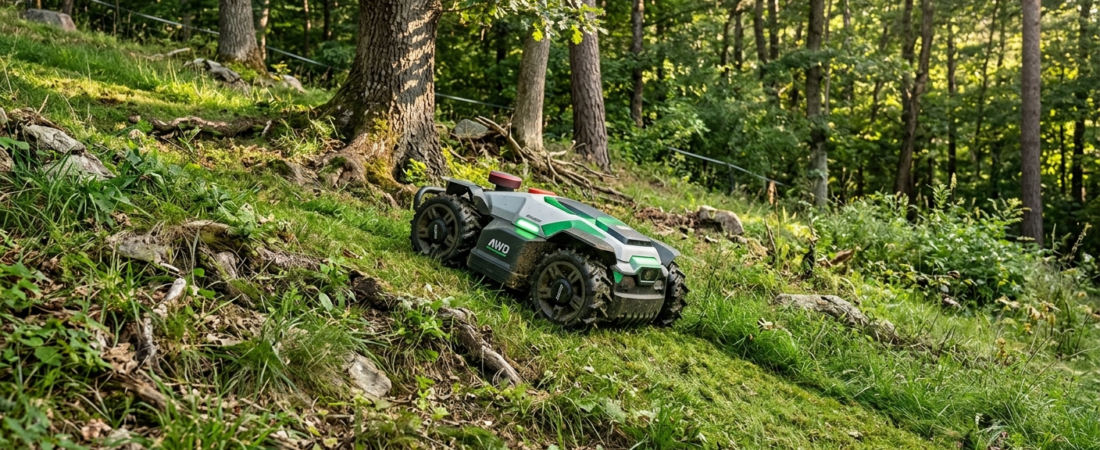
If you’ve spent any time researching automated lawn care, you’ve likely seen the glossy commercials: a sleek little machine gliding over a perfectly flat, emerald-green golf course of a lawn. But your reality is different. You have a steep front yard that makes your shins ache, a backyard hill that feels like a mountaineering expedition, or a wooded yard littered with roots and hidden dips.
Impact-Site-Verification: 11304db1-e3fc-4fcd-8e90-5d5a33479a6cYou’re worried about slipping wheels, missed patches, or—worse—finding your $2,000 investment flipped upside down at the bottom of a ditch. This guide will tell you, with brutal honesty, if a robot mower for sloped yard use will actually work for you.
By the end, you’ll know exactly what type of mower you need, what features are non-negotiable, or if you should skip the tech entirely and stick to your trusty push mower.
Stop! Use this guide before you spend $1,500+ on the wrong mower. Choosing a unit that isn’t rated for your specific incline is the #1 cause of “buyer’s remorse” in the robot mower world.
Is the terrain in your yard compatible with the available Robot Mowers? Find out with our FREE tool.
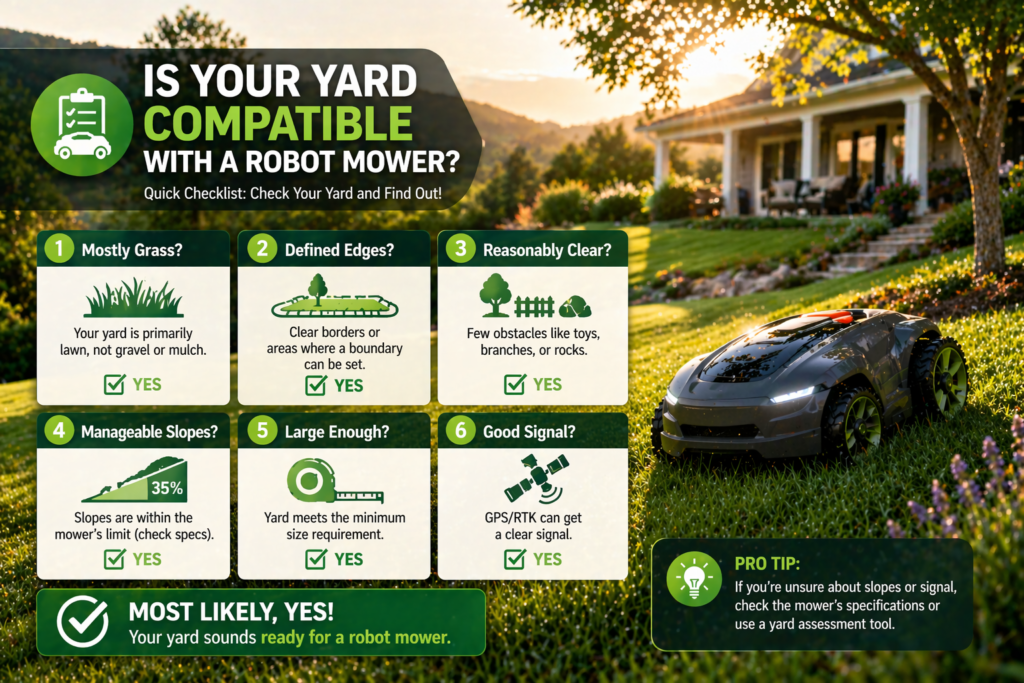
Select the option that best describes each aspect of your yard. Your compatibility score updates instantly as you go.
Quick Yard Reality Check: Pick Your Pain Point
Before we dive into the mechanics, let’s identify your specific “yard profile.” Not all “difficult” yards are difficult in the same way. Click the profile that matches your property to understand your requirements:
- The Mountain Goat: You have a steep front yard or a backyard hill that is dangerous to mow with a traditional tractor.
- The Forest Floor: You have a wooded yard with heavy tree coverage, falling debris, and constant shade.
- The Quarry: You are dealing with rocky terrain or areas where the soil is thin and stones often surface.
- The Off-Roader: You need a robot mower for uneven terrain yard use because of molehills, old stump holes, or “wavy” turf.
- The Obstacle Course: Your yard is beautiful but complex—full of garden beds, low-hanging branches, and tight corners.
The Truth About Robot Mowers on Difficult Yards
Let’s address the elephant in the room: Most robot mowers are designed for suburban flatlands. When you take a standard, entry-level robot and put it on a 35% incline, things go south quickly. Here is when robot mowers fail, and why most manufacturers bury these details in the fine print:
- Slopes Beyond Capability: If a mower is rated for a 20% slope and you put it on a 25% slope, it won’t just “go slower.” It will lose traction, slide sideways (scuffing your grass), and eventually trigger a “tilt sensor” error that shuts the machine down.
- Uneven Ground & “Scalping”: On a bumpy or rough lawn, a mower with a fixed cutting deck will “scalp” the high spots—cutting the grass down to the dirt—while missing the low spots entirely.
- GPS Blind Spots: In a wooded yard, heavy leaf canopies can block the signals for high-end “wire-free” RTK-GPS mowers. If the mower loses its “eyes,” it stops dead in its tracks.
- The Wet Grass Factor: A hill that is mowable when dry becomes a slide when the grass is damp. Without specialized tires or All-Wheel Drive (AWD), the mower becomes a 30-pound projectile.
The takeaway? The mower isn’t the problem—the match is. A robot mower for sloped yard success depends entirely on matching the machine’s drive system to your yard’s specific geometry.
Yard Factor #1: Can a Robot Mower Handle Your Slope?
Slope is the single biggest factor in robot mower pricing and performance. If you have a backyard hill, you cannot afford to guess on the “grade.”
Understanding Slope Percentages
Manufacturers rate mowers in percentages, not degrees. Here is a simple translation:
- 10% – 20% (5.7° – 11.3°): A gentle hill. Almost any reputable robot mower can handle this.
- 35% (19.3°): A noticeable incline. This is the limit for most standard, rear-wheel-drive robots.
- 45% (24.2°): A serious slope. You are now in “Specialist” territory.
- 50% – 70% (26.6° – 35°): Extreme terrain. Only AWD or “Spider” style robots can survive here.
Robot Mower for Steep Front Yard vs. Backyard Hill
If you are looking for a robot mower for steep front yard use, aesthetics matter. You don’t want a mower that leaves “burn marks” from spinning its wheels near the sidewalk.
For a backyard hill, traction is king. These areas often stay damp longer, meaning you need a mower with “Off-Road” wheels—deep treads that can bite into the soil.
Pro Tip: If your yard is over 35%, skip the standard front-wheel or rear-wheel drive models. You need AWD (All-Wheel Drive). AWD units use independent motors on all four wheels, allowing the mower to “climb” rather than “push.”
Take a look at our break down of the best AWD models available today.
Yard Factor #2: Will it Work on Uneven & Bumpy Terrain?
Many homeowners think their yard is “flat,” only to realize it’s actually a series of miniature craters. Finding a robot mower for uneven terrain yard use is about more than just wheels; it’s about the “suspension” of the blade.
Dips, Bumps, and Molehills
When a mower hits a bump, a fixed deck (the housing around the blade) will hit the ground. This causes the motor to stall or the blade to break.
What to Look For:
- Floating Cutting Decks: These decks move up and down independently of the wheels. If the mower hits a hump, the blades lift up to avoid scalping.
- Large Diameter Wheels: Small wheels get stuck in moleholes. Large, “high-clearance” wheels roll right over them.
Deep Dive: [Full Guide: Robot Mowers for Uneven Lawns]
Yard Factor #3: Robot Mower for Rocky Terrain
Let’s be clear: Most robot mowers are NOT built for rocky yards. If your “grass” is actually a mix of weeds and protruding limestone, a standard robot will be destroyed in a month.
However, if you have a robot mower for rocky terrain needs, you can succeed if you follow these rules:
- Pivot Blades vs. Fixed Blades: Choose a mower with small, razor-like pivot blades. If they hit a rock, they “tuck in” rather than shattering or bending the motor shaft.
- High Ground Clearance: You need a machine that sits high enough to pass over a 2-inch rock without bottoming out.
- Brushless Motors: These are more durable and can handle the sudden torque changes when the mower encounters resistance.
Deep Dive: [Full Guide: Robot Mower for Rough Terrain ]
Yard Factor #4: Navigation in Wooded Yards
A robot mower for yard with trees faces two enemies: Navigation Loss and Surface Roots.
The Navigation Trap
Modern “wire-free” mowers use RTK-GPS. They need a clear line of sight to the sky. In a wooded yard, the thick canopy acts like a shield. If you have more than 50% tree cover, you should stick to a boundary wire system. It’s “old school,” but it never loses its signal.
The Root Problem
If you have large oaks or maples with protruding roots, you need a mower with “Ultrasonic Sensors.” This allows the mower to “see” the root and slow down or turn before it gets high-centered.
- Robot mower for wooded yard checklist:
- Ultrasonic obstacle avoidance.
- Boundary wire (if canopy is thick).
- Heavy-duty traction wheels (for leaves/pine needles).
Deep Dive: [Full Guide: Robot Mower for Slopes with Obstacles (Coming Soon)]
Must-Have Features for Difficult Yards
If you are shopping for a robot mower for sloped yard use, do not buy a unit unless it has these four “Hard Terrain” specs:
1. All-Wheel Drive (AWD)
Just like a truck, AWD provides the torque necessary to pull the machine up a hill. Standard mowers “push” from the back; on a slope, the front wheels will lift slightly, losing all steering control. AWD keeps the machine glued to the grass.
2. High Slope Rating (Minimum 35%–45%)
Check the manual—not just the marketing. You want a mower that lists its “Maximum Incline” and its “Maximum Edge Incline” (the slope it can handle near the boundary wire, which is usually lower).
3. Smart Obstacle Avoidance (LiDAR or AI Camera)
On uneven ground, things move. A branch falls, or a new hole appears. A mower with an AI camera can distinguish between “tall grass” (keep mowing) and “a rock” (turn around).
4. Rugged Wheel Kits
Many brands offer “Terrain Kits” or “Spiked Wheels” as an add-on. For a backyard hill, these are mandatory. They look like heavy-duty cleats and prevent the mower from sliding into your flower beds.
Best Robot Mower Types by Yard Condition
| Yard Condition | Recommended Tech | Best Feature to Look For |
| Steep Slopes (>35%) | AWD Electric | Spiked Traction Wheels |
| Uneven / Bumpy | Floating Deck | High Ground Clearance |
| Wooded / Trees | Boundary Wire | Ultrasonic Sensors |
| Rocky / Rough | Pivot Blade System | Brushless Torque Motors |
Best for Steep Slopes: The AWD Powerhouses
If you have a robot mower for steep front yard requirement, look at the Husqvarna 435X AWD or the Mammotion LUBA 2 AWD. These machines are built specifically to climb. They don’t just “handle” hills; they dominate them.
Best for Wooded & Complex Yards
If your yard is a maze of trees and gardens, look at the Worx Landroid series with the “ACS” (Anti-Collision System) module. It uses ultrasonic sensors to navigate around trees without constantly bumping into them.
Cost vs. Reality: Is it Worth It?
A high-end robot mower for sloped yard use will cost you between $1,800 and $5,000.
Is it worth it? Let’s look at the ROI:
- Landscaping Costs: If you pay a crew $60/week for 30 weeks a year, you’re spending $1,800 annually. A robot mower pays for itself in 1.5 to 2 years.
- Health & Safety: Mowing a backyard hill is dangerous. Every year, thousands of injuries occur from slip-and-fall accidents involving traditional mowers on slopes.
- Your Time: For a homeowner with a 0.5-acre difficult yard, you are likely spending 3 hours a week on lawn care. That’s 120 hours a year. What is your time worth per hour?
If your yard is hard to mow, a robot mower isn’t a luxury—it’s leverage. It’s the difference between spending your Saturday morning sweating on a hill and spending it with your family.
Check out our comprehensive look into the ROI of a Robot Mower vs lawn service.
 When You SHOULD NOT Buy a Robot Mower
I promised brutal honesty. Do not buy a robot mower if:
- Your slope is >55%: At this point, you need a specialized remote-controlled industrial mower, or you should consider planting ground cover.
- Your yard is loose gravel: The mower will get stuck constantly and the blades will be ruined in hours.
- You have heavy debris: If your yard is constantly covered in large sticks, pinecones, and walnuts, you’ll be “rescuing” the mower three times a day.
- The “Lawn” is actually a Field: If you have 3-foot tall brush and woody stalks, a robot mower (which is a “maintenance” tool) will stall.
Final Recommendation: So, Will it Work?
Yes, a robot mower for sloped yard use is absolutely possible—if you stop buying the “budget” models designed for flat city lots.
The Decision Tree:
- Check your slope: Is it over 35%? Go AWD.
- Check your sky: Are there heavy trees? Go Boundary Wire.
- Check your turf: Is it bumpy? Go Floating Deck.
- Check your rocks: Are they everywhere? Go High-Clearance + Pivot Blades.
Don’t guess and watch your money slide down a hill. Choose the right mower the first time.
Next Step: Deep Dive Into Your Yard Type
- [Best Robot Mowers for Uneven Lawns]
- [How to Measure your yard slope]
- [The Secret to Navigating Slopes with Obstacles]
Compare our recommended models with our FREE comparison tools.
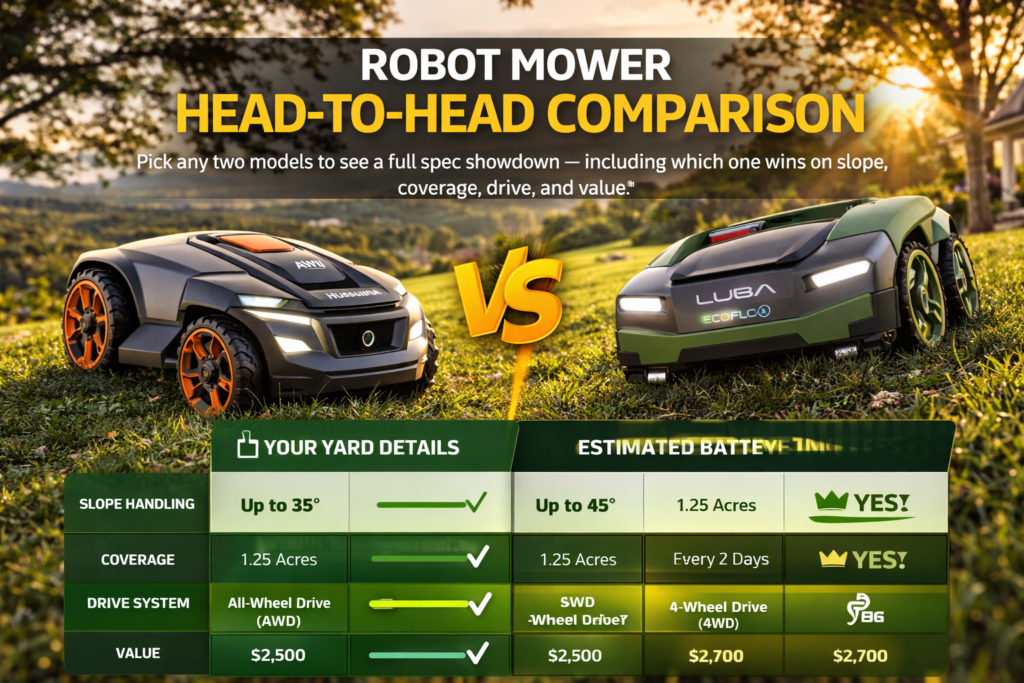
[See the Best AWD Robot Mowers for Slopes]
[Shop Top-Rated Mowers for Large sloped Yards]
[Compare High-Clearance Models for Tough Terrain]