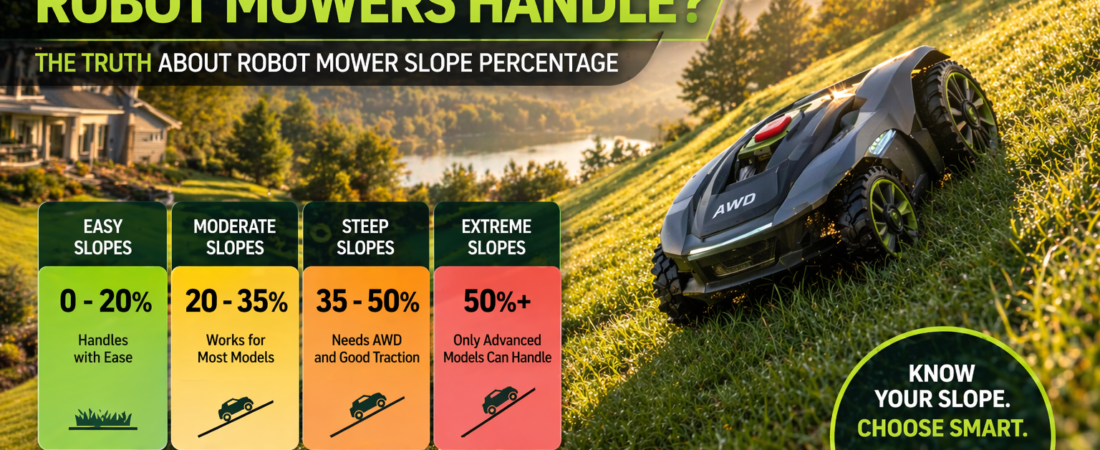
If you’ve spent one too many weekends clinging to a riding mower on a hill, white-knuckling the steering wheel while praying the machine doesn’t tip over, you’ve probably looked into robot mower alternatives. The marketing promises sound tempting: “Handles 45% slopes!” “Conquers 80% grades!” But when you start reading forums or watching real-world tests, you notice some patterns; some owners boast about their mower scaling a steep embankment, while others complain theirs slides right past the boundary wire and into their garden bed.
The disconnect isn’t about dishonest marketing. It’s about a fundamental misunderstanding of how slope is measured and how robot mowers actually behave on uneven terrain. This guide cuts through the BS and gives you the truth about robot mower slope percentage so you can match the right machine to your landscape/yard without wasting money on overkill or undershooting and dealing with a mower that gets stuck every afternoon.
Check out our FREE Yard Slope Calculator
What does your slope actually look like?
Select a slope grade to see a visual diagram, real-world examples, and which robot mowers can handle it.
Slope diagrams are illustrative. Measure your actual grade with a free clinometer app before purchasing.
See our Guide on how to measure the slope of your yard.
The Math You Must Understand: Percentage vs. Degrees
Before you measure a single incline in your yard, you need to understand how the industry talks about steepness. This is one of the biggest source of confusion when shopping for a robot mower.
Slope percentage represents “rise over run.” If your ground rises 1 foot for every 2 horizontal feet, that’s a 50% slope. Degrees, on the other hand, measure the literal angle of the incline. A 45-degree slope is not 45%,it’s a massive 100% grade that would require a winch, not a lawn mower.
Most homeowners think in degrees. Most manufacturers list capabilities in percentages. This gap leads to countless Amazon returns and frustrated Reddit threads.
Here’s the conversion you need to internalize :
| Slope Percentage | Degree Angle | Real-World Feel |
|---|---|---|
| 20% | 11° | Gentle, manageable suburban roll |
| 27% | 15° | Noticeable incline; entry-level challenge |
| 35% | 19° | Difficult for standard 2WD mowers |
| 36% | 20° | Requires high-traction tires or RWD |
| 47% | 25° | Steep; specialized hardware needed |
| 58% | 30° | Severe; AWD strongly recommended |
| 70% | 35° | Extreme; only specialized AWD models |
| 84% | 40° | “Black diamond” terrain |
Pro Tip: Don’t guess. Download a free “Level” or “Clinometer” app on your smartphone. Lay a 4-foot board on the steepest section of your lawn and place your phone on top. The number you see is the degree angle. Convert it using the table above to understand the true robot mower slope percentage your machine will face.
Why 2WD Fails on Hills (and What AWD Actually Solves)
When you’re pushing a traditional mower up a hill, you instinctively lean forward to keep the drive wheels planted. A robot mower can’t do that. Its weight distribution is fixed, and gravity works against it in ways that aren’t obvious until you watch it happen.
Front-Wheel Drive (FWD): The Flat-Lawn Specialist
FWD mowers pull themselves forward. On an incline, the mower’s weight naturally shifts backward, unloading the front drive wheels. The result? Reduced traction and wheel spin. These machines are best reserved for completely flat lawns.
Rear-Wheel Drive (RWD): Better, With a Catch
RWD mowers push from behind. As the mower climbs, weight transfers onto the rear drive wheels, improving grip. This makes RWD the minimum viable option for mild slopes in the 20-30% range. However, there’s a significant flaw: on damp grass or soft soil, RWD units can “scuff” the turf, digging shallow holes as the rear wheels break traction and spin. If robot mower slope percentage ratings on RWD units look decent on paper, remember that those numbers assume dry, firm conditions.
All-Wheel Drive (AWD): The Hill Standard
AWD powers all four wheels independently. If one wheel loses grip on a damp patch or a small depression, the other three continue driving the mower forward. This isn’t just about raw climbing power—it’s about stability and preventing turf damage. Independent testing and user forums consistently confirm that AWD is the gold standard for properties where the robot mower slope percentage exceeds 35% . Modern AWD systems, like those in the Mammotion LUBA series or Segway’s Navimow X4, use real-time electronic controls to adjust power delivery wheel-by-wheel, mimicking the traction control in your car .
Check out our deep dive into the best AWD Robot Mowers

The Boundary Trap: The #1 Reason Mowers “Fail” on Hills
Even the most capable AWD mower has an Achilles’ heel: the edge of your lawn. This is the single most overlooked factor in hill performance, and it’s where the robot mower slope percentage rating on the box becomes nearly meaningless.
Here’s the physics problem: A robot mower navigates by either following a buried boundary wire or using GPS/RTK virtual boundaries. When the mower reaches the bottom of a hill and encounters that boundary, it must stop, reverse, and turn. At that exact moment, gravity is pulling a 30-40 pound machine straight downhill. If the slope is steep, the mower’s momentum—combined with wet grass—can cause it to slide right past the boundary line before the wheels can regain traction.
Manufacturers rarely advertise this limitation, but the technical support pages tell the real story. Robomow explicitly states that perimeter wires laid across slopes steeper than 10% will cause slippage, especially when the grass is wet .
The Practical Rule: If your slope ends at a fence, retaining wall, or road, do not place the boundary at the very edge of the drop. Pull the mowing area back 3 to 5 feet from the steepest section. Let the mower turn around on flatter ground. That remaining strip can be handled with a string trimmer in about 90 seconds, a small price for a mower that doesn’t end up in the neighbor’s yard.
Traction Reality Check: Power Means Nothing Without Grip
High-torque motors generate impressive spec sheets, but motors spin wheels. What matters is whether those wheels actually move the mower forward on your specific terrain.
Wheel Material Is Non-Negotiable
Hard plastic wheels with shallow tread patterns are essentially skates on any incline. Look for heavy-duty rubber wheels with deep, aggressive “cleat” or “paddle” treads. These are standard on AWD models designed for slopes but often absent on entry-level RWD units marketed for “flat to gently rolling” lawns.
Weight Distribution and Chassis Design
Top-tier hill-climbing mowers employ a lower center of gravity and often feature an articulated chassis (a pivot point in the middle of the body). This articulation keeps all four wheels in contact with the ground even when transitioning over a hump or dip. Without it, a rigid chassis can lift a drive wheel off the ground during a transition, causing immediate loss of traction and a “stuck” notification on your phone.
The Wet Grass Penalty
This is the fine print no one reads. Grass that’s damp with morning dew or light rain reduces available traction significantly. As a conservative rule, subtract 10-15% from the manufacturer’s maximum robot mower slope percentage if you intend to run the mower during typical humid mornings or after light showers . A 45% slope mower becomes a 35-38% mower in the real world of dew and occasional damp soil.
Slope Capability Comparison: What Specs Actually Mean
Here’s a practical decision matrix based on actual terrain measurement and real-world owner experiences across forums and reviews:
| Measured Slope (Percentage) | Required Drive System | Real-World Performance Notes |
|---|---|---|
| 0-20% | Standard 2WD (RWD acceptable) | Any quality mower will perform reliably |
| 20-35% | High-traction RWD or AWD | RWD works if tires are aggressive; AWD provides insurance |
| 35-50% | AWD required | This is AWD territory; RWD will scuff and struggle |
| 50-70% | Premium AWD with aggressive tread | Look for models specifically marketed for extreme terrain |
| 70%+ | Specialized AWD (e.g., Mammotion LUBA) | Only a handful of commercial-grade residential units handle this |
Current AWD Models Built for Steep Slopes (2025-2026)
- Mammotion LUBA 3 AWD: Rated for 80% (38.6°) slopes with Tri-Fusion navigation
- Mammotion LUBA mini 2 AWD: 80% rating in a compact chassis for smaller, complex yards
- Segway Navimow X4: AWD with dual suspension; rated for 40° slopes (84% grade)
- Segway Navimow i2 AWD: Rated for 24° slopes (45% grade) with off-road wheels
Common Failure Modes: What Actually Goes Wrong on Hills
Understanding potential failures helps you design your installation correctly from day one.
“Tipping” (The Rollover): Top-heavy mowers with narrow wheelbases can flip backward during aggressive climbs or tip sideways during turns on cross-slopes. This is why AWD units typically feature wider, lower chassis designs.
“High Centering”: On uneven slopes with mounds or depressions, the mower’s belly pan can get hung up on a high spot while the wheels spin freely in the air. This is a function of ground clearance and wheel articulation. If your slope has significant undulations, look for models with generous clearance and pivoting suspension.
“Drifting” in Wire-Free Systems: GPS/RTK-guided mowers (no boundary wire) rely on precise positioning. On a steep side-hill, the mower may naturally drift downhill several inches per pass. Sophisticated software compensates by steering slightly uphill, but lower-end vision-only systems may struggle with this correction. The robot mower slope percentage a wire-free mower can handle is often limited as much by its navigation algorithms as by its drive motors .
Installation Strategies for Sloped Properties
If you’re planning an installation on a challenging slope, these practical steps will prevent most common issues:
- Measure Accurately First: Use that phone app on a board. Know your true degree angle and convert to percentage.
- Pull Boundaries Back from Drop-offs: Leave a 3-5 foot buffer zone at the base of steep slopes ending at hard barriers.
- Run Guide Wires Strategically: On steep lawns, guide wires that lead the mower straight up the fall line (perpendicular to the contour) are more efficient than asking the mower to traverse across the slope.
- Adjust Mowing Schedule: If your slope faces east and stays dewy until 10 AM, schedule mowing for the afternoon when traction is optimal.
- Consider Zone Management: On properties with both flat and steep sections, use multi-zone features to assign different schedules or cutting patterns to the challenging areas.
The Bottom Line
A robot mower’s slope capability is not a single number, it’s more like a system of drive type, tire compound, chassis design, and installation strategy all working together. The robot mower slope percentage on the box is a starting point for comparison, not a guarantee of real-world performance on your specific lawn.
For properties with gentle rolls under 20%, nearly any quality RWD unit will serve you well. For properties where the robot mower slope percentage exceeds 35%, All-Wheel Drive isn’t a luxury, it’s the difference between a machine that works autonomously and one that sends you “stuck” notifications every other day. And for those estate properties with truly aggressive terrain in the 50%+ range, only specialized AWD units with aggressive tread and low centers of gravity will deliver the hands-off freedom you’re investing in.
Measure accurately, choose the right drive system, and install with the boundary trap in mind. Do those three things, and your robot mower will handle the hills while you handle everything else you’d rather be doing on a Saturday afternoon.
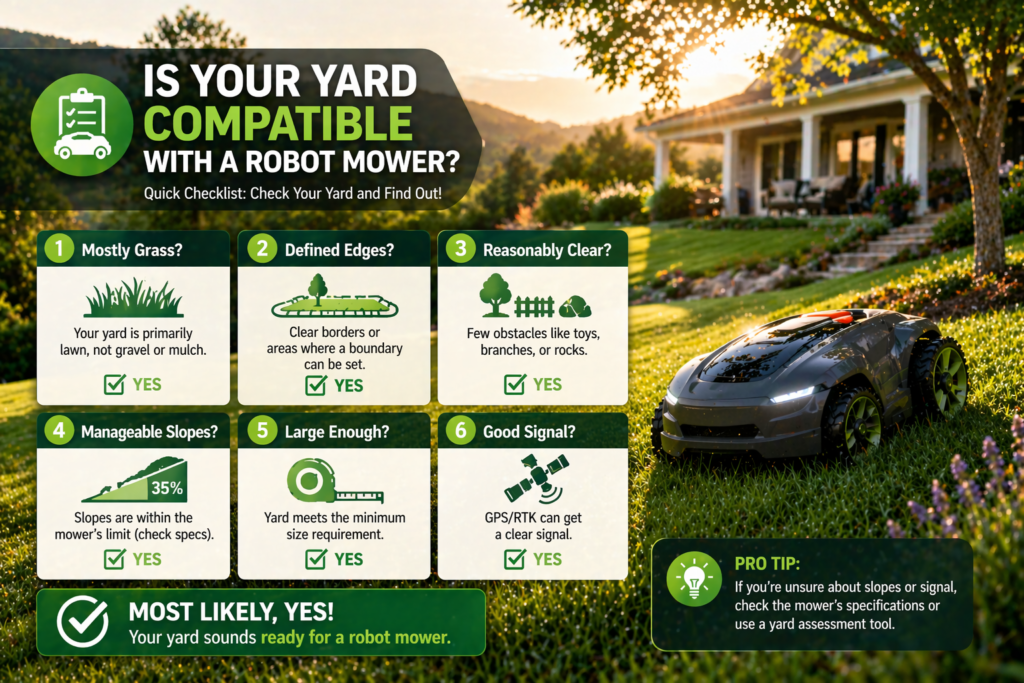
See if the slope of your yard affects your compatibility for a Robot Mower. FREE Tool.
Learn More [Don’t Waste Money: The Definitive Guide to Robot Mower for Sloped Yards with Difficult Terrain]
Learn More [Best Robot Mower for 45 Degree Slopes (2026): Most Mowers Fail Above 35% — These Don’t]
Make this the year your lawn mows itself! Explore our top picks and secure the best robot mower for steep slopes through the trusted affiliate links above and below. Your weekends (and your back) will thank you.
Disclaimer: This article contains affiliate links. As an Amazon Associate, I earn from qualifying purchases. Prices fluctuate, but the recommendation logic remains the same. Always check the slope rating before buying.