You’ve seen the neighbor’s robot mower gliding across their flat, suburban lot like a high-tech vacuum. It looks effortless. But then you look at your yard—the rolling hills, the steep backyard drop-off, and the front bank that makes your shins burn every time you use a push mower. You wonder: Is my yard too steep for robot mowers?
It is the most critical question any hillside property owner can ask before spending $2,000 or more. Manufacturers love to brag about “climbing ability,” but the reality of a steep yard involves more than just raw power. It involves traction, software “tilt” limits, and the physics of momentum.
In this comprehensive guide, we will break down the exact math of slopes, the different drive systems available in 2026, and the “boundary traps” that often make a yard too steep for robot mowers to handle safely.
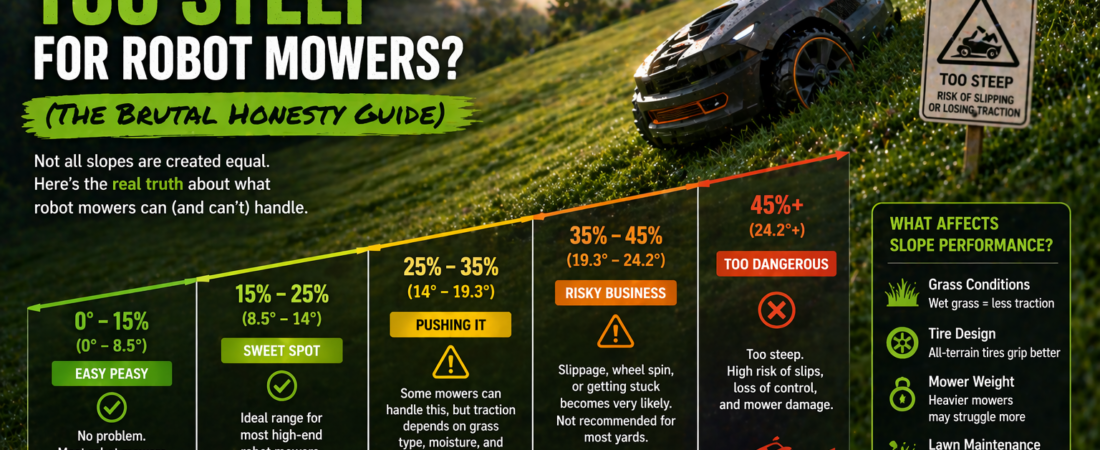
What does your slope actually look like?
Select a slope grade to see a visual diagram, real-world examples, and which robot mowers can handle it.
Slope diagrams are illustrative. Measure your actual grade with a free clinometer app before purchasing.
Understanding the Math: Percentage (%) vs. Degrees (°)
The first hurdle in determining if a yard is too steep for robot mowers is the industry’s obsession with percentages. While most homeowners think in degrees (like a 45-degree angle), manufacturers almost always use “Slope Percentage.”
How to Calculate Your Slope
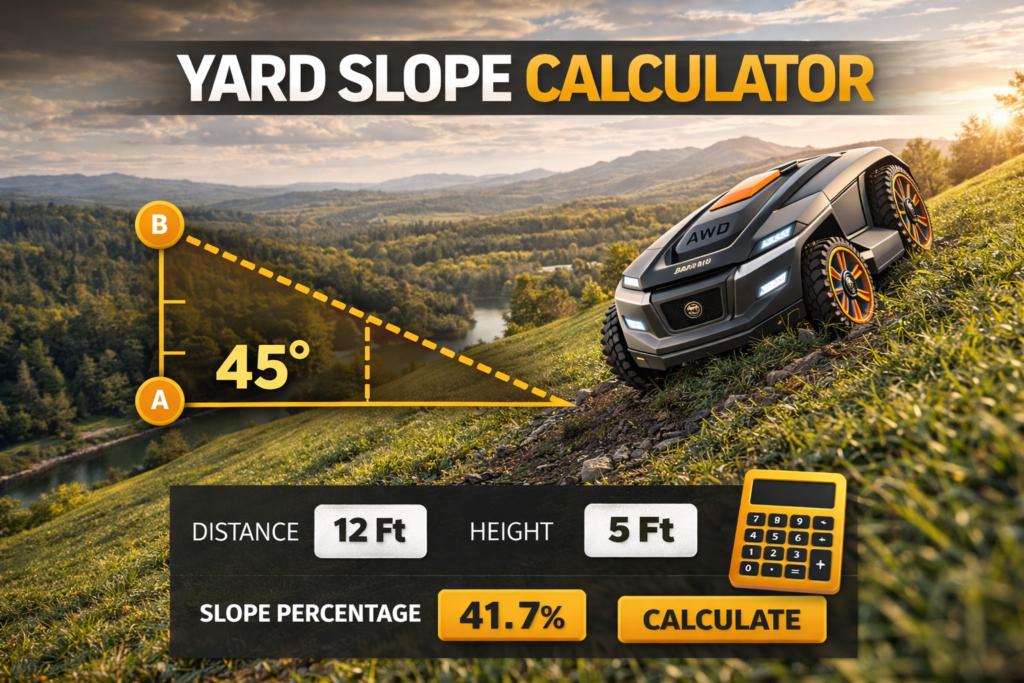
- The Formula: (Rise ÷ Run) x 100 = Slope %.
- The Manual Method: Take a 10-foot (120-inch) board and a level. Lay the board horizontally from the top of the hill. Measure the vertical distance from the end of the board to the ground. If that distance is 3 feet (36 inches), your math is 36 ÷ 120 = 0.3. Multiply by 100, and you have a 30% slope.
The “Cheat Sheet” for Slope Capability
| Category | Slope % | Degrees (Approx) | Mower Type Needed |
| Gentle | 0%–20% | 0°–11° | Standard 2WD / Entry-level |
| Moderate | 20%–35% | 11°–19° | High-torque RWD or 4WD |
| Steep | 35%–50% | 19°–26° | All-Wheel Drive (AWD) |
| Extreme | 50%–80%+ | 26°–38°+ | Specialist Hill Climbers / Articulated |
If your yard falls into the “Extreme” category, you are approaching the limit of current technology. In 2026, anything over 85% (roughly 40°) is generally considered too steep for robot mowers designed for residential use.
Use our yard slope calculator to find your slope and which robot mower fits it.
Drive Systems: The Difference Between Climbing and Sliding
When you are assessing if an incline is too steep for robot mowers, the “Drive System” is your most important spec.
1. Two-Wheel Drive (2WD)
Most budget-friendly robot mowers are rear-wheel drive. They push the machine forward. On a hill, the weight of the mower shifts to the back wheels, which is good for traction. However, the front caster wheels become “light” and can lift off the ground, causing the mower to drift sideways.
- The Limit: Usually 35% slope.
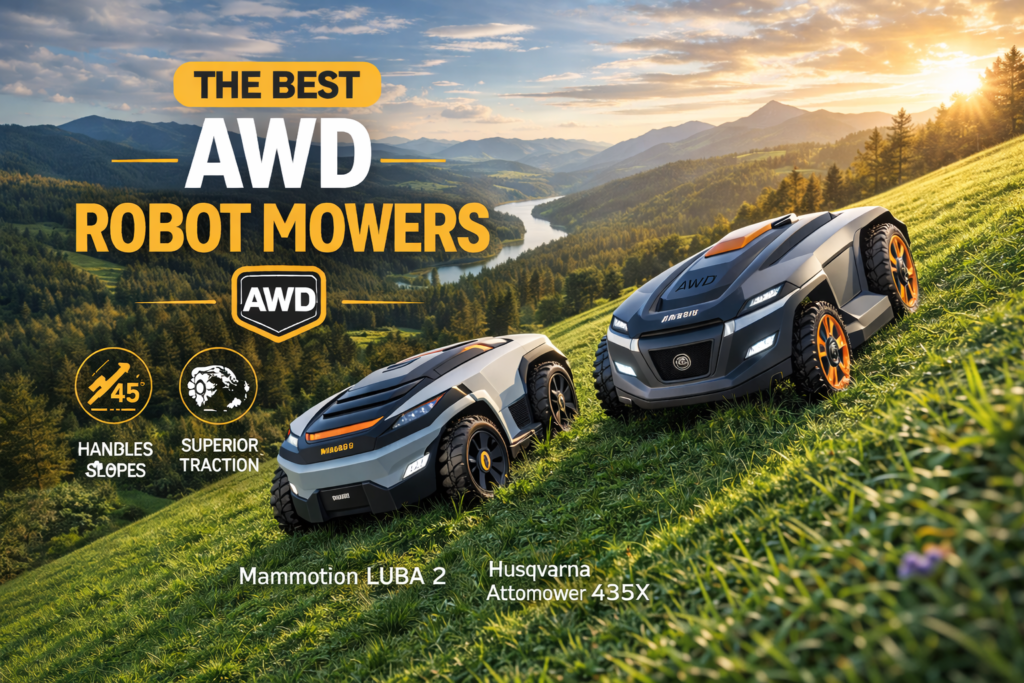
2. All-Wheel Drive (AWD)
AWD models, like those seen in the 2026 Husqvarna or Mammotion lineups, power all four wheels independently. This prevents “wheel spin” because even if one corner hits a damp patch, the other three pull the machine upward.
- The Limit: 70% to 80% slope.
3. Articulated Chassis
The “Articulated” design (where the mower “bends” in the middle) is the ultimate hill-climbing tech. It allows the mower to keep all four wheels glued to the soil even as it transitions from flat ground to a steep incline. Without this, a mower might “high-center,” leaving its wheels spinning in the air.
The “Boundary Wire” Penalty: The Hidden Failure Point
Here is a fact that most marketing brochures won’t tell you: A yard can be “too steep” for a mower even if the mower has the power to climb it.
This is due to the Boundary Stop. Imagine your backyard hill ends at a fence or a road. Your robot mower drives down the hill at full speed. It hits the boundary wire at the bottom. The sensors tell the mower to stop and reverse.
- The Failure: Gravity and momentum pull the 30-pound machine downward. On a steep slope, the tires lock up, but the mower slides right past the boundary wire and into the “No-Go” zone.
- The Safety Lock: Once a mower crosses the wire, it shuts down for safety. You then have to walk down the hill, pick up the machine, and restart it.
The Pro Rule: If your slope is over 15% at the boundary line, it is likely too steep for robot mowers to navigate without a “safety runway.” You need at least 5 feet of level ground at the bottom of the slope to allow the mower to turn safely.
The “Wet Grass” Variable
When researchers analyze why mowers fail, the most common factor isn’t the angle—it’s the weather. A 35% slope might be perfectly fine on a sunny Tuesday, but on a dewy Wednesday morning, that same slope is too steep for robot mowers with standard plastic tires.
- Traction Loss: Wet grass acts as a lubricant. It fills the tread of the wheels, turning them into smooth “slicks.”
- The Fix: In 2026, high-end mowers feature “Rain Sensors.” If it’s too wet, they stay at the dock. If your yard is steep, you must prioritize a mower with a reliable rain sensor to prevent “turf scuffing” (where spinning wheels dig holes in your grass).
Solutions for Yards That Are “Almost” Too Steep
If your yard measurement is right on the edge of being too steep for robot mowers, you don’t necessarily have to give up. There are three common “upgrades” that can shift a yard from the “Impossible” category to the “Manageable” one.
1. Stainless Steel Wheel Spikes
You can now purchase “Crampons” for your mower. These are thin, stainless steel rings with sharp teeth that bolt onto the side of the drive wheels. They bite through the grass and into the soil, providing mechanical grip that rubber cannot provide.
2. Grass Reinforcement Grids
If your mower only slips in one or two specific “turn zones,” you can install plastic grass grids. These are pinned to the ground, and the grass grows through them. They provide a stable, high-friction surface for the mower’s wheels to grip when it needs to execute a turn on an incline.
3. Terrain Kits (Weighted Wheels)
Adding weight to the wheels increases the “Downforce.” Many manufacturers sell official “Terrain Kits” that replace standard wheels with heavier, coarser versions. This lowers the center of gravity and reduces the chance of the mower flipping backward on a climb.
How to Know for Sure: The 4-Step Checklist
Before you click “buy,” run through this final checklist to ensure your property isn’t too steep for robot mowers.
- Measure the Peak: Don’t measure the average slope. Find the single steepest 4-foot section in your yard. If it’s over 50%, you must buy an AWD model.
- Inspect the Transitions: Look for “peaks and valleys.” If the transition from flat to steep is sharp (like a curb or a retaining wall edge), a rigid mower will get stuck. You need a model with high ground clearance.
- Check the Perimeter: Is the boundary wire at the bottom of the hill? If so, is there 5 feet of flat land before the “edge”? If the answer is no, your yard might be too steep for robot mowers to handle without sliding out of bounds.
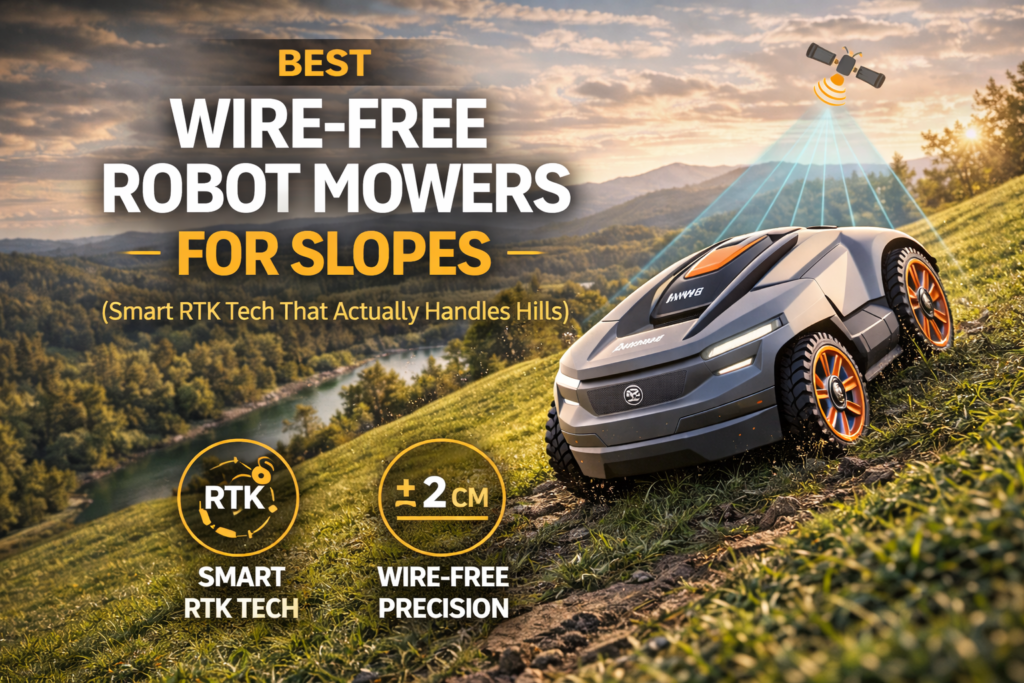
- Satellite Coverage: If your hillside is heavily wooded, an RTK-GPS (wire-free) mower might lose signal. On a hill, losing signal is dangerous because the mower may stop and drift. For wooded hills, boundary wires are still the gold standard for safety.
Is an Extreme Hill Mower Worth the Investment?
Mowers capable of handling 70%+ slopes are usually in the $3,500 to $5,000 price bracket. This is a significant investment. However, for a homeowner with a difficult property, the ROI is often higher than on a flat lot.
- Safety ROI: Mowing a 30-degree slope with a traditional tractor or push mower is a leading cause of residential landscaping accidents. Removing the human from the hill eliminates the risk of slips, falls, or mower rollovers.
- Time ROI: Difficult yards take longer to mow manually. If a robot saves you 3 hours of grueling labor every weekend, it pays for itself in “life hours” within a single season.
- Property Value: A clean, well-manicured hillside significantly improves curb appeal. Most people let their hills go “wild” because they are too hard to mow; a robot keeps them looking like a golf course.
Final Recommendation
If your yard’s steepest point is under 35%, a high-quality RWD mower will likely serve you well. If you are pushing into the 40%–70% range, do not waste money on entry-level tech; it will simply spend its life “stuck” or “trapped.” You need the torque and stability of an AWD system.
Only when a slope exceeds 85% do we truly say it is too steep for robot mowers. At that point, your best bet is a remote-controlled industrial slope mower or converting the area into a low-maintenance ground cover garden.
Don’t guess on your slope. Measure today, choose the right drive system, and finally stop dreading the weekend mow.
Make this the year your lawn mows itself! Explore our top picks and secure the best robot mower for steep slopes through the trusted affiliate links above and below. Your weekends (and your back) will thank you.
Disclaimer: This article contains affiliate links. As an Amazon Associate, I earn from qualifying purchases. Prices fluctuate, but the recommendation logic remains the same. Always check the slope rating before buying.
Ready to Conquer Your Hill?
 [Compare the Top 5 AWD Robot Mowers for Steep Slopes]
- [Shop Stainless Steel Wheel Spikes for Extra Traction]
- [See our Robot Mowers with Tracks that handle extreme terrain]