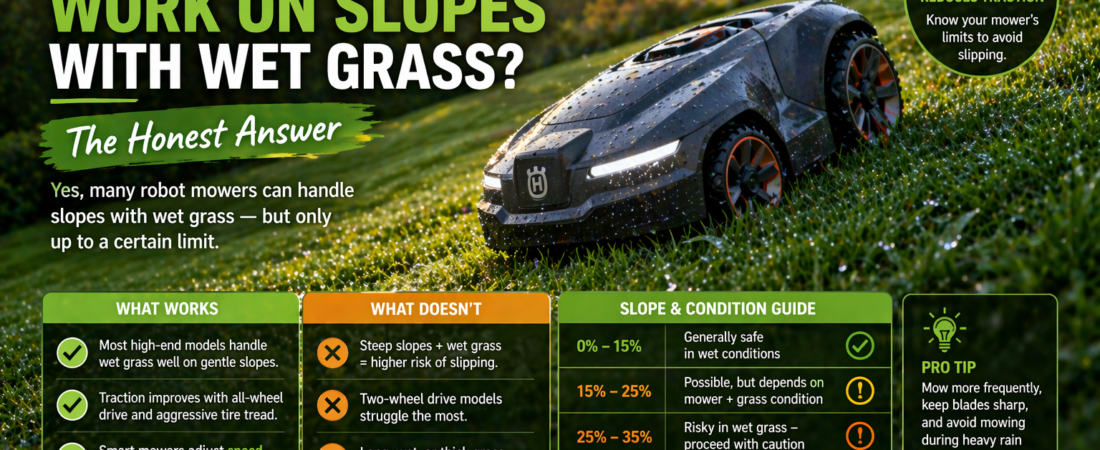
If you own a sloped property in a climate that gets regular rainfall, you already know the frustration. You invest in a robot mower to reclaim your weekends, and then the first wet week of spring reveals something the spec sheet never mentioned — your machine spinning its wheels on the hill, digging holes in the turf, or returning to its dock having covered half the yard. The question isn’t whether robot mowers work in general. The specific question that matters to you is whether robot mowers work on slopes with wet grass, consistently, without destroying the lawn in the process.
The honest answer is yes — under the right conditions, with the right machine, and the right configuration. But the research makes clear that wet grass on a slope is the single most challenging operating condition in the entire category, and most buyers are not adequately prepared for what it demands.
Why Wet Grass and Slopes Are a Compounding Problem
On flat ground, wet grass is a manageable inconvenience. On a slope, it becomes a multiplying failure risk. Moisture reduces the friction between wheel treads and grass, slopes increase the force the wheels need to overcome to maintain position, and together those two variables produce failures that neither would cause alone.
Wet grass, loose soil, and steep inclines can cause wheels to slip. Slippage does not only interrupt mowing sessions. It also damages turf, creates bare patches, and forces the mower to re-cut the same area multiple times. Slippage is more likely on clay soil, new turf, or areas with heavy shade where moisture lingers.
The consequences run deeper than an incomplete mow. Mowing after heavy rain can also create wheel ruts in the soft, wet soil, leading to deep grooves and depressions that can make future mowing more difficult by creating an uneven surface, possibly also further restricting drainage. Husqvarna Ruts on a sloped lawn are particularly damaging because water channels into them, worsening the drainage problem over time.
This is why the question of whether robot mowers work on slopes with wet grass deserves a serious answer rather than a marketing one. The answer changes depending on your slope gradient, your soil type, your machine’s drive system, and how the mower is configured to behave in wet conditions.
What Manufacturer Documentation Actually Confirms
The clearest evidence that this is a known, documented problem comes from the manufacturers themselves. Husqvarna’s official support documentation has a dedicated error code for the exact scenario. The “No Drive” error is triggered when the Automower wheels are spinning but the machine isn’t moving — and one of the listed causes is specifically a slope that is slippery due to wet grass, with the official guidance to let the cutting area dry before resuming.
The boundary wire should not be laid across a slope that is steeper than 10%. There is a risk that the robotic lawnmower will find it difficult to turn there. The mower will then stop and display an error message. The risk is at its greatest in damp weather conditions, as the wheels can slip on the wet grass.
This means even a mower rated for 40 percent slopes can only handle 10 percent at its boundary wire in damp conditions. That is a critical installation constraint that most buyers never encounter until they’ve already installed the machine incorrectly.
If there is a decline directly towards a boundary wire, the slope should be less than 10 degrees to prevent the mower from overrunning and passing the boundary wire due to downhill running speed, especially if raining or cutting in wet slippery conditions.
When a mower on a wet descent loses traction, it doesn’t just stop — it gains speed downhill and can overshoot its boundary entirely, sliding into garden beds, features below the slope, or off the edge of the property.
Take our Quiz to find the Robot Mower that perfectly fits your yard.

The Real Problems — What Users Experience
Wheel Spin and Hole Digging
When the ground is soft after rain or the turf becomes slippery, the wheels can spin. The robot then can’t move forward at the same spot, digs in slightly, or simply stops on a small slope. This problem occurs particularly often on inclines, tight turns, or at the edges of the mowing area. The heavier the robot and the narrower the wheels, the more noticeable it can become.
One forum user described their experience with a Navimow on a sloped Irish property bluntly: the machine had gone from performing well to failing in the wet. With the rain sensor turned off to prioritise keeping grass under control, the result was repeated getting-stuck and hole-digging events. The frustration with a machine that spins long enough to excavate rather than stopping and trying a different direction is one of the most consistent real-world complaints from sloped-property owners in rainy climates.
Uneven Cuts and Clumping
Wet blades tend to bend and stick together, creating an uneven cut. Clumps left behind can smother the lawn and clog your mower. Wet grass bends under the weight of the mower rather than standing upright, so blades are trimmed unevenly. This results in a patchy finish, and doing it repeatedly can weaken grassroots and lead to thin or bare spots across the garden.
On slopes, this problem intensifies because the cutting deck tilts with the terrain, making consistent blade height even harder to maintain in conditions where grass is already lying flat.
Blade Clogging and Mechanical Stress
Wet grass clippings are sticky. On a slope, the mower works harder to maintain position while simultaneously trying to process heavier, clumping cuttings through its blade system. The result is motor strain, more frequent cleaning requirements, and — if the mower is run through repeated wet sessions without maintenance — reduced machine lifespan.
Lawn Disease Spread
This consequence is rarely mentioned in robot mower reviews but is consistently flagged by lawn care professionals. Fresh cuts made on wet blades of grass act as open wounds, making it easier for pathogens to infect your lawn. This is why many lawn care experts recommend waiting until grass is dry before mowing — especially in warm, humid climates where fungal growth is common.
Wet grass is more prone to tearing, which creates an entry point for pathogens. Combined with wet conditions that favour fungal growth, cutting wet grass increases the risk of common diseases like red thread and dollar spot.
On a slope where clippings accumulate at the base after each wet mow, these conditions concentrate. Buyers who configure their mowers to ignore rain sensors and mow through wet conditions often notice deteriorating lawn health in spring — not realising the mowing schedule is the cause.
Not All Wet Conditions Are Equal
One of the most important distinctions the research makes is between different moisture levels — because they require different responses.
Morning Dew
If the grass is only damp from morning dew, wait 30 to 60 minutes after sunrise. Dew dries much faster than rain because the soil underneath is not saturated. For most slopes, morning dew is manageable if the mowing schedule is set to start mid-morning rather than at dawn. Configuring the mower to begin at 10am or 11am eliminates morning dew as a variable entirely on most days.
Light Rain
Most premium robot mowers are designed to resume after light rain, and for mild slopes with good drainage this works reasonably well. The problem arises on steeper grades or clay soil where even light rain creates prolonged wet conditions at the surface.
Heavy Rain and Saturated Ground
After a light shower, drying may take about 3 to 5 hours, but after heavy storms, it is better to wait 24 hours or longer. Mowing too soon can lead to clumping, uneven cuts, and extra strain on your robot mower.
For sloped properties, the relevant test is not when the grass looks dry — it is whether the ground is firm enough to support the mower without compressing into ruts. The practical check: walk the slope, press your heel into the ground. If it leaves a clear impression, the soil is too soft to mow.
Clay soil is the worst-case scenario because it retains moisture far longer than sandy or loam soils. A clay slope can remain functionally saturated for 24 to 48 hours after significant rainfall, meaning the standard rain sensor delay of 2 to 3 hours is dramatically insufficient.
Do Robot Mowers Work on Slopes with Wet Grass? — Buyer Comparison Table
| Condition / Factor | 2WD Robot Mowers | AWD / 4WD Robot Mowers | Tracked Robot Mowers |
|---|---|---|---|
| Wet Grass Traction | Poor | Good | Excellent |
| Performance on Slopes | Fair on mild slopes only | Strong on moderate to steep slopes | Best on steep / extreme slopes |
| Wheel Spin Risk | High | Moderate | Very Low |
| Turf Damage Risk | High in wet conditions | Low to Moderate | Lowest |
| Clay Soil Performance | Poor | Good | Excellent |
| Cross-Slope Stability | Weak | Strong | Excellent |
| Best Slope Range | 0–20% | 20–50% | 35–60%+ |
| Needs Dry Conditions? | Yes | Preferred but flexible | Least dependent |
| Price Range | Lowest | Mid to High | Highest |
| Best Buyer Type | Flat lawn budget buyer | Hilly yard owner | Extreme slope / wet climate owner |
Do Robot Mowers Work on Slopes with Wet Grass? The Drive System Answer
The single most important hardware decision for a sloped property in a rainy climate is the drive system. The evidence across independent testing, user reviews, and manufacturer guidance is consistent.
Two-Wheel Drive
Standard 2WD robot mowers are functionally inappropriate for any sloped property with regular rainfall. Whether front-wheel or rear-wheel driven, they rely on two contact points for all traction — and on wet grass those two points are not enough to prevent spin, slide, and turf damage. If you own a sloped property and live somewhere it rains, a 2WD machine will create the exact problems described above on a recurring basis.
All-Wheel Drive
AWD systems power all wheels, providing balanced traction in all directions, making it ideal for yards with hills, tree roots, drainage dips, or soft soil.
AWD mowers outperform standard models in damp or soft conditions, gripping the turf instead of sliding or carving tracks into your lawn. That’s especially helpful in regions with unpredictable weather, where waiting for the lawn to dry isn’t always realistic.
AWD significantly reduces wet-slope problems but does not eliminate them. On very steep grades or heavily saturated clay, even AWD machines will struggle. The improvement over 2WD is real and significant — but AWD is not a blanket solution for all wet slope conditions.
See our Deep dive on the best AWD Robot Mowers

Tracked Systems
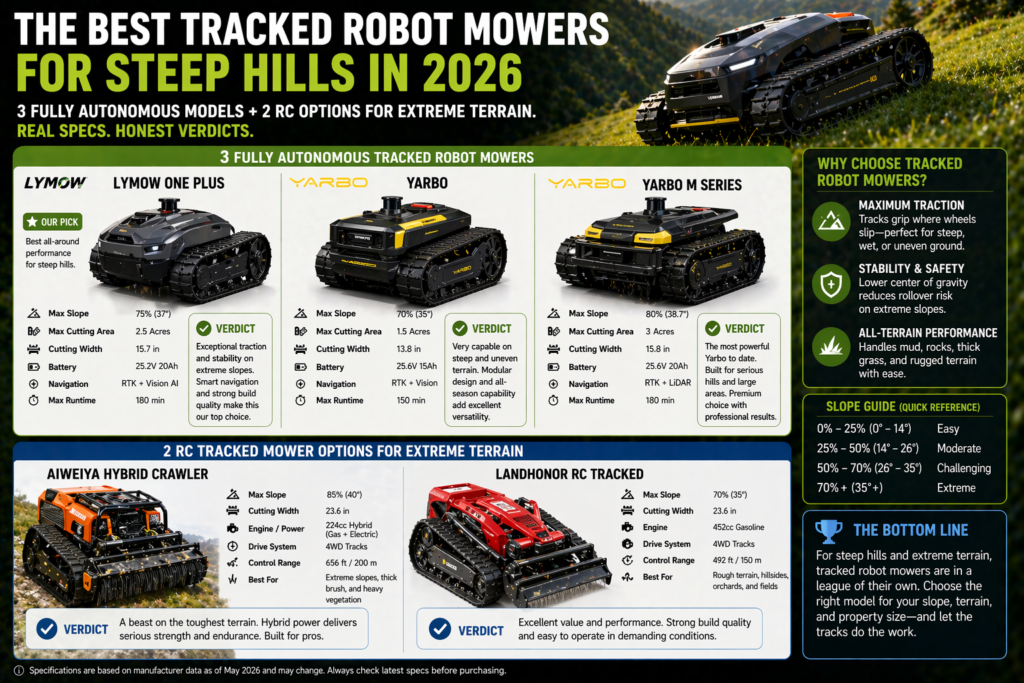
Tracked models distribute weight evenly across the surface, reducing ground pressure by approximately 40% compared to wheeled designs. This prevents turf damage on soft soil and maintains traction where wheels slip — particularly on wet grass, muddy patches, or cross-slope mowing.
The Lymow One Plus uses continuous rubber tank treads, giving it unparalleled traction on wet grass, loose soil, and slopes. Test footage confirms the mower stays planted on 45% slopes without slipping or chewing up the turf.
For the steepest properties in the wettest climates, tracked systems are the only residential machines where wet slope performance is a genuine strength rather than a managed limitation.
Proven Solutions: How to Make Robot Mowers Work on Slopes with Wet Grass
The good news is that robot mowers work on slopes with wet grass reliably when the right configuration choices are made. Here are the solutions with the strongest support from research and real-world experience.
Configure Your Rain Sensor Delay for Your Actual Conditions
Standard delays of 2 to 3 hours are designed for flat lawns with good drainage. For sloped properties, especially those with clay soil, configure delays of at least 6 to 12 hours after heavy rain. For properties where the steepest sections push the mower’s rated capability, 24 hours is not excessive.
The ECOVACS GOAT system, for example, defaults to resuming 3 hours after the rain sensor detects rain has stopped — but this setting can be adjusted in the app. Most premium brands offer similar configurability. Using it correctly for your specific terrain is one of the highest-impact adjustments available.
Schedule Mowing in the Afternoon
Mow grass in the afternoon if possible, when the morning dew has evaporated. For sloped properties this is more important than for flat lawns. An afternoon start time of 10am to 12pm eliminates morning dew as a daily variable and gives light overnight rain several hours to drain from the slope before the mower begins its cycle.
Raise Cutting Height During Wet Seasons
Adjust cutting height: set the cutting height higher during wet conditions to reduce strain on the mower and achieve a more even cut. A higher cut reduces blade resistance through wet grass, reduces deck clogging, and puts less mechanical stress on the drive system at exactly the moment when traction is already compromised.
Clean Wheel Treads After Every Wet Session
Clean wheels have significantly more grip. If grass residues and mud get stuck in the tread, traction quickly worsens. On a sloped property, this is not an occasional maintenance task — it is a regular operational requirement. Five minutes with a soft brush after any session that involves wet or damp grass preserves the traction that makes wet-slope operation viable.
Consider Wheel Spikes for Persistent Problem Areas
If the robot mainly slips on wet grass or slight slopes, wheel spikes can be a sensible solution. Wheel spike accessories are available for several premium robot mowers and provide grip on saturated ground that standard treads cannot achieve. For localised problem sections — the approach to the steepest part of the slope, the clay section near the bottom — spikes address the specific traction deficit where it occurs.
Use No-Go Zones for Extreme Sections in Wet Season
For properties where the steepest sections approach the mower’s rated limit, the cleanest seasonal solution is app-based no-go zones that exclude those sections from the wet-season schedule. The mower handles the lower-gradient areas reliably, and the extreme sections wait for conditions to improve. This is not a failure — it is intelligent terrain management.
Address Drainage if Ruts Are a Recurring Problem
If your yard already shows signs of standing water or deep tire tracks, you may need to address underlying drainage issues. Persistent wet conditions on slopes are often a drainage problem as much as a mowing problem. Aeration, French drains, or improved surface drainage reduce the duration of saturated conditions after rainfall — directly expanding the window in which robot mowers work on slopes with wet grass safely.
Wet Weather Setup Checklist
| Problem | Best Fix |
|---|---|
| Morning dew slipping | Start mower 10am–12pm |
| Heavy rain saturation | Delay mowing 6–24 hrs |
| Clay soil stays wet | Longer delay + drainage fixes |
| Wheels losing grip | Clean tread after each session |
| Slipping on one section | Add wheel spikes |
| Extreme steep zone | Use no-go zone in wet season |
| Clumping grass | Raise cutting height |
Best Robot Mowers for Wet Slopes
| Model | Drive Type | Best For | Wet Slope Verdict |
|---|---|---|---|
| Mammotion LUBA 2 AWD | AWD | Slopes + RTK yards | Excellent |
| Mammotion LUBA 3 AWD | AWD | Larger wet hills | Excellent |
| Sunseeker X7 AWD | AWD | Mid-size hilly lawns | Very Good |
| Mowrator S1 4WD | 4WD | Tough terrain | Very Good |
| Kress EyePilot 4×4 | 4×4 | Steep premium yards | Excellent |
| Lymow One Plus | Tracked | Extreme wet slopes | Best Overall |
Which Models Handle Wet Slopes Best
For slopes in the 25 to 50 percent range with regular rainfall, the Mammotion LUBA 2 or LUBA 3 AWD, the Sunseeker X7 AWD, and the Mowrator S1 4WD all provide meaningfully better wet-slope traction than standard 2WD alternatives. For extreme slopes above 50 percent or properties with clay soil and heavy rainfall, the Kress EyePilot 4×4 adds its hybrid navigation capability to strong 4×4 traction. For anyone asking whether robot mowers work on slopes with wet grass at the steepest end of the residential spectrum — the Lymow One Plus tracked system is the only machine where the answer is an unqualified yes.
In every case, the IPX rating matters. Look for IPX5 as a minimum on any sloped property with regular rainfall — IPX6 if your slope channels significant runoff after storms.
The Bottom Line
Robot mowers work on slopes with wet grass — reliably and consistently — when three things align: the machine has the right drive system for the grade and conditions, the rain sensor and scheduling are configured for the actual terrain rather than the default flat-lawn settings, and basic maintenance like wheel cleaning is kept up between sessions.
Robot mowers work on slopes with wet grass poorly when a 2WD machine is used on any meaningful grade, when standard rain delays are applied to clay or steep terrain, and when the mower is configured to ignore moisture conditions in favour of sticking to a fixed schedule.
The difference between these two outcomes is almost entirely configuration and machine selection — not the technology itself. The technology has reached the point where robot mowers work on slopes with wet grass as part of a normal operating routine. The buyers who achieve that outcome reliably are the ones who approached the purchase and setup with the honesty that wet conditions on a slope demand.
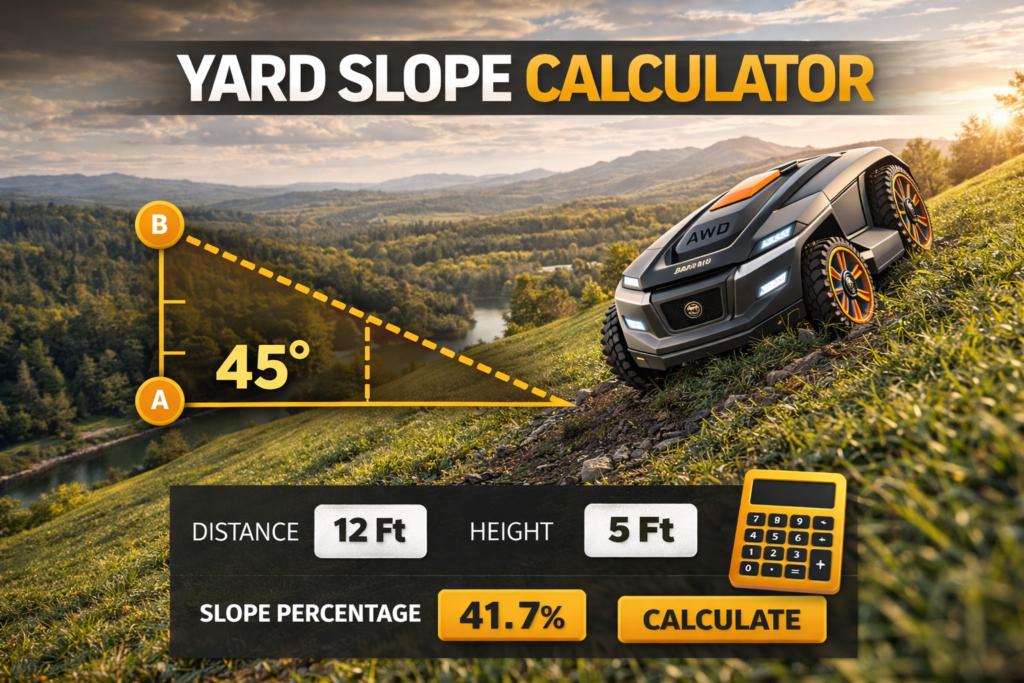
Use our free Slope Calculator to find your exact grade and match to the right mower
 [Compare AWD and tracked robot mowers built for wet and hilly terrain]
[Check current pricing on the Mammotion LUBA 3 AWD ](coming Soon)
[See the Lymow One Plus tracked system — the wet slope specialist](coming soon)
Make this the year your lawn mows itself! Explore our top picks and secure the best robot mower for steep slopes through the trusted affiliate links above and below. Your weekends (and your back) will thank you.
Disclaimer: This article contains affiliate links. As an Amazon Associate, I earn from qualifying purchases. Prices fluctuate, but the recommendation logic remains the same. Always check the slope rating before buying.