Best Robot Mowers for Yards with Trees and Obstacles (2026 Expert Guide)
You didn’t buy a property with majestic oaks and sprawling maples just to spend four hours every Saturday playing “obstacle course” with a heavy zero-turn mower. For the homeowner with a 0.25 to 2+ acre estate, trees represent beauty—but they also represent the ultimate challenge for automation.
Traditional robot mowers of the past decade were notorious for getting stuck on exposed roots, losing their GPS signal under thick canopies, or endlessly “pinballing” off trunks. However, as we move through 2026, the technology has fundamentally shifted. We’ve moved from “dumb” bump-and-turn robots to sophisticated AI-driven machines that see, map, and think.
If you are looking for the best robot mowers for yards with trees, you are no longer limited to the “flat rectangle” models. In this guide, we evaluate the elite performers that utilize LiDAR, AI Vision, and advanced All-Wheel Drive to turn a complex obstacle-heavy yard into a hands-free masterpiece.
How robot mowers navigate
Select a navigation system to see an animated diagram, plain-English breakdown, and what it means for your sloped yard.
Navigation diagrams are illustrative. Real-world performance varies by terrain, tree cover, and environmental conditions.
Navigation diagrams are illustrative. Real-world performance varies by terrain, tree cover, and environmental conditions.
Navigation diagrams are illustrative. Real-world performance varies by terrain, tree cover, and environmental conditions.
Navigation diagrams are illustrative. Real-world performance varies by terrain, tree cover, and environmental conditions.
The Three Challenges of Tree-Heavy Lawns
Before we dive into the models, it is essential to understand why robot mowers for yards with trees require specific hardware. A standard robot mower that works on a football field will fail in a wooded backyard for three reasons:
1. The “Canopy Blackout” (Signal Loss)
Most modern wire-free mowers use RTK-GPS. This requires a clear “line of sight” to satellites. A thick leaf canopy acts like a lead shield. Without a backup navigation system (like Vision or LiDAR), the mower will simply stop and wait for a signal that never comes.
2. The “Root Trap” (Clearance)
Old-growth trees often have exposed surface roots. Low-clearance mowers will high-center on these roots, leaving their wheels spinning in the air. High-end robot mowers for yards with trees need adjustable cutting heights and sophisticated traction control.
3. The “Twig Factor” (Durability)
Trees drop things—twigs, acorns, pinecones, and small branches. While no robot is a woodchipper, the best models for wooded areas feature “swing-back” blades or high-torque motors that can handle minor debris without shattering.
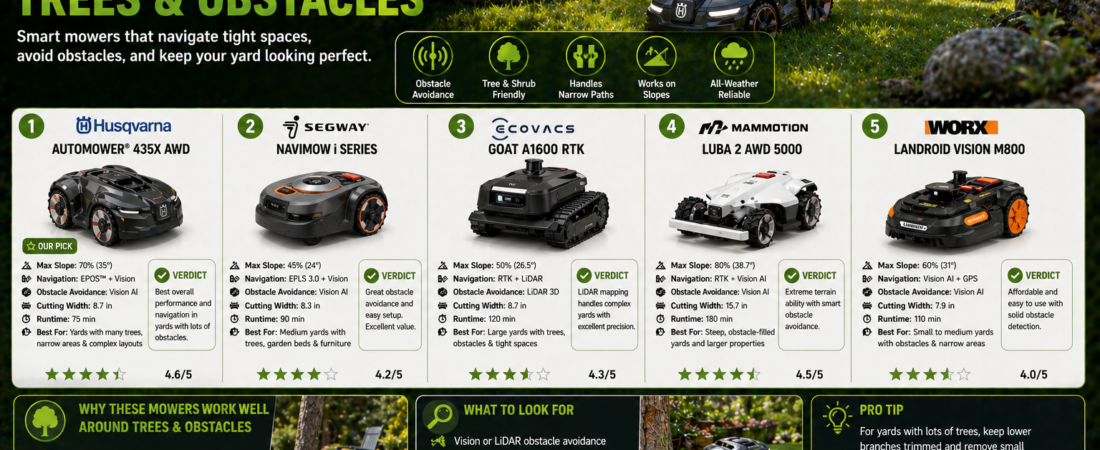
 2026 Comparison: Top Robot Mowers for Yards with Trees
| Model | Navigation Tech | Best Feature for Trees | Max Slope | Obstacle Avoidance |
| Mammotion LUBA 3 AWD | Dual RTK + 3D Vision | All-Wheel Drive Grip | 80% (38°) | AI Binocular Vision |
| Husqvarna 450X NERA | EPOS (GPS) + Radar | Professional Reliability | 50% (26°) | Object Detection Radar |
| Segway Navimow H3000 | EFLS 2.0 (Vision+GPS) | Superior “Under-Canopy” Logic | 45% (24°) | BladeStop & AI Cam |
| Ecofacs GOAT G1-2000 | Visual Beacon System | Works without Satellites | 45% (24°) | 360° LiDAR + Vision |
| Worx Landroid Vision | Pure AI Vision | No Wire, No GPS required | 35% (19°) | Deep Neural Network |
Deep Dive: The 5 Best Robot Mowers for Yards with Trees
1. The “Visionary Climber”: Mammotion LUBA 3 AWD
The LUBA series has become a cult favorite for a reason. The LUBA 3 AWD is specifically engineered for “complex terrain.” It is one of the premier robot mowers for yards with trees because it combines raw power with dual-navigation.
- Why it handles trees: If the RTK-GPS signal drops under a thick oak tree, the LUBA 3 switches to its 3D Binocular Vision. It “sees” the trunks and navigates relative to them until it finds a clear sky again.
- Root Mastery: Its All-Wheel Drive system allows it to climb over exposed roots that would strand a 2WD mower.
Expert Insight: The LUBA 3 is the “Mountain Goat” of the 2026 lineup. If your trees are on a hill, this is your only real choice.
2. The “Reliable Titan”: Husqvarna Automower 450X NERA
Husqvarna pioneered this industry, and the NERA line is their 2026 masterpiece. For large estates, it remains one of the most trusted robot mowers for yards with trees.
- Why it handles trees: It uses a combination of EPOS (wire-free) technology and a built-in Radar Object Detection system. It doesn’t need to “bump” into a tree to know it’s there; it senses the trunk and slows down, gently mowing right up to the edge without damage.
- Debris Handling: The 450X features a heavy-duty cutting disk that is less prone to damage from fallen acorns or small twigs.
3. The “Navigation Specialist”: Segway Navimow H-Series
Segway’s EFLS (Exact Fusion Locating System) 2.0 is specifically designed for yards with signal challenges. It is a top-tier contender for robot mowers for yards with trees because it prioritizes software logic over brute force.
- Why it handles trees: The Navimow H-Series uses a “Vision+GPS” fusion. While other mowers get confused when a signal flickers, the Navimow uses a camera to identify its surroundings. It recognizes grass vs. mulch vs. trunk with startling accuracy.
- App Control: The app allows you to set “No-Go Zones” around delicate flower beds at the base of trees with centimeter precision.
4. The “No-Satellite” King: Ecofacs GOAT G1
The GOAT G1 takes a different approach. It doesn’t rely on satellites. Instead, you place small “beacons” (like mini-lighthouses) around your yard. This makes it one of the most reliable robot mowers for yards with trees where the canopy is 100% closed.
- Why it handles trees: Because it navigates via local beacons, it doesn’t care how thick your leaves are. It maintains its position perfectly even in “deep woods” sections of a property.
- Obstacle Avoidance: Its AIVI 3D technology is borrowed from high-end robot vacuums, allowing it to avoid even small obstacles like garden hoses or stray branches.
5. The “Simple Solution”: Worx Landroid Vision
The Landroid Vision is the “plug-and-play” option for the 2026 season. It is unique among robot mowers for yards with trees because it requires absolutely no boundary wire and no GPS antenna.
- Why it handles trees: It operates entirely on a Neural Network camera. If it sees green, it mows. If it sees a brown trunk or a grey sidewalk, it turns. It is effectively “blind” to signal loss because it doesn’t use satellites.
- Limitations: It struggles more with very complex “multi-zone” yards compared to the LUBA or Husqvarna, but for a single-zone yard with heavy shade, it is incredibly efficient.
Pros and Cons of Robotic Mowing in Wooded Yards
Pros
- Consistent Mulching: Constant mowing turns leaves and organic debris into nitrogen for your trees.
- Time Freedom: Saves an average of 150 hours per year on a 1-acre lot.
- Soil Health: Unlike heavy tractors, robots don’t compact the soil around delicate tree roots.
- Quiet Operation: Mow at 2:00 AM without waking the neighbors or disturbing local wildlife.
Cons
- Maintenance: You must still occasionally clear large branches that the robot cannot handle.
- Initial Setup: Mapping a yard with 30+ trees takes longer than mapping a flat field.
- Cost: High-end robot mowers for yards with trees start at $2,500 and can go up to $6,000.
The “Under-Canopy” Survival Guide: Tips for Success
If you are deploying robot mowers for yards with trees, follow these three rules to ensure your machine doesn’t end up a permanent resident of your mulch pile.
1. The “Root Buffer”
Don’t try to mow over large, protruding roots. Use your app to create a small “No-Go Zone” (island) around the base of the tree. Fill the space with mulch or shade-loving hostas. This protects both the tree and the mower’s blades.
2. High-Lift Blades
In the autumn, trees drop debris. Most robot mowers for yards with trees allow for aftermarket blade upgrades. Look for “high-lift” or “serrated” blades that are better at handling leaf litter without clogging.
3. RTK Antenna Placement
If you choose a GPS-based model, place your reference station (antenna) on the highest point of your roof, not on a fence post. This gives the mower the best chance of “seeing” the signal through gaps in the branches.
Frequently Asked Questions (FAQ)
Q: Will a robot mower hit my trees and damage the bark?
A: Modern robot mowers for yards with trees use LiDAR or Ultrasound to slow down before impact. Most 2026 models won’t even touch the tree; they stop 1-2 inches away and turn.
Q: Can a robot mower handle leaves in the fall?
A: Robots are designed to mulch grass, not bulk leaves. They can handle a light dusting of leaves, but a 3-inch thick layer of maple leaves will stall the motor. You should still plan to mulch or blow heavy leaf falls.
Q: What happens if the robot gets stuck on a root?
A: You will receive a “Stuck” notification on your smartphone. The mower will shut down its blades for safety. You can then use the app’s “Remote Control” feature (on models like the LUBA 3) to drive it off the root manually.
Q: Do I need a special mower for pine needles?
A: Pine needles are notoriously slippery. If you have heavy pine needle coverage, you need robot mowers for yards with trees that feature 4WD or aggressive “terrain” wheels to prevent slipping.
Conclusion: Is Your Yard Ready for 2026?
The dread of the “weekend mow” shouldn’t loom over your property. For the time-poor homeowner, the modern generation of robot mowers for yards with trees represents a shift from a chore to a utility. By choosing a machine with the right navigation—whether it’s the satellite-free Ecofacs GOAT or the all-terrain Mammotion LUBA—you are investing in the freedom to actually enjoy your estate rather than just maintaining it.
Your trees provide the shade; let the robot provide the service.
Ready to find your perfect match?
 [View Today’s Best Deals on AWD Robot Mowers]
- [Take Our Compatibility Yard Quiz to See Which Model Fits You]
- [Download the 2026 Setup Guide for Wooded Properties]
Make this the year your lawn mows itself! Explore our top picks and secure the best robot mower for steep slopes through the trusted affiliate links above and below. Your weekends (and your back) will thank you.
Disclaimer: This article contains affiliate links. As an Amazon Associate, I earn from qualifying purchases. Prices fluctuate, but the recommendation logic remains the same. Always check the slope rating before buying.