Let’s be honest: if you’re reading this, your backyard isn’t a flat, boring suburban rectangle. You have a yard with “character”—which is just a polite way of saying your shins burn every time you mow, and you’ve spent more than one Saturday afternoon worried that your riding mower might actually tip over.
For a long time, the dream of automated lawn care was exactly that—a dream—for those of us with significant inclines. Early robot mowers were great for flat “golf course” lawns, but they would “turtle” (flip over) or “scuff” (spin wheels until the grass died) at the first sign of a 20% grade.
But we are in 2026. The technology has finally caught up to the terrain.
With the advent of All-Wheel Drive (AWD), articulated chassis, and even tank-style tracks, finding Robot Mowers for Sloped Backyard use is no longer about finding “the only one that works,” but about choosing the best specialist for your specific degree of steepness. In this guide, we’re breaking down the top 5 performers that turn “unmowable” hills into manicured assets.
Why Most Mowers Fail Where These 5 Succeed
Before we dive into the list, you need to understand the “Hill Physics” that separate a toy from a tool. Standard mowers fail on slopes because of two things: Traction Loss and Software Panic.
- Traction Loss: Most mowers are 2WD. When they climb, the weight shifts to the rear wheels. If those wheels hit a patch of damp grass or loose soil, they spin. This “burns” your lawn and leaves the mower stuck.
- Software Panic: Most mowers have “Tilt Sensors.” If the mower feels it is leaning too far, it shuts down for safety. The mowers on this list have higher tilt thresholds and sophisticated gyroscopes to keep moving.
When shopping for Robot Mowers for Sloped Backyard properties, you aren’t just buying a mower; you’re buying a climber.
What Does Your Slope Actually Look Like?
Select a slope grade to see a visual diagram, real-world examples, and which robot mowers can handle it.
Slope diagrams are illustrative. Measure your actual grade with a free clinometer app before purchasing.
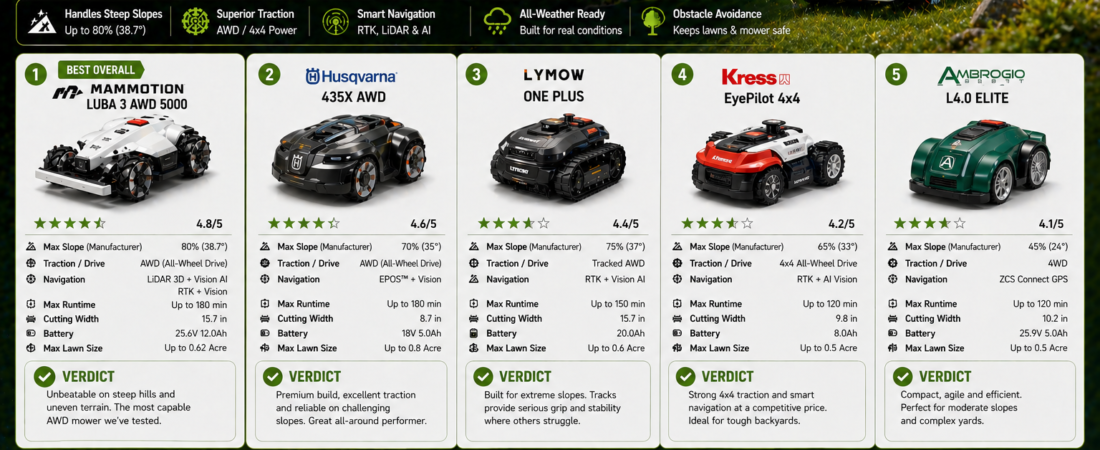
 2026 Comparison: Top 5 Hill Climbers at a Glance
| Model | Max Slope % | Drive System | Navigation | Best For |
| Mammotion LUBA 3 AWD | 80% (38.6°) | All-Wheel Drive | RTK + 3D Vision | Extreme Slopes |
| Husqvarna 435X AWD | 70% (35°) | Articulated AWD | GPS (EPOS) | Estate Luxury |
| Lymow One Plus | 100% (45°) | Tracked (Tank) | RTK + LiDAR | Rough/Wild Terrain |
| Kress EyePilot 4×4 | 84% (40°) | 4×4 Independent | AI-SLAM Vision | High-Tech Precision |
| Ambrogio L4.0 Elite | 65% (33°) | 4WD / Rubber | Boundary Wire | Heavy-Duty Durability |
 1. The “Mountain Goat”: Mammotion LUBA 3 AWD
Mammotion fundamentally changed the market when they introduced the LUBA series. By 2026, the LUBA 3 has refined the “brute force” approach into a sophisticated climbing machine. It is widely considered one of the most capable Robot Mowers for Sloped Backyard use because it doesn’t just “handle” hills; it attacks them.
Why it wins on slopes:
The LUBA 3 uses a true All-Wheel Drive system with high-torque in-wheel motors. While other mowers “push” themselves up a hill, the LUBA pulls and pushes simultaneously. Its “Tri-Fusion” navigation (RTK + LiDAR + Vision) ensures that even if the hill itself blocks the satellite signal, the mower “sees” the terrain and keeps moving.
- Pros:
- Incredible 80% slope capability.
- No boundary wires required.
- Dual-cutting disks for a wider 400mm path.
- Cons:
- Can “scuff” the turf during tight turns on damp hills.
- Customer support is primarily digital/app-based.
Best For: Homeowners with “ski-slope” backyards who want the highest climbing specs for the dollar.
[For Current Pricing on Amazon for Mammotion Luba 3 ]
 2. The “Articulated King”: Husqvarna Automower 435X AWD
Husqvarna is the “Old Guard” of the industry, and the 435X is their masterpiece. If you have a complex estate where a hill meets a flower bed or a narrow passage, this is the gold standard for Robot Mowers for Sloped Backyard performance.
Why it wins on slopes:
The 435X features an articulated chassis. The mower actually “bends” in the middle. This allows all four wheels to remain in contact with the ground at all times, even when traversing uneven “humps” on a hillside. It’s the difference between a rigid truck and a flexible off-road vehicle.
- Pros:
- Unmatched reliability and local dealer support.
- Articulated steering is very gentle on the grass.
- Smart home integration (Google, Alexa, IFTTT) is seamless.
- Cons:
- Very high price point ($5,000+).
- EPOS (wire-free) kit is often sold separately.
Best For: High-income estate owners who value long-term reliability and professional local service.
[For Current Pricing on Amazon for Husqvarna Automower 435X AWD ]
 3. The “Tank”: Lymow One Plus (Tracked System)
Sometimes, wheels aren’t the answer. The Lymow One Plus made waves in late 2025 and 2026 by replacing wheels with a heavy-duty Tracked Tread System. It is the most aggressive option for Robot Mowers for Sloped Backyard properties that aren’t just steep, but “wild.”
Why it wins on slopes:
Physics is simple: more surface area equals more grip. By using tracks, the Lymow distributes its weight over a much larger area. This provides a 100% (45-degree) slope capability. It doesn’t slip on pine needles, wet leaves, or loose soil where wheeled mowers would simply spin their tires.
- Pros:
- Highest slope rating in the residential category (100%).
- Rolls over roots and small branches that stop other mowers.
- Virtually impossible to get “high-centered.”
- Cons:
- The tracked design is less “manicured” looking than a sleek Husqvarna.
- Heavier than wheeled models; can be harder to carry if it does get stuck.
Best For: Semi-rural or “wooded” yards with extreme inclines and rough ground.
[For Current Pricing on Lymow One Plus ]
4. The “Intelligent Climber”: Kress EyePilot 4×4
Kress has emerged as a favorite among landscaping professionals who want to transition to autonomy. The EyePilot 4×4 is their high-performance answer for those seeking Robot Mowers for Sloped Backyard solutions that don’t rely on perfect satellite signals.
Why it wins on slopes:
The EyePilot uses a proprietary “AI-SLAM” camera system. It maps your yard with visual landmarks. On a steep hill, where GPS signals can often “bounce” (multipath error), the EyePilot stays perfectly on track because it “sees” its position relative to your house and trees. Its 4×4 drive system manages torque independently at each wheel to prevent slipping.
- Pros:
- Extraordinary precision near edges and boundaries.
- “Zero-Turn” capability that doesn’t tear the grass.
- Fast-charging technology (60 minutes for a full charge).
- Cons:
- Typically only sold through authorized dealers (professional installation required).
- Newer tech; long-term parts availability is still being established.
Best For: Tech-savvy homeowners who have “signal dead zones” or heavy tree cover on their hills.
[For Current Pricing on The Kress EyePilot 4×4 3 ]
 5. The “Stable Workhorse”: Ambrogio L4.0 Elite 4WD
Ambrogio mowers are built in Italy, a country that knows a thing or two about hills. The L4.0 Elite is a “mechanical-first” machine. While other brands focus on AI and apps, Ambrogio focuses on the ruggedness of the build, making it a staple for Robot Mowers for Sloped Backyard use.
Why it wins on slopes:
It features a pivoting rear axle and high-grip rubber tires (not plastic). It feels “heavier” and more planted than many of its competitors. It’s a “brutal honesty” machine—it might not have the flashiest app, but it will mow a 65% incline in a rainstorm without complaining.
- Pros:
- Incredible build quality (heavy-duty plastics and stainless steel).
- Self-cleaning wheels prevent mud buildup.
- Large battery allows for 4+ hours of continuous hill climbing.
- Cons:
- App interface feels a bit dated compared to Mammotion or Segway.
- Requires a boundary wire (old-school setup).
Best For: Homeowners who want a “tank-like” wheeled mower that will last 10+ years with proper maintenance.
[For Current Pricing on Amazon for Ambrogio L4.0 Elite 4WD ]
What to Look for in Robot Mowers for Sloped Backyard Properties
If you aren’t choosing one from the list above, you need to be an educated shopper. Here are the three “Non-Negotiables” for hill performance:
1. AWD or Tracked Drive
A 2WD mower will work up to a 20-25% grade. Once you hit 35%, you are in “Wheel Spin” territory. If your yard looks like a hill to a human, it’s a mountain to a mower. Only look at AWD or tracked models.
[We go into this a little more indeth in our AWD vs Tracked Robot Mowers for Hills — The Definitive Comparison for Sloped Properties]
[Also check out our reccomendations in 5 Best Tracked Robot Mowers for Steep Hills and Difficult Terrain (2026)]
2. The “Boundary Trap” Awareness
A mower can climb a hill, but it often cannot turn at the bottom of one. If your boundary wire is at the base of a 45% slope, the mower will slide right past it when it tries to stop.
The Pro Tip: Ensure you have at least 5 feet ($1.5m$) of level ground at the bottom of a slope for the mower to safely reverse and turn.
3. Active Torque Management
On a hill, weight shifts. Good Robot Mowers will have sensors that detect when one wheel is spinning faster than the others and shift power to the wheels that have grip. This prevents the “scuffing” that ruins a lawn’s appearance.
The ROI of a Hill-Climbing Robot
Is it worth spending $3,000 to $5,000 on a specialized mower? Consider the “Hidden Costs” of your current hillside:
- Safety: Every year, thousands of people are injured by mowers on slopes. Removing yourself from the incline is a massive safety upgrade.
- Landscaping Fees: Hiring a crew to weed-whack or mow a steep hill is often double the cost of a flat lawn. A robot pays for itself in roughly 2 seasons.
- Your Time: Mowing a difficult hill takes twice as much physical effort and time. If you save 3 hours every Saturday, that’s 120 hours of your life back per year.
[Check our Deep Dive: Robot Mower vs Lawn Service Cost: Is a Robot Mower Worth It in 2026?]
[We compare Robot Mower vs Riding Mower for Hills: Which One Saves You More Time and Money?]
Conclusion: Take Your Weekends Back
Your yard doesn’t have to be a source of stress. In 2026, the market for Robot Mowers for Sloped Backyard use is more diverse and capable than ever before. Whether you need the raw power of the Mammotion LUBA 3, the articulated finesse of the Husqvarna 435X, or the tank-like grip of the Lymow One, there is a solution that will turn your “problem hill” into a manicured masterpiece.
Don’t settle for “good enough” mowers that get stuck. Choose a climber, and finally enjoy your property from the comfort of your patio.
 [See Today’s Prices on Best AWD Robot Mowers]
[Compare All 5 Models on Our Interactive Chart]
[Read: How to Measure Your Slope % Like a Pro]
Disclaimer: As an affiliate, I may earn a commission from purchases made through links in this post. I only recommend products that have been vetted for performance in difficult terrain.