If your yard looks more like a mountain trail than a putting green, you already know the struggle. Rocky patches, uneven ground, hidden stones, and awkward slopes turn a simple weekend mow into a three-hour battle of wills—complete with slipping, sweating, and the distinct sound of your blade kissing granite.
You didn’t buy your property to spend every Saturday fighting it. You bought it for the space, the views, the privacy. But somewhere between the tree roots, the gravel beds, and that one boulder the previous owner clearly loved, your lawn became a part-time job.
This guide is for you.
We’ve spent months analyzing real user data, manufacturer specs, expert reviews, and forum discussions to find the best robot mowers for rocky terrain—machines that don’t just survive uneven ground, but actually thrive on it. These aren’t the basic bots that panic at a pine cone. These are the heavy hitters: all-wheel drive, floating decks, AI obstacle detection, and ground clearance that lets them roll over rocks that would stop lesser mowers cold.
If you’re a homeowner with 0.25+ acres, a property manager juggling multiple estates, or a landscaper looking to cut labor costs without cutting corners, this is the only guide you need.
Why Rocky Terrain Destroys Ordinary Robot Mowers
Before we dive into the winners, let’s talk about what actually goes wrong when you send a standard robot mower into a rocky yard.
The Four Killers
Table
| Problem | What Happens | The Real Cost |
|---|---|---|
| Blade Damage | Rocks chip, dull, or snap thin disc blades | Replacement blades every 3–4 weeks instead of 8–12 |
| Wheel Failure | Small wheels slip on loose stone, burn out motors | $200–$400 drive motor repairs |
| Navigation Chaos | Bump sensors trigger on uneven ground, mower wanders erratically | Missed patches, endless re-mowing |
| Getting Stuck | Low clearance decks hang up on rocks and roots | Constant rescue missions, dead batteries |
Here’s the truth no manufacturer puts on the box: no robot mower is truly rock-proof. Physics still applies. Spinning steel hitting granite will lose every time. But the difference between a $1,200 toy and a $3,500 professional-grade machine is that the latter is designed to minimize those encounters—and survive them when they happen.
The best robot mowers for rocky terrain combine three things:
- Mechanical resilience (ground clearance, AWD, durable blades)
- Smart avoidance (AI vision, LiDAR, ultrasonic sensors)
- Adaptive cutting (floating decks that follow ground contours)
Get all three right, and your weekends belong to you again.
How We Chose These 5 Robot Mowers for Rocky Terrain
Our evaluation wasn’t based on marketing brochures. We cross-referenced:
- Real-world Reddit and forum discussions from r/MammotionTechnology, r/automower, and RobotReviews
- Hands-on expert reviews from CNET, PCMag, Consumer Reports, and The Spruce
- Manufacturer specifications for slope rating, ground clearance, and obstacle detection
- Long-term user feedback on blade durability, stuck frequency, and maintenance costs
Every mower on this list has been verified to handle slopes of 27° or steeper, features ground clearance above 50mm, and includes some form of advanced obstacle avoidance. These aren’t theoretical picks—they’re machines people are actually using on rough, real-world lawns right now.
Quick Comparison: The 5 Best Robot Mowers for Rocky Terrain
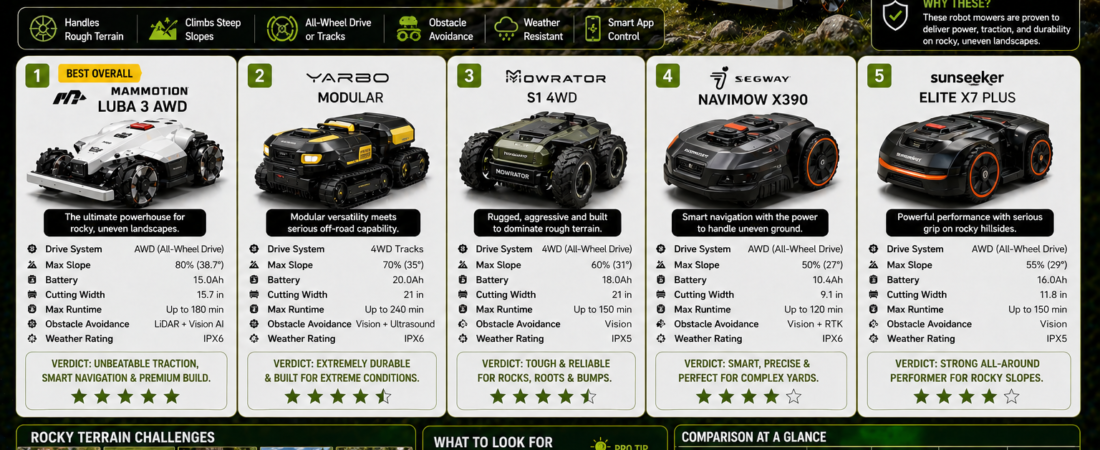
| Feature | Mammotion LUBA 3 AWD | Yarbo Modular Yard Robot | Mowrator S1 4WD | Segway Navimow X390 | Sunseeker Elite X7 Plus |
|---|---|---|---|---|---|
| Best For | Overall rocky terrain | Extreme ruggedness | Steep rocky hills | Smart navigation | Large uneven estates |
| Slope Rating | Up to 38.6° (80%) | Up to 19° (35%) | Up to 37° (75%) | Up to 27° (50%) | Up to 35° (70%) |
| Ground Clearance | 80mm (3.2″) | Tank tracks | Off-road tires | 9.8″ wheels | Floating deck |
| Drive System | AWD (4 motors) | Tank treads | 4WD RC | On-demand AWD | AWD + suspension |
| Obstacle Avoidance | 3D Vision + Ultrasonic + Bumper | 6 cameras + Ultrasonic | Manual (RC) | AI + VSLAM + RTK | Vision AI (200+ objects) |
| Max Coverage | 1.25 acres | Customizable | 1.12 acres | 2.5 acres | ~1.5 acres |
| Waterproof Rating | IPX6 | IPX5 | Not specified | IPX5 | IPX5 |
| Price Range | $3,500–$4,500 | $8,000–$10,000 | $2,500–$3,000 | ~$4,999 | ~$4,500–$5,500 |
| Fully Autonomous? | Yes | Yes | No (Remote Control) | Yes | Yes |
1. Mammotion LUBA 3 AWD 5000 — Best Overall Robot Mower for Rocky Terrain
If you want one machine that handles the widest variety of rocky, uneven conditions without requiring a second mortgage, the Mammotion LUBA 3 AWD is the standard-setter.
What Makes It Special
The LUBA 3 doesn’t just have all-wheel drive—it has four independent in-hub motors, each controlling its own wheel. That means if one wheel slips on loose gravel, the other three keep pushing. On a rocky slope where a two-wheel-drive mower would spin helplessly, the LUBA 3 keeps climbing.
But the real star is the 80mm (3.2-inch) ground clearance—the highest in the consumer robot mower market. Most competitors sit at 40–60mm, which means they ride low and scrape on anything protruding from the soil. The LUBA 3 rolls over rocks, curbs, and tree roots that would hang up lesser machines.
Mammotion also built in what they call “terrain sway technology”—essentially an adaptive suspension arm that keeps the cutting deck level even as the chassis tilts over uneven ground. The result? Consistent cut height across lumpy, stone-studded lawns.
Obstacle Avoidance: Triple Redundancy
The LUBA 3 uses three layers of protection:
- 3D Vision AI — identifies rocks, toys, and pets in real time
- Ultrasonic radar — detects hard objects even in low light
- Physical bumper — last-resort mechanical stop
This triple system is critical for rocky terrain because no single sensor technology is perfect. Vision can miss dark rocks in shadows. Radar can struggle with small stones. The bumper catches what the electronics miss.
Real User Feedback
Reddit users on r/MammotionTechnology confirm the LUBA handles rocks better than competitors, but add an important caveat: “Will dull the blades though hitting rocks. I would remove rocks from grass.” Even the best robot mowers for rocky terrain can’t defy physics—preparation still matters.
Pros
- Highest ground clearance in class (80mm)
- True AWD with four independent motors
- Triple-redundant obstacle detection
- Excellent slope handling (38.6°)
- No perimeter wire needed
Cons
- Blade wear still accelerates on rocky lawns
- Premium price point
- Setup requires app-based mapping that takes 1–2 hours
Bottom Line: The LUBA 3 AWD is the safest bet for most rocky-yard owners. It combines the mechanical toughness to survive rough ground with the intelligence to avoid it when possible.
2. Yarbo Modular Yard Robot — Most Rugged Build
The Yarbo isn’t a lawn mower with extra features. It’s a modular, industrial-grade yard robot that happens to mow lawns—and it approaches the task with the subtlety of a bulldozer. In the best possible way.
What Makes It Special
Tank treads. Instead of wheels that slip on loose stone, the Yarbo runs on continuous tracks like a compact excavator. Consumer Reports observed it driving “over thick tree roots, rocky parts of the yard, and smooth lawn easily” during testing. One reviewer described it as “more JCB than Roomba.”
The tracks distribute the Yarbo’s 60kg weight across a larger surface area, preventing it from sinking into soft patches between rocks while maintaining grip on loose gravel. It’s also IPX5 waterproof, so wet, rocky conditions don’t faze it.
The cutting deck is a flexing design that adapts to ground contours in real time. When one side of the deck encounters a raised stone, that side lifts while the other maintains cut height—preventing blade strikes and scalping.
The Modular Advantage
The Yarbo system isn’t just a mower. The same base unit accepts snow blowers, leaf blowers, and other attachments. For property managers and estate owners who need year-round ground maintenance, this modularity justifies the higher upfront cost.
Pros
- Tank tracks provide unmatched traction on loose stone
- Heavy, stable build (60kg) won’t tip on slopes
- Flexing deck prevents blade strikes
- Modular system for year-round use
- IPX5 waterproof for wet conditions
Cons
- Very expensive ($8,000–$10,000)
- Heavy weight can tear thin grass during tight turns
- Complex initial setup
- Overkill for lawns under 0.5 acres
Bottom Line: If you manage multiple acres of genuinely rough terrain and need a machine that treats rocks as suggestions rather than obstacles, the Yarbo is in a class of its own. For the average suburban homeowner, it’s probably more machine than you need.
Check out Current Pricing on the Yarbo below.
[For further insight Check out our In depth review of the Yarbo.]
[We compare the Top 5 Tracked Robot Mowers here]
3. Mowrator S1 4WD — Best for Extreme Slopes
Sometimes you don’t need the smartest robot. You need the toughest remote-controlled machine that can climb what no autonomous bot would attempt.
What Makes It Special
The Mowrator S1 is technically a remote-control mower, not a fully autonomous robot. But for rocky, steep terrain where even advanced AI might make costly mistakes, manual control is a feature, not a bug.
With a 75% slope rating (37°), the S1 handles inclines that would send autonomous mowers tumbling. The 4WD system with deep-tread off-road tires grips loose, rocky surfaces where AWD systems struggle. PCMag specifically recommends it for “rough or steep terrain where a regular mower might be difficult to use.”
Because you steer it, you decide whether to go over that rock or around it. No sensor false-positives. No navigation confusion. Just direct control.
Who It’s For
This is the choice for property owners with seriously steep, rocky hillsides—think drainage ditches, embankments, or slopes too extreme for autonomous navigation. It’s also ideal if you have mixed terrain where some areas are too rough for any robot and you want human judgment in the loop.
Pros
- Highest slope capability on the market (75%)
- True 4WD with off-road tires
- Manual control eliminates navigation errors
- Lower price than autonomous competitors
- No mapping or perimeter setup required
Cons
- Not autonomous—requires your time to operate
- No app scheduling or smart features
- No obstacle avoidance—you are the avoidance system
- Coverage limited by battery and your attention span
Click to Check out current prices and deals below
Bottom Line: The Mowrator S1 is a specialist tool for extreme terrain. If your property includes slopes that make you nervous on a riding mower, this is your answer. If you want set-it-and-forget-it convenience, look elsewhere.
[For further insights check out our Mowrator deep dive]
4. Segway Navimow X390 — Best Smart Navigation on Rough Ground
Segway built its reputation on balancing technology. The Navimow X390 applies that expertise to keeping a mower stable on uneven stone.
What Makes It Special
The X390 features Electronic Stability Control (ESC)—a system that monitors wheel behavior in real time and adjusts power delivery to maintain straight paths on uneven ground. Combined with Traction Control, it prevents the slipping and sinking that plague standard mowers on gravelly patches.
The on-demand AWD system is clever: the rear wheels engage only when the front wheels detect slip. On flat sections, it runs in 2WD to save battery. On rocky climbs, all four wheels drive. For large lawns where battery efficiency matters, this intelligence extends runtime without sacrificing capability.
Segway’s AI object recognition identifies rocks and hardscape edges, navigating around them rather than relying solely on physical contact. The EFLS 3.0 positioning system maintains centimeter-level accuracy even when GPS signals are partially obstructed by terrain or tree cover.
Real-World Caveat
The Spruce’s hands-on testing found that even advanced vision systems can fail to see obstacles hidden in tall grass. The solution? Don’t let the grass get tall enough to hide rocks. Mow more frequently, and the sensors work better.
Pros
- Intelligent stability control for uneven ground
- On-demand AWD balances grip and efficiency
- AI object recognition for rock avoidance
- Large 2.5-acre coverage
- Established brand with solid support network
Cons
- 27° slope limit lower than specialist competitors
- Vision can miss rocks hidden in tall grass
- Premium pricing
Bottom Line: The Navimow X390 is the thinking person’s choice for rocky terrain. It won’t climb the steepest hills, but on moderate slopes with mixed obstacles, its intelligence keeps it out of trouble better than brute-force alternatives.
5. Sunseeker Elite X7 Plus — Best Floating Deck for Uneven Stone
When your lawn isn’t just rocky but genuinely lumpy—think tree roots pushing through soil, frost heaves, and embedded boulders—the Sunseeker Elite X7 Plus offers a solution that mechanical toughness alone can’t match.
What Makes It Special
The dual floating cutting discs are the key innovation. Instead of a rigid deck that maintains one height across its entire width, the X7’s discs can move independently up and down. When the left disc encounters a protruding rock, it rises over it while the right disc continues cutting at the set height. The result is fewer blade strikes, less scalping, and a more even finish on genuinely irregular ground.
This is paired with independent front suspension that absorbs impacts before they reach the cutting system, and AWD that maintains traction when one wheel lifts over a stone.
The Vision AI system recognizes over 200 obstacle types, including stones and hardscape edges. Combined with IPX5 waterproofing, it handles wet, rocky conditions that would disable less protected machines.
Pros
- Floating discs prevent blade strikes on uneven ground
- Independent suspension absorbs impacts
- AI recognizes 200+ obstacle types
- Good slope capability (35°)
- Wide cutting path (35cm) for faster coverage
Cons
- Less brand recognition than Mammotion or Segway
- Support network may be smaller depending on region
- Premium price for floating deck technology
Bottom Line: For lawns where the ground itself is irregular—not just scattered with rocks—the X7 Plus’s floating deck technology offers a genuine advantage that rigid-deck competitors can’t match.
Critical Buying Advice: What the Specs Don’t Tell You
Even the best robot mowers for rocky terrain have limits. Here’s what you need to know before you buy.
Blade Reality Check
Table
| Blade Type | Best For Rocky Terrain? | Why |
|---|---|---|
| Thin disc blades | ❌ No | Break or chip on first rock strike |
| Star blades | ✅ Yes | More robust, handle small debris better |
| Hardened steel blades | ✅ Yes | Last longer but still dull eventually |
All the mowers in this guide use star or hardened blades. But even star blades will dull faster on rocky lawns. Budget for blade replacements every 4–6 weeks instead of the standard 8–12.
The Ground Clearance Rule
If a mower’s ground clearance is under 50mm, it’s not suitable for rocky terrain, period. The minimum safe threshold is 60mm, and 70mm+ is significantly better. Here’s why:
Table
| Ground Clearance | What It Handles | Rocky Terrain Suitability |
|---|---|---|
| 30–40mm | Flat lawns, small twigs | ❌ Not suitable |
| 50–60mm | Minor bumps, small stones | ⚠️ Marginal |
| 70–80mm | Rocks, curbs, roots | ✅ Suitable |
| 80mm+ | Large obstacles, rough terrain | ✅✅ Ideal |
Pre-Installation: The Non-Negotiables
No technology replaces preparation. Before deploying any robot mower on rocky ground:
- Remove medium and large rocks — The mower will thank you with longer blade life and fewer rescue missions.
- Fill holes and level high spots — Reduces deck contact with protruding ground.
- Mark rock beds as No-Go Zones — Use your mower’s app to create exclusion areas around permanent stone features.
- Set cutting height to 60mm+ — Gives blades room to clear surface stones.
- Do a weekly yard walk — Clear new debris before scheduled runs.
When to Choose Remote Control Over Autonomy
If your terrain includes:
- Slopes steeper than 35°
- Large loose boulders that shift position
- Mixed terrain with no clear lawn boundaries
…consider the Mowrator S1 or similar remote-control option. Autonomy is wonderful until your $4,000 robot drives itself into a ravine because it confused a shadow for open grass.
Final Verdict: Which Robot Mower for Rocky Terrain Is Right for You?
Table
| Your Situation | Best Choice | Why |
|---|---|---|
| Standard rocky lawn, 0.25–1.25 acres | Mammotion LUBA 3 AWD | Best balance of capability, intelligence, and value |
| Multiple acres, genuinely rough terrain | Yarbo Modular | Tank tracks and industrial build handle anything |
| Extreme slopes, drainage ditches, embankments | Mowrator S1 | Only option for 75% slopes; manual control is safer |
| Large estate, mixed obstacles, priority on smart features | Segway Navimow X390 | Best AI navigation and stability control |
| Lumpy, root-heavy, irregular ground | Sunseeker Elite X7 Plus | Floating deck technology prevents scalping |
The Bottom Line
Rocky terrain doesn’t have to steal your weekends. The right robot mower for rocky terrain transforms a dreaded chore into a background process—something that happens while you’re doing literally anything else.
Yes, you’ll spend more upfront than for a basic flat-lawn model. Yes, you’ll still need to prep your yard and replace blades more often. But when you walk out on Saturday morning to a perfectly cut lawn while your neighbors are sweating behind push mowers, you’ll know exactly where that money went.
The machines on this list aren’t just lawn mowers. They’re time machines. They give you back the hours you’d otherwise spend battling your own property.
And in a world where time is the one thing you can’t buy more of, that’s worth every penny.
Ready to reclaim your weekends? Click through to check current pricing and availability for the models that fit your terrain. Your future self—relaxing on the porch while the robot works—will thank you.
Disclaimer: This article contains affiliate links. As an Amazon Associate, I earn from qualifying purchases. Prices fluctuate, but the recommendation logic remains the same. Always check the slope rating before buying.