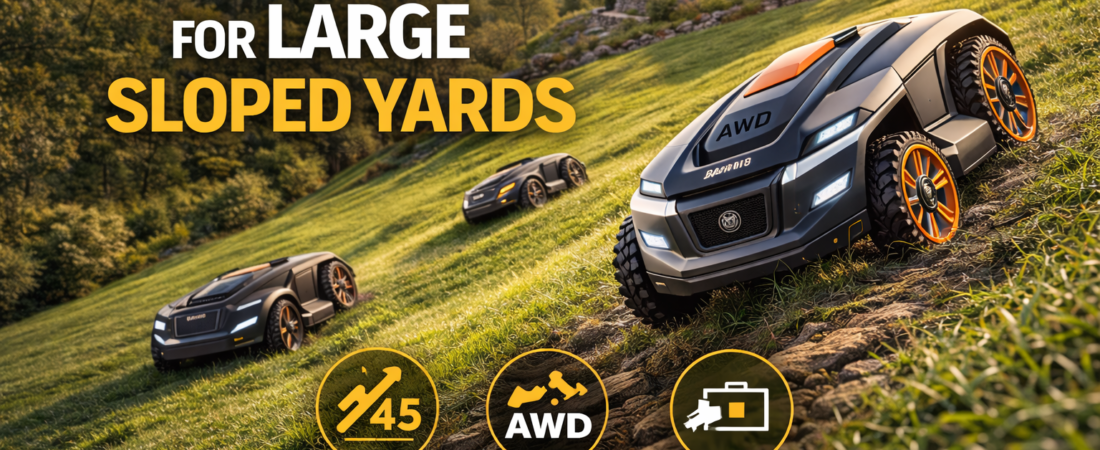
If you’ve been researching robot mowers for large sloped yards, you’ve probably noticed something frustrating:
Most recommendations are written for flat suburban lawns… not real properties with acreage, hills, and obstacles.
And here’s the truth most sites won’t tell you:
If you have 1–3+ acres AND slopes… most robot mowers will fail.
- They stall on hills
- They run out of battery before finishing
- They get lost, stuck, or miss entire zones
So instead of repeating generic specs, I went deep:
- Manufacturer data
- Real owner feedback (Reddit, forums)
- Battery performance analysis
- Real-world usage patterns
This is the no-BS guide to the best robot mowers for large sloped yards—based on what actually works.
Why Most Robot Mowers Fail on Large Sloped Yards
Before we get into the best models, you need to understand why most fail.
1. Coverage Ratings Are Misleading
Most mowers claim:
- “Up to 1 acre”
- “Handles large yards”
Reality:
- That’s under perfect flat conditions
- Add slopes, trees, or distance → performance drops fast
Owners consistently report:
A “2-acre mower” may take 20–30+ hours to fully maintain a large property.
2. Slopes Break Most Machines
Typical mower limit:
- 20–25% slope
But real yards:
- 30–40% front yard hills
- Uneven terrain + wet grass
Even more important:
Side-hill movement is harder than climbing straight up
That’s why only a few robot mowers for large sloped yards actually work reliably.
3. Battery Efficiency Matters More Than You Think
Here’s what people discover after buying:
- Travel time eats battery
- Turning, mapping, and navigation drain power
- Charging cycles dominate runtime
That’s why battery capacity + efficiency = EVERYTHING for robot mowers for large sloped yards
The 5 Best Robot Mowers for Large Sloped Yards
After analyzing specs + real-world feedback, these are the only models that consistently perform.
 Buyer’s Matrix (Side-by-Side Comparison)
| Model | Max Acreage | Max Slope | Battery | Runtime | Charge | Drive | Navigation | Best For |
|---|---|---|---|---|---|---|---|---|
| Husqvarna 450X EPOS | 2.5 acres | 45% | 10 Ah | 210 min | 60 min | 2WD | RTK GPS | Balanced large lawns |
| Mammotion LUBA 2 AWD | 2.5 acres | 70–80% | 15 Ah | 250–300 min | 60–90 min | AWD | RTK GPS | Steep terrain |
| Kress KR233 | 3 acres | 40% | 10 Ah | 80 min | 84 min | 2WD | RTK network | Estate lawns |
| Kress KR236 | 6 acres | 40% | 10 Ah | 66 min | 30 min | 2WD | RTK network | Huge properties |
| Husqvarna 535 AWD | 1.5 acres | ~70% | ~8–10 Ah | 145 min | 45 min | AWD | RTK GPS | Steep smaller yards |
| Segway X390 | 2.5 acres | 50% | 12.8 Ah | 240 min | 100 min | 2WD | RTK GPS | Open lawns |
1) Husqvarna Automower 450X EPOS
This is the safest “all-around” premium pick for a large residential lawn if your property is mostly open and you want mature software, dealer support, and predictable behavior. Husqvarna rates it for 2.5 acres, with 45% max slope inside the installation, a 10 Ah Li-ion battery, and 210 minutes typical mow time.
What owners seem to discover after living with it:
- It performs best when the yard is kept on a continuous maintenance schedule, not when you let grass get long. One owner with 2.5 acres said it took about 28 hours to do the whole property, and that it “operates best on a continuous basis.”
- Owners repeatedly say sizing up helps. A 450X EPOS owner with only about an acre said the extra battery life and fast recharge were worth it because GPS searching and transport time eat into useful mowing time.
- The main weakness is not raw mowing—it is RTK/GPS edge cases, especially near trees or awkward dock locations. Several Husqvarna threads point to dock placement and transport-path tuning as key to avoiding weird behavior.
Best for:
- 1.25–2.5 acre properties
- Open lawns
- Buyers who want the least experimental platform
Not best for:
- Extreme slopes
- Properties where the mower must constantly traverse soft/wet side-hills
Real-World Weaknesses
- RTK signal struggles near trees
- Dock placement is critical
- Not ideal for extreme slopes
Verdict
If you want the safest, most proven option for robot mowers for large sloped yards, this is it.
2) Mammotion LUBA 2 AWD 10000HX
If the question is “what handles the nastiest residential terrain,” this is the standout. Mammotion markets the large LUBA 2 with AWD, up to 80% slope capability, up to 15 Ah battery capacity, and on the upgraded 2025/2026 messaging says runtime increased to up to 270 minutes per charge. The product pages also say the platform can cover about 1200–1500 m² per charge, depending on version/page.
What owners are discovering:
- On real hills, users like the hardware a lot. Large-yard owners describe it as durable enough that their zero-turn mostly stopped getting used.
- The caveat is that AWD does not mean “ignore physics.” Owners say it still works better when it travels up and down slopes, not sideways across them, because side-hill sliding can still happen.
- Mammotion’s software/support reputation is mixed. Some owners praise the hardware, while others complain that promised software improvements arrive slowly or older models lose attention faster than they’d like.
Best for:
- Steep and uneven 1–2.5 acre yards
- Owners who value traction over brand maturity
- Yards where boundary wire would be a pain
Not best for:
- Buyers who want the most conservative, dealer-led ownership experience
[For pricing on Mammotion Luba 2 AWD]
Real-World Weaknesses
- Software bugs reported
- Support complaints
- Still struggles with side-hill sliding
Verdict
For extreme terrain, this is one of the most capable robot mowers for large sloped yards available today.
3) Kress KR233 RTKn / Kress KR236 RTKn
Kress is the “serious acreage” option. The current KR233 is recommended for 3 acres and the KR236 for 6 acres on a 48-hour schedule, both with 10 Ah / 20 V batteries and 40% incline capability. Official Kress pages confirm the capacity, and dealer/trade sources list the runtime figures at about 80 min run / 84 min charge for KR233 and 66 min run / 30 min charge for KR236.
What people are discovering:
- Users and forum posters are attracted to Kress because it can mow in a more commercial, systematic way and can scale far beyond ordinary consumer mowers.
- The biggest recurring concern is the RTKn ecosystem. Reddit users have flagged dependence on Kress’s network/dealer infrastructure, with one poster saying coverage and dealer proximity matter a lot.
- In practice, Kress feels more like a dealer-supported machine than a plug-and-play gadget. That is not bad, but it changes who it is for.
Best for:
- 2+ acres and especially 3+ acres
- Large open properties
- Buyers comfortable working with a dealer
Not best for:
- Buyers wanting the simplest self-install path
What Owners Love
- Commercial-style mowing logic
- Scales to very large properties
- Fast recharge cycles
Real-World Weaknesses
- Requires dealer ecosystem
- RTK network dependency
- Not as DIY-friendly
Verdict
If your definition of robot mowers for large sloped yards includes estate-level acreage, Kress is a serious contender.
4) Husqvarna Automower 535 AWD EPOS
This is the “slope specialist” from Husqvarna’s pro side. Husqvarna rates the 535 AWD EPOS for about 1.5 acres on the 48-hour standard measure, with 145 minutes typical mow time and 45 minutes charging time. Husqvarna’s AWD range is marketed for slopes up to 35°, and community discussion consistently treats the 535/435 AWD platform as the climbing benchmark on tough terrain.
What owners and enthusiasts discover:
- The AWD Husqvarnas are the machines people mention when ordinary 2WD platforms are not enough.
- The trade-off is coverage. If your lawn is truly 2 acres plus, a 535 AWD can be the right answer only if slope is the dominant problem and your expectations match its capacity. For peak growth, people warn not to dramatically exceed the rated area.
Best for:
- Very steep 1–1.5 acre lawns
- Buyers who want Husqvarna reliability plus AWD
Not best for:
- Flat 2+ acre lawns where a bigger-capacity mower makes more sense
What Owners Love
- Proven AWD performance
- Extremely stable climbing
- Reliable Husqvarna build
Real-World Weaknesses
- Limited coverage vs others
- Expensive for its size
Verdict
If slope is your biggest problem (not acreage), this is one of the best robot mowers for large sloped yards.
5) Segway Navimow X390
The X390 is the strongest current “consumer-friendly, wire-free, big battery” option for large open lawns. The X3 comparison/spec pages and related review sources show the X390 at about 2.5 acres, 12.8 Ah battery capacity, 100 minutes charge time, 240 minutes full-charge mowing time, and 50% max slope ability.
What people are discovering:
- Owners like the app and the straightforward mapping experience. Reddit comments and reviews repeatedly describe the X3 family as intuitive and fast to set up.
- Real-world traction seems good on mild-to-moderate uneven ground, but it is still a rear-wheel-drive platform, not an AWD mountain goat. Owners mention good anti-slip behavior, yet the praise is more about efficiency and ease than about conquering extreme hills.
- Some users think part of the model differentiation is software and battery size, not just frame or cutting hardware.
Best for:
- 1–2.5 acre open lawns
- Buyers who want wire-free setup and long single-charge runtime
Not best for:
- The steepest or slickest slopes
What Owners Love
- Easy setup
- Strong battery life
- Excellent app experience
Real-World Weaknesses
- Not built for extreme slopes
- Newer platform (less proven)
Verdict
A strong option if your robot mowers for large sloped yards search leans toward open, less extreme terrain.
Battery Strategy: What Actually Works (From Real Owners)
This is where most buyers get it wrong.
Myth: “I’ll just use a second battery”
Reality:
- Most mowers are NOT designed for swapping
- You risk damaging the system
- Warranty issues
Some advanced users:
- Modify batteries (especially LUBA)
- But this requires technical skill and risk
What Actually Works
1. Oversize Your Mower
Most common advice:
“Buy bigger than you need.”
Why:
- Longer runtime
- Fewer charge cycles
- Better real-world coverage
2. Optimize Dock Placement
Huge factor:
- Central location
- Clear sky for RTK
- Short travel paths
Bad placement = wasted hours daily
3. Run Continuous Scheduling
Successful owners:
- Run mowers daily
- Keep grass short
- Reduce workload per cycle
4. Use Two Mowers (Advanced Strategy)
Instead of:
One mower + battery hacks
Use:
Two mowers
Benefits:
- Parallel mowing
- Faster completion
- Redundancy
The practical answer
For almost all owners, the winning strategy is not carrying or hot-swapping a second battery mid-job. It is one of these:
- Buy the larger model than your acreage strictly requires.
- Keep the dock centrally located so the mower wastes less time commuting.
- Split awkward properties into better zones and transport paths.
- Use a second mower for separated areas or extremely large acreage.
- In some cases, use a second charging station only if the platform supports it cleanly.
What owners are trying
- DIY battery upgrading on Mammotion: There are Reddit threads from technically skilled users discussing cell replacement and even temporarily wiring a second pack to keep the BMS alive during an upgrade. Those same threads warn that disconnecting the BMS incorrectly can permanently disable it. That makes this a hobbyist/electronics project, not a normal ownership strategy.
- Second charging station on Mammotion: Mammotion community responses say one LUBA generally cannot just live with two chargers in one property the way people hope; moving base stations tends to force relocation/remapping.
- Two charging stations on Husqvarna wired systems: Older Automower owners have used two stations in separate areas by moving the mower and regenerating loop signal, but that is not the same as seamless multi-dock intelligence.
- Second battery on Segway/Navimow: I found discussion of battery interchangeability and battery replacement cost, but not a mainstream, supported hot-swap workflow for continuous field use.
Final Buying Advice
What I would buy by yard type
If your yard is:
- 2 acres, open, lightly sloped: Husqvarna 450X EPOS or Segway X390.
- 1–2 acres, steep, rough, or slippery: Mammotion LUBA 2 AWD 10000HX first, Husqvarna 535 AWD EPOS second if the acreage is closer to 1–1.5.
- 3+ acres or estate-style open ground: Kress KR233 or KR236, assuming strong dealer support where you live.
- Tech-forward and willing to accept some software evolution risk for better hill ability: LUBA 2 over LUBA 3 right now, because LUBA 3 looks promising on paper but early owner reports include some navigation complaints.
Choosing between these robot mowers for large sloped yards comes down to ONE thing:
Your yard type—not the spec sheet
Quick Picks:
- Best overall → Husqvarna 450X EPOS
- Best for steep terrain → Mammotion LUBA 2 AWD
- Best for massive acreage → Kress KR233 / KR236
- Best for steep smaller lawns → Husqvarna 535 AWD
- Best wire-free simplicity → Segway X390
Final Thought
Here’s what experienced owners all eventually realize:
Robot mowers for large sloped yards aren’t about raw power… they’re about system efficiency.
If you get:
- The right mower size
- Proper setup
- Smart scheduling
You get:
Zero weekend mowing
Perfectly maintained lawn
Total freedom from yard work
Make this the year your lawn mows itself! Explore our top picks and secure the best robot mower for steep slopes through the trusted affiliate links above and below. Your weekends (and your back) will thank you.
Disclaimer: This article contains affiliate links. As an Amazon Associate, I earn from qualifying purchases. Prices fluctuate, but the recommendation logic remains the same. Always check the slope rating before buying.