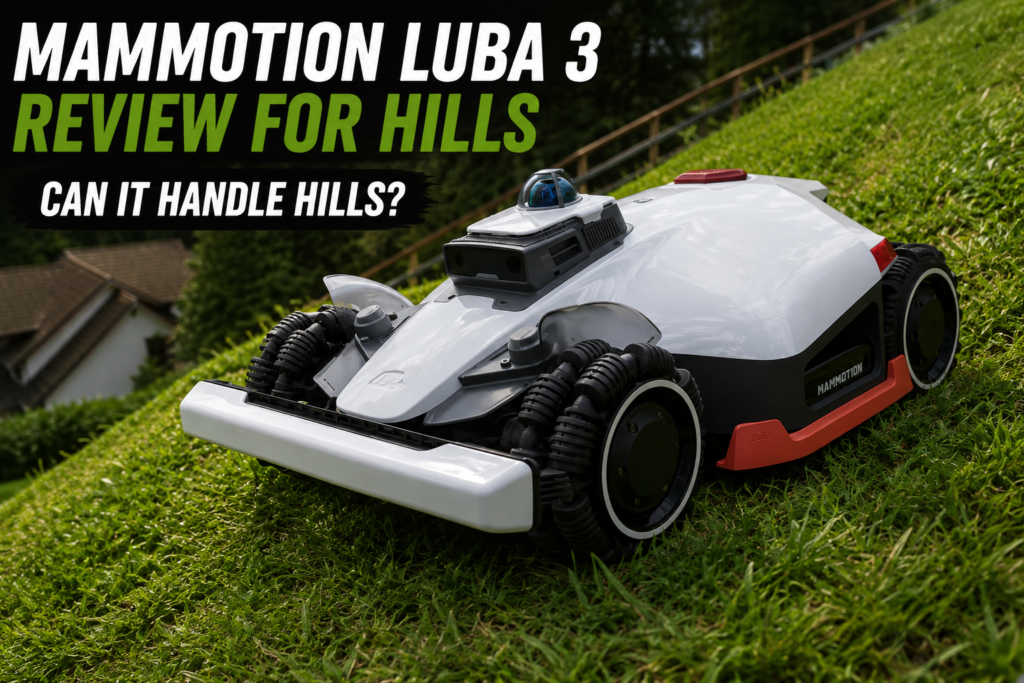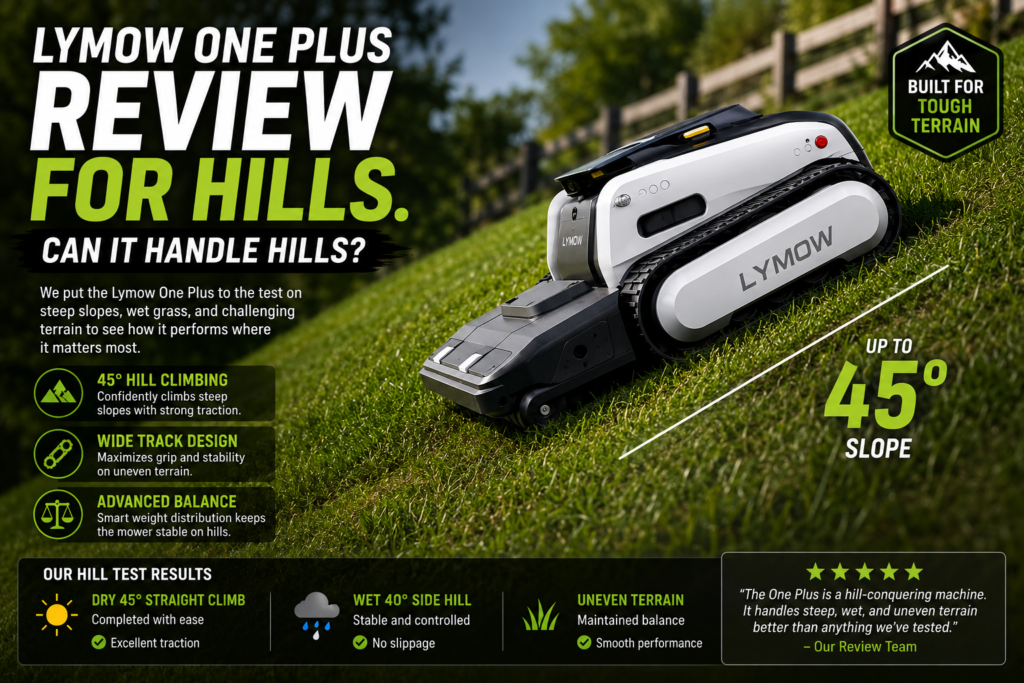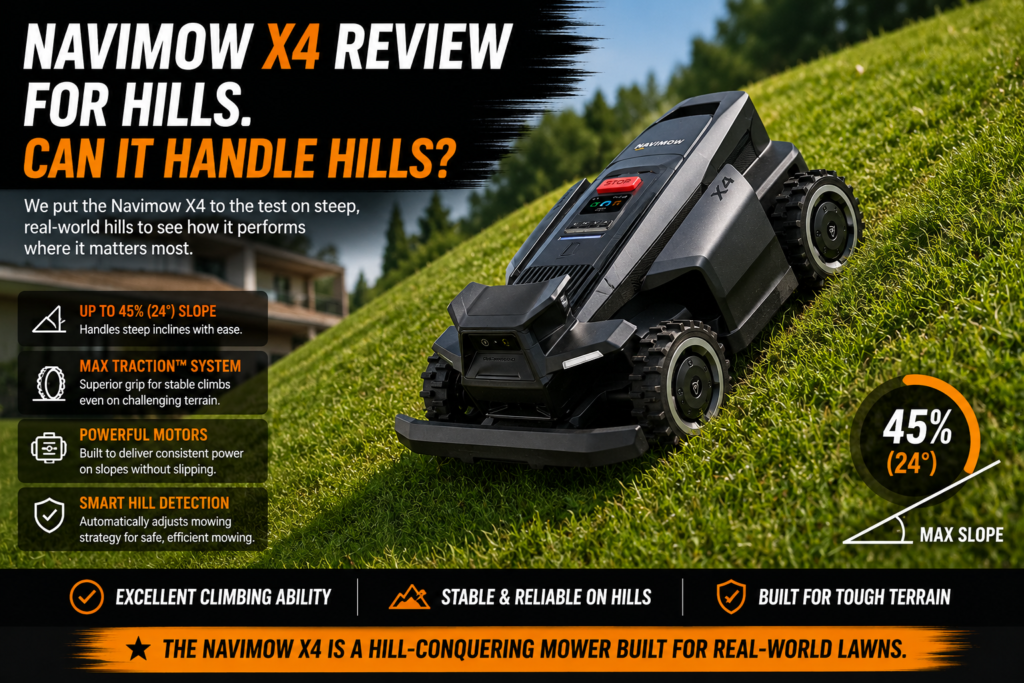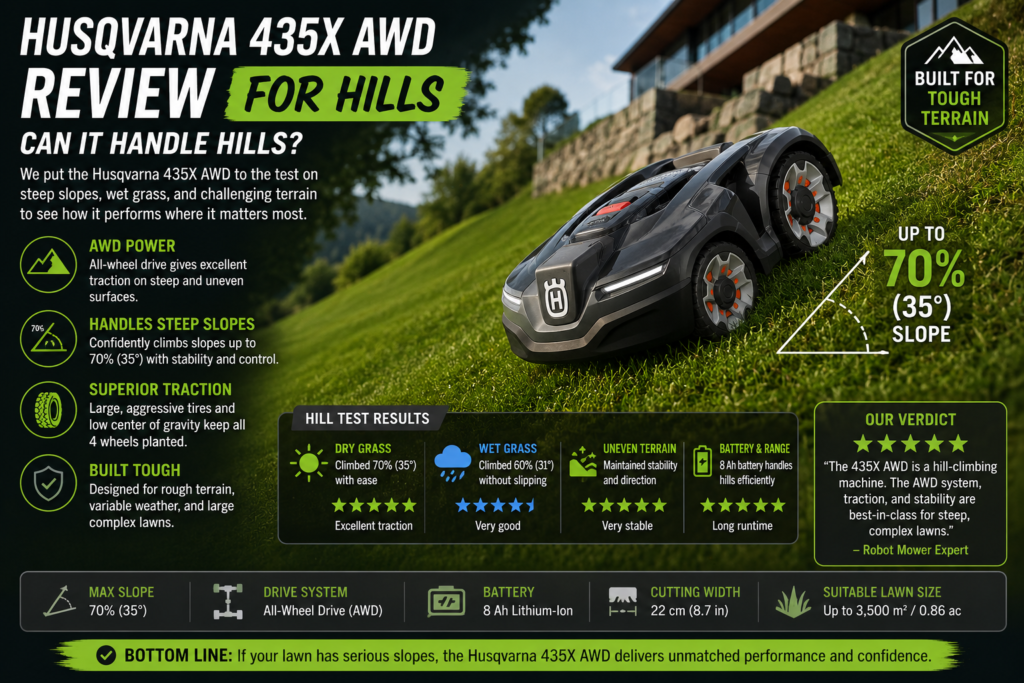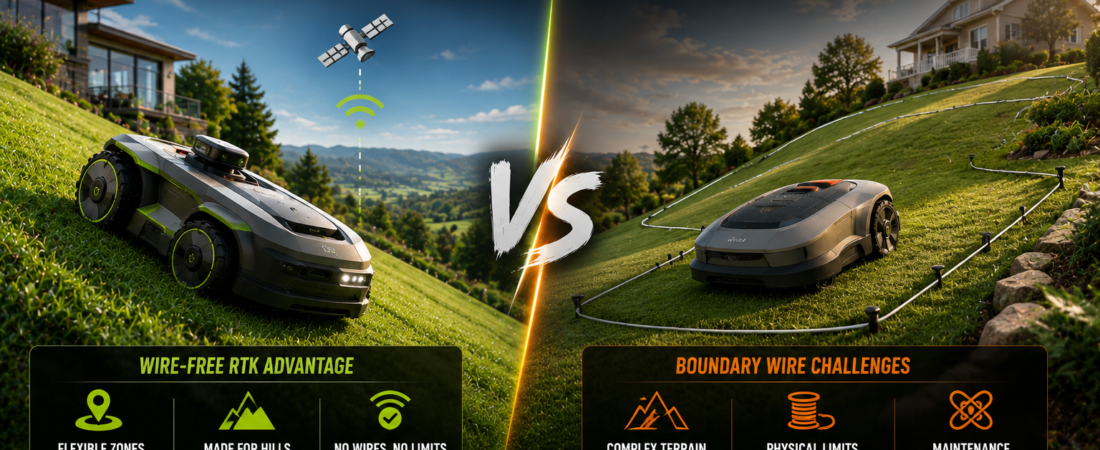
If you own a sloped, awkward, or multi-zone yard, the question is no longer “Can a robot mower replace my weekend mowing?” It is: which navigation system can actually handle your terrain without becoming another thing you have to babysit?
That is where the debate around Wire‑Free RTK vs Boundary‑Wire Robotic Mowers for Hills matters most.
Flat lawns are forgiving. Hills are not. Slopes expose weak traction, poor navigation, bad turning logic, signal problems, installation mistakes, and turf damage fast. A mower that works beautifully on a simple rectangle can become frustrating on a hillside with trees, drainage swales, retaining walls, narrow passages, and multiple zones.
For time-poor homeowners, estate managers, and small landscapers, the right robotic mower can remove hours of weekend labor and reduce the physical risk of mowing slopes. The wrong one can leave you chasing error codes, repairing buried wires, or rescuing a mower from the bottom of a hill.
This guide takes a deeper look at Wire‑Free RTK vs Boundary‑Wire Robotic Mowers for Hills, including the issues most comparison articles skip: slope direction, soil movement, GPS shadows, guide-wire placement, wet-grass traction, long-term maintenance, and the real cost of ownership.
Table of Contents
The Quick Verdict
For most hilly yards over 0.25 acres, especially properties with multiple zones, awkward edges, or changing landscaping, wire-free RTK robotic mowers are usually the better long-term choice.
They offer:
- Faster setup
- Smarter route planning
- Better slope-aware mowing patterns
- Easier multi-zone management
- No buried wire to break, shift, or repair
- Better app control for high-effort yards
Boundary-wire mowers still have a place. They remain dependable in dense tree cover, narrow urban yards, and properties where satellite reception is poor. But on larger sloped lawns, the physical wire often becomes the weak link.
The practical answer is this:
- Choose wire-free RTK if your hill is large, open enough for satellite positioning, multi-zone, or difficult to wire.
- Choose boundary wire if your lawn is smaller, heavily shaded, and you value proven simplicity over smart mapping.
- Choose RTK + vision or LiDAR if your yard combines slopes with trees, obstacles, and GPS-challenged areas.
How the Two Systems Actually Work
Before comparing performance on hills, it helps to understand the basic difference.
Boundary-Wire Robotic Mowers
Boundary-wire mowers use a low-voltage electrical loop installed around the mowing area. The mower detects the signal and stays inside the perimeter.
Most traditional robotic mowers from brands like Husqvarna, Worx, Gardena, Stihl, and Robomow have used this approach for years.
A typical installation includes:
- A perimeter wire around the lawn edge
- Optional guide wires to help the mower return to its charging station
- Pegs or buried wire to hold the boundary in place
- Manual setup around trees, beds, paths, slopes, and narrow passages
This system is simple and proven, but it is physically tied to the landscape. If the landscape moves, the boundary can move with it.
Wire-Free RTK Robotic Mowers
How robot mowers navigate
Select a navigation system to see an animated diagram, plain-English breakdown, and what it means for your sloped yard.
Navigation diagrams are illustrative. Real-world performance varies by terrain, tree cover, and environmental conditions.
Navigation diagrams are illustrative. Real-world performance varies by terrain, tree cover, and environmental conditions.
Navigation diagrams are illustrative. Real-world performance varies by terrain, tree cover, and environmental conditions.
Navigation diagrams are illustrative. Real-world performance varies by terrain, tree cover, and environmental conditions.
Wire-free RTK mowers use Real-Time Kinematic satellite positioning to locate the mower with centimeter-level accuracy. Most modern systems combine RTK with one or more backup technologies:
- Vision cameras
- LiDAR
- IMU tilt sensors
- Wheel odometry
- Ultrasonic sensors
- 4G or Wi-Fi correction data
- App-based virtual boundary maps
Instead of installing a physical wire, you map the lawn digitally by walking or driving the mower around the boundary. The mower then follows a virtual map.
Well-known wire-free or wire-light systems include models from Mammotion, Segway Navimow, Husqvarna EPOS, ECOVACS GOAT, Dreame, Sunseeker, and Ambrogio.
On hills, this matters because the mower is no longer just reacting to a wire. It can understand where it is, where it is going, and how the slope affects its route.
Comparison Table: Wire-Free RTK vs Boundary-Wire Robotic Mowers for Hills
| Category | Wire-Free RTK Mowers | Boundary-Wire Mowers |
|---|---|---|
| Best yard type | 0.25+ acre, sloped, multi-zone, open or semi-open properties | Smaller, simpler, shaded, well-defined lawns |
| Setup difficulty | Usually easier; map boundaries in the app | More labor-intensive; wire must be laid or buried |
| Hill performance | Strong when paired with AWD, IMU, vision, or LiDAR | Depends heavily on mower traction and wire layout |
| Slope-aware routing | Often supports systematic mowing and zone control | Usually random or semi-random on many older models |
| Boundary reliability | Depends on satellite visibility and sensor fusion | Very reliable if wire is intact and installed well |
| Tree canopy performance | Varies by model; best with vision/LiDAR backup | Excellent because boundary signal is local |
| Long-term maintenance | Firmware, sensor cleaning, occasional remapping | Wire breaks, frost heave, animal damage, edging damage |
| Changing landscaping | Easy to redraw in app | Requires wire adjustment |
| Multi-zone control | Strong; app-based scheduling by zone | Possible, but more complex with guide wires |
| Best fit for hills | Most large or complex hilly yards | Smaller hilly lawns with poor GPS reception |
Why Hills Are Harder Than Flat Lawns
Most robotic mower marketing focuses on maximum slope ratings: 35%, 45%, 50%, 80%, and so on. Those numbers matter, but they do not tell the full story.
A mower’s real hill performance depends on several interacting factors:
- Slope angle: A short 25% slope is very different from a long 25% hill.
- Slope direction: Mowing straight up and down is different from traversing sideways.
- Grass moisture: Dew can cut traction dramatically.
- Soil firmness: Loose topsoil and clay slopes behave differently.
- Turning zones: The steepest part of the hill may not be the climb; it may be where the mower turns.
- Wheelbase and weight: A heavier mower can grip better but may also rut soft turf.
- Drive system: AWD usually matters more than headline navigation tech on steep slopes.
- Navigation recovery: The mower must know how to correct slide, drift, or wheel slip.
That is why Wire‑Free RTK vs Boundary‑Wire Robotic Mowers for Hills is not simply a GPS vs wire question. It is a whole-system question.
A great hillside robot mower needs three things:
- Traction to stay planted.
- Navigation accuracy to stay on course.
- Smart recovery behavior when conditions change.
Slope Ratings: Percent Grade vs Degrees
One source of confusion is slope measurement. Manufacturers often use percent grade, while homeowners think in degrees.
Here is the basic relationship:
Percent grade=tan(degrees)×100\text{Percent grade} = \tan(\text{degrees}) \times 100Percent grade=tan(degrees)×100
Approximate conversions:
| Percent Grade | Degrees | Real-World Feel |
|---|---|---|
| 20% | 11.3° | Noticeable incline |
| 35% | 19.3° | Steep for walking mower use |
| 45% | 24.2° | Challenging slope |
| 50% | 26.6° | Very steep residential hill |
| 70% | 35.0° | Extreme for most lawns |
| 80% | 38.7° | Specialist AWD territory |
This is where buyers get caught. A mower advertised for 45% slopes may sound extreme, but 45% is about 24 degrees. Many hilly properties have short sections that exceed this, especially near drainage ditches, retaining walls, road banks, and transitions between lawn levels.
When comparing Wire‑Free RTK vs Boundary‑Wire Robotic Mowers for Hills, do not just look at the max slope rating. Ask where that slope occurs: in the middle of an open lawn, along the boundary, beside a fence, under trees, or at the charging route.
Where Boundary-Wire Mowers Struggle on Hills
Boundary-wire mowers can be excellent when installed correctly. Premium models, especially AWD units, can handle impressive slopes. The problem is that hills make wire installation and long-term reliability harder.
Wire Movement and Soil Creep
On slopes, soil gradually moves downhill due to rain, freeze-thaw cycles, foot traffic, animal activity, and erosion. If the wire is pegged at the surface, it can loosen or become exposed. If buried shallowly, it can shift, break, or become difficult to locate.
This is especially common on:
- Clay slopes
- Newly graded lawns
- Areas with runoff
- Edges near drainage channels
- Hillsides with thin turf cover
A small shift may not matter on a flat lawn. On a slope, it can cause the mower to stop short, ride too close to an edge, or miss a strip that becomes visible from the house.
Boundary Turns on Inclines
Many boundary-wire mowers slow down or pivot when they detect the wire. On a slope, that turn can cause:
- Wheel slip
- Turf scuffing
- Repeated wear marks
- Sliding outside the intended path
- More frequent lift or tilt errors
This is why installation manuals often recommend leaving extra space near steep boundaries. That may solve the safety problem, but it also means you still need to trim more manually.
Guide-Wire Complexity
Guide wires help the mower return to its dock or reach remote zones. On hilly properties, guide-wire placement can become tricky.
Poor guide-wire routing may force the mower to:
- Climb the steepest route back to the charger
- Cross wet low spots
- Repeat the same hillside track, creating wear
- Struggle through narrow passages at an angle
- Miss upper or lower zones
For a homeowner trying to eliminate mowing stress, this can feel like replacing one weekend chore with another.
Where Wire-Free RTK Mowers Struggle on Hills
Wire-free RTK mowers solve many wire problems, but they are not magic. Their weak point is signal quality.
RTK Needs Sky Visibility
RTK relies on satellite signals and correction data. If your property has dense tree cover, steep wooded banks, tall retaining walls, metal buildings, or narrow side yards between structures, positioning can degrade.
Common trouble spots include:
- North-facing tree-covered slopes
- Lawns beside tall houses or garages
- Narrow side passages
- Areas under dense evergreen canopy
- Sloped yards bordered by fences or walls
The best newer mowers reduce this risk with camera vision, LiDAR, and inertial sensors. But budget RTK-only models may pause, wander, or require remapping in difficult areas.
The Base Station Matters More Than People Think
Many RTK complaints come from poor base station placement. On hills, the reference station needs a clear sky view and stable mounting location.
Bad placement can create:
- Random positioning loss
- Boundary drift
- Slow startup
- Docking errors
- More frequent manual rescues
A good installation often means placing the RTK antenna higher than expected, away from rooflines and trees, with a wide view of the sky.
Firmware Maturity Matters
Wire-free mowers are software-heavy. That can be good because performance improves over time. But it also means early owners may deal with bugs, app changes, or occasional mapping quirks.
For cautious buyers, this is important. A boundary wire is old-school, but predictable. RTK is smarter, but more dependent on the manufacturer’s software quality.
The Hidden Hill Factor: Direction of Travel
Most articles compare max slope ratings. They rarely discuss travel direction, which is critical.
A robotic mower behaves differently when mowing:
- Up and down the slope: Better traction, less sideways drift, but more battery use.
- Across the slope: Cleaner striping, but higher risk of lateral slide.
- Diagonally: Often the best compromise, depending on turf and grade.
- Turning on the slope: Usually the highest-risk moment.
Wire-free RTK mowers with systematic path planning can often be configured to mow in patterns that work with the slope. This is a major advantage. You can set mowing direction, zone behavior, and sometimes pattern rotation.
Boundary-wire mowers, especially random-pattern models, may approach the slope from inconsistent angles. Over time, this can mean more missed patches and more wear in recovery zones.
For hilly properties, controllable mowing direction is not a luxury feature. It can determine whether the mower looks professional or constantly leaves scars.
Cut Quality on Slopes
The best robotic mower is not just the one that avoids getting stuck. It is the one that leaves the lawn looking intentionally maintained.
Wire-Free RTK Cut Quality
Wire-free RTK mowers usually perform better on visible hills because they can mow in planned lines. This creates:
- More consistent coverage
- Cleaner stripes or rows
- Fewer random missed patches
- Better zone scheduling
- Less over-mowing in high-traffic areas
For estate homes and higher-end suburban properties, this matters. A sloped front lawn is highly visible. Random mowing may keep grass short, but systematic mowing often looks more polished.
Boundary-Wire Cut Quality
Boundary-wire mowers traditionally use random patterns. Over frequent mowing cycles, they eventually cover the area. On flat lawns, this can work well. On hills, wheel slip and repeated recovery movements can create unevenness.
That said, premium boundary-wire mowers can still produce excellent results if:
- The slope is within spec
- The wire is installed carefully
- The mower runs frequently
- The lawn is not overly wet
- Edges are designed with enough safety margin
The difference is not that wired mowers cannot cut hills. It is that they usually require more careful setup and more patience.
Safety on Sloped Lawns
For the target buyer, safety is one of the biggest reasons to automate mowing. Slopes and heavy equipment are a bad combination, especially in heat or wet conditions.
A robotic mower reduces the need to push or ride across risky terrain. But the mower itself must behave safely.
Look for:
- Lift sensors
- Tilt sensors
- Blade stop response
- Obstacle detection
- Anti-theft tracking
- Rain delay
- Geofencing
- Slope-aware speed control
- Reliable return-to-dock behavior
Wire-free RTK mowers often have more advanced obstacle detection, especially models with vision or LiDAR. Boundary-wire mowers may be simpler, but can be very reliable inside a fixed perimeter.
For hills near roads, ponds, retaining walls, or drop-offs, do not rely purely on manufacturer claims. Add conservative no-go zones, physical barriers where necessary, and extra boundary margins.
Pros and Cons
Wire-Free RTK Robotic Mowers for Hills
Pros
- Much faster setup than burying boundary wire.
- Easier to adjust zones when landscaping changes.
- Better for large, multi-zone, awkward, or estate-style properties.
- Systematic mowing creates cleaner visible results on hills.
- App-based control gives homeowners and property managers more flexibility.
- No wire breaks from frost, pets, edging tools, or soil movement.
- Best models combine RTK with vision, LiDAR, IMU, and AWD for strong hill performance.
Cons
- Higher upfront cost.
- Requires good RTK antenna placement.
- Can struggle under dense tree canopy without vision or LiDAR backup.
- Firmware quality varies widely by brand.
- Some models may require cellular or network subscriptions after an included period.
- More advanced systems have a steeper learning curve.
Boundary-Wire Robotic Mowers for Hills
Pros
- Proven technology with many years of real-world use.
- Does not depend on satellite visibility.
- Often cheaper upfront.
- Strong choice for small, shaded, simple lawns.
- Good reliability when the wire is professionally installed.
- Less dependent on app ecosystems and software updates.
Cons
- Installation is time-consuming, especially on slopes.
- Wire can break, shift, or surface due to erosion and frost heave.
- Changing zones requires physical wire changes.
- Random mowing can look less refined on visible slopes.
- Guide-wire routing can be tricky on multi-zone hillside properties.
- Boundary turns on inclines can cause turf wear or slipping.
Decision Table: Which System Should You Buy?
| Your Property Situation | Better Choice | Why |
|---|---|---|
| 0.25–0.5 acre with mild slopes and open sky | Wire-free RTK | Easy setup and clean mowing patterns |
| 0.25–0.5 acre with dense canopy everywhere | Boundary wire or RTK + LiDAR/vision | Standard RTK may struggle without sensor backup |
| 0.5–2 acres with rolling terrain | Wire-free RTK | Easier zone control and better long-term maintenance |
| Steep front hill visible from the street | Wire-free RTK AWD | Planned mowing lines look more professional |
| Narrow shaded side yard between buildings | Boundary wire | Satellite reception may be unreliable |
| Estate property with changing landscaping | Wire-free RTK | Virtual maps are easier to edit |
| Small landscaper managing several properties | Wire-free RTK | Faster deployment and less install labor |
| Yard near drop-offs, ponds, or roads | Depends; |
The Real Cost: Not Just Purchase Price
A common mistake is comparing only the price tag. For hilly properties, the better question is: what does this system cost in money, time, frustration, and unfinished work over five years?
Boundary-wire systems often look cheaper upfront. But on a sloped lawn, you may need:
- Extra boundary wire
- Extra guide wire
- Professional installation
- Wire repair kits
- Signal testers
- Seasonal troubleshooting
- Manual trimming where the mower cannot safely reach
- Time spent locating breaks after edging, frost heave, or animal damage
Wire-free RTK mowers usually cost more upfront, but they reduce the physical installation burden. For a busy homeowner, estate manager, or small landscaper, that time savings can be significant.
If you value your weekend time at even $40–$75 per hour, a mower that prevents 10–20 hours of installation and seasonal troubleshooting can close the price gap quickly.
For many premium-property owners, the real value is not only the cut. It is removing the mental load of wondering, “Do I have to mow this weekend?”
What Most Blogs Miss: The Charging Station Route
One of the most overlooked issues in Wire‑Free RTK vs Boundary‑Wire Robotic Mowers for Hills is not the mowing area itself. It is the route back to the charger.
A robot mower may handle your steepest lawn section just fine, then fail because the charging station is placed in a poor location.
On hills, avoid placing the dock:
- At the top of a steep ramp
- At the bottom of a wet slope
- Near a tight turn immediately after a climb
- Under dense trees that block RTK signals
- In a narrow side passage with poor satellite view
- Where runoff collects after rain
- Where the mower must reverse or pivot on a slope
Better dock placement:
- Flat, firm ground
- Good drainage
- Clear sky exposure for RTK models
- Short, simple approach path
- Minimal turning immediately before docking
- Close to power and Wi-Fi if needed
- Away from sprinkler overspray
For boundary-wire mowers, dock placement also affects guide-wire routing. If the guide wire sends the mower across the same hillside track every day, you may get worn grass even if the mower technically works.
For wire-free RTK mowers, dock placement affects positioning lock, return accuracy, and startup reliability. This is one of the first things to get right.
What Most Blogs Miss: Wet Grass Changes Everything
A mower that handles a 30-degree slope on dry turf may struggle on a 20-degree slope covered in morning dew.
Wet grass affects:
- Tire grip
- Braking distance downhill
- Turning stability
- Clipping buildup under the deck
- Wheel slip detection
- Turf scuffing
- Battery consumption
For hillside lawns, schedule mowing after dew has lifted. This is especially important for shaded north-facing slopes, where grass can stay damp for hours longer than sunny areas.
Wire-free RTK mowers with app scheduling make this easier because you can create separate mowing windows by zone. For example, a sunny front slope may be fine at 9 a.m., while a shaded back hill should wait until noon.
Boundary-wire mowers can also be scheduled, but zone-specific control is usually less precise unless you have a more advanced model and a carefully designed wire layout.
What Most Blogs Miss: Turf Type Matters
Slope performance is not only about the mower. It is also about the lawn surface.
Better turf for robotic mowing on hills
- Dense Bermuda
- Zoysia
- Kentucky bluegrass blends
- Well-rooted fescue
- Mature perennial ryegrass
More challenging surfaces
- Thin grass over clay
- Patchy shaded slopes
- Newly seeded lawns
- Mossy or damp areas
- Loose sandy soil
- Drought-stressed turf
- Areas with exposed roots
Wire-free RTK mowers can help by adjusting routes and reducing repeated passes in weak zones. Boundary-wire mowers may repeatedly cross the same areas randomly or follow guide wires through vulnerable spots.
If your hillside turf is thin, fix the grass before expecting any robot mower to perform perfectly. A mower cannot create traction where the lawn has no root structure.
What Most Blogs Miss: The Edge Problem
Many buyers expect a robot mower to eliminate all trimming. On hills, that is rarely realistic.
Edges are difficult because robotic mowers must keep their wheels safely inside the boundary. This is true for both RTK and boundary-wire systems.
Problem edges include:
- Retaining walls
- Ditches
- Ponds
- Roads
- Gravel transitions
- Mulch beds
- Drop-offs
- Fence lines on slopes
- Raised roots around trees
Boundary-wire mowers need physical wire offsets. If you set the wire too conservatively, you trim more. If you set it too aggressively, the mower may slip or cross into unsafe areas.
Wire-free RTK mowers allow easier boundary adjustment in the app, which is a major advantage. You can test, refine, and create no-go zones without digging. But you should still leave extra safety margins on downhill edges.
A realistic expectation is this: a good robotic mower can eliminate most mowing, but you may still need occasional trimming around risky edges and complex landscaping.
How Landscapers and Property Managers Should Think About This
For small landscapers and estate managers, the comparison changes slightly. The question becomes less emotional and more operational.
You care about:
- Labor reduction
- Repeatability
- Setup time
- Client satisfaction
- Rescue frequency
- Multi-property scalability
- Downtime
- Ease of training staff
- Remote monitoring
- Long-term service costs
For multiple hilly properties, wire-free RTK is compelling because it reduces installation labor and allows faster deployment. A physical wire install can take half a day or more per property. Mapping an RTK mower can often be done much faster.
However, boundary-wire systems may still be a better fit for clients with heavily wooded properties or places where you cannot guarantee good RTK reception.
A professional approach is to perform a simple site audit before recommending either technology:
- Check slope severity and direction.
- Identify trees, buildings, and GPS-shadow zones.
- Locate safe dock placement.
- Walk the likely return-to-charge route.
- Identify wet areas and drainage paths.
- Mark drop-offs, roads, water, and retaining walls.
- Decide whether virtual no-go zones are enough or physical barriers are needed.
This kind of pre-installation thinking prevents most bad experiences.
Best Features to Look for in a Robotic Mower for Hills
When shopping, do not buy based on navigation system alone. For hills, prioritize the full hardware and software package.
Must-have features for sloped properties
- All-wheel drive for steep or uneven yards.
- High slope rating with margin above your steepest area.
- IMU/tilt sensors for slope detection and safety.
- Good obstacle detection for trees, toys, pets, furniture, and roots.
- Rain delay to avoid wet-slope slipping.
- Zone scheduling for different sun and moisture conditions.
- Adjustable mowing direction for slope-aware cutting.
- Strong app mapping for no-go zones and boundary edits.
- Reliable return-to-dock behavior.
- Replaceable blades and accessible deck cleaning.
Nice-to-have features
- LiDAR backup for trees and low light
- Vision-based localization
- 4G connectivity
- Anti-theft GPS tracking
- Multi-map support
- Cutting-height automation
- Edge-cutting modes
- Smart home integration
- Fleet management for landscapers
In the debate over Wire‑Free RTK vs Boundary‑Wire Robotic Mowers for Hills, the best mower is not always the most advanced one. It is the one whose feature set matches your exact terrain.
Buying Recommendations by Yard Type
Best for Open, Rolling 0.25–1 Acre Lawns
Choose a wire-free RTK mower with systematic mowing and strong app control. This type of yard is where RTK shines. You avoid the installation hassle and get a cleaner, more intentional cut pattern.
Best for Steep, Rugged, Uneven Terrain
Choose a wire-free RTK AWD mower with strong traction, hill-hold behavior, and sensor fusion. Models with LiDAR or vision backup are better if the slope includes trees or obstacles.
Best for Dense Tree Cover
Choose either a boundary-wire mower or a higher-end RTK mower with strong non-GPS backup. If the entire lawn is under canopy, traditional wire may still be more dependable.
Best for Estate Properties and Property Managers
Choose wire-free RTK if the property has adequate sky view. The ability to adjust zones digitally, schedule sections independently, and avoid wire repairs is a major operational advantage.
Best for Budget-Conscious Buyers
Choose boundary wire if the lawn is not too large, the slope is moderate, and you do not mind installation work. A well-installed wired mower can still be a very smart purchase.
Choose the Technology That Matches Your Hill
If your main goal is to stop spending weekends wrestling with a mower on slopes, start with the technology that removes the most friction from ownership.
For most 0.25+ acre sloped yards, a wire-free RTK mower is the smarter long-term upgrade. Look for AWD, strong app mapping, RTK + vision or LiDAR, and a slope rating comfortably above your steepest area.
Recommended next step: compare current wire-free RTK AWD models from brands like Mammotion, Segway Navimow, Husqvarna EPOS, Sunseeker, and ECOVACS before buying. Prioritize hill performance, docking reliability, and sensor fusion over headline acreage alone.
Affiliate CTA: Check today’s prices and availability on top-rated wire-free RTK robotic mowers for hills here: [View Best Wire-Free RTK Mowers for Sloped Yards]
When Boundary Wire Still Makes Sense
Do not rule out boundary-wire mowers if your property is smaller, heavily shaded, or satellite-challenged. A good wired model can be reliable, affordable, and low-drama once installed correctly.
The key is installation quality. On hills, wire layout matters as much as mower selection.
If your yard is shaded, compact, or has poor GPS visibility, compare proven boundary-wire robotic mowers here: [Shop Reliable Boundary-Wire Robot Mowers]
Final Verdict
The winner in Wire‑Free RTK vs Boundary‑Wire Robotic Mowers for Hills depends on your terrain, but the market is clearly moving toward wire-free systems for larger and more complex properties.
Boundary-wire mowers are still dependable, especially in dense canopy and smaller lawns. But for the homeowner with a 0.25+ acre sloped property, limited free time, and a desire for app-based control, wire-free RTK offers a more modern ownership experience.
It is easier to install, easier to adjust, better suited for multi-zone yards, and usually more efficient on visible slopes. The best RTK mowers also produce cleaner patterns, reduce wire-related maintenance, and give you more control over how your lawn is managed.
The practical recommendation is simple:
- Choose wire-free RTK for larger, sloped, multi-zone, or evolving properties.
- Choose boundary wire for smaller, shaded, stable lawns where GPS reception is weak.
- Choose RTK with vision or LiDAR for the best balance of slope performance and obstacle handling.
The real win is not just a shorter lawn. It is getting your weekends back, reducing the physical strain of mowing hills, and owning a system that makes your property feel easier to manage.
For most modern hillside homeowners, Wire‑Free RTK vs Boundary‑Wire Robotic Mowers for Hills comes down to this: wire-free RTK is the better fit when convenience, control, and long-term flexibility matter most.
Make this the year your lawn mows itself! Explore our top picks and secure the best robot mower for steep slopes through the trusted affiliate links above and below. Your weekends (and your back) will thank you.
Disclaimer: This article contains affiliate links. As an Amazon Associate, I earn from qualifying purchases. Prices fluctuate, but the recommendation logic remains the same. Always check the slope rating before buying.
More Comparisons…






Other Comparisons…


More Reviews…