If you’ve been researching robot mowers for a hilly property, you’ve probably noticed that most buying guides treat slope performance as a single variable: get a higher slope rating and you’re done. What they don’t tell you is that the decision between AWD vs tracked robot mowers for hills is one of the most consequential choices you’ll make — and it has nothing to do with the headline percentage on the spec sheet.
Two machines can both claim 80% slope capability and perform completely differently on your property. One slips on wet clay. The other digs ruts at every turn. One handles your 38-degree embankment without hesitation. The other beachees itself on the exposed roots halfway up. The drive system — wheels with AWD or continuous rubber tracks — is what separates consistent performance from recurring frustration on genuinely steep terrain.
This guide breaks down the AWD vs tracked robot mowers for hills debate with the evidence it deserves.
Why Drive System Matters More Than Slope Rating
The slope rating on a robot mower spec sheet is measured on dry, firm, short grass under controlled conditions. Your hill is none of those things.
Wet conditions reduce effective slope performance by 15–30% on any wheeled platform. Clay soil retains moisture for 24–48 hours after rain, meaning a machine rated for 50% grade can slip repeatedly on wet clay at 35%. Long grass adds blade resistance that compounds motor load on climbs. Exposed roots, drainage dips, and soft patches create traction failures at the specific moments such as mid-climb, mid-turn and can cause the most damage.
Three primary factors cause robotic mowers to stall on inclines: traction loss, navigation challenges, and stability issues. Morning dew or recent rain reduces friction between wheels and ground, causing even capable mowers to slip backward or spin in place.
Understanding AWD vs tracked robot mowers for hills means understanding how each system addresses these three failure modes — and where each one runs out of solutions.
How AWD Works on Hills — And Where It Breaks Down
The AWD Mechanism
AWD technology revolutionized robot mower hill capability by powering all four wheels independently. This design distributes torque dynamically — if one wheel loses grip, the other three compensate. Premium AWD models feature individual hub motors at each wheel, allowing sophisticated traction control algorithms to adjust power delivery in real-time based on terrain feedback.
In practical terms, this means an AWD machine can lose grip on one wheel in a soft patch and continue climbing where with a 2WD the machine would spin and stall. For most sloped residential properties in the 25–80% grade range, this is sufficient.
Traction Control — The Critical Setting Most Owners Miss
The most important AWD refinement for hills is real-time traction control, and it’s often buried in the settings menu. Segway’s official documentation makes the stakes clear:
TCS ON: Actively detects wheel slip and adjusts wheel speed in real time, preventing digging and protecting your lawn with smooth traction. TCS OFF: High-speed wheel rotation on slick or wet grass may skid and dig into the ground, leading to unnecessary sinking, slippage, and serious turf damage.
TCS should always be enabled on sloped properties. It’s the difference between an AWD machine that protects your turf and one that progressively destroys it at every turning point.
The Skid Steering Problem — AWD’s Biggest Weakness on Slopes
This is what most AWD buying guides completely ignore, and it matters enormously on hills.
Traditional AWD robots use skid-steering — locking one side of wheels — which can scuff and tear grass on slopes. Segway’s Xero-Turn AWD adds independent front-wheel steering for car-like turns that protect your turf — especially important on hills where grass is already stressed.
Standard AWD turning works by slowing or reversing one side of wheels to pivot. On a slope, where the grass is already under stress from the machine’s weight and the gradient, this creates the ruts and divots that frustrated owners report after months of AWD operation. The problem isn’t the climb — it’s every direction change.
Turf-safe turning systems (Segway’s Xero-Turn, Mammotion’s omni-wheel) eliminate this by using independent front-wheel steering instead. If you have delicate turf on slopes, this feature matters as much as slope rating in the AWD vs tracked robot mowers for hills decision.
AWD’s Real-World Ceiling
Even advanced AWD systems face limitations on extremely steep or muddy terrain where all four wheels simultaneously lose purchase.
Premium AWD machines — Mammotion LUBA 3 AWD (80%), Segway Navimow X4 (84%), Kress EyePilot 4×4 (84%) — represent the practical ceiling of wheeled performance. Above approximately 38–40 degrees on wet ground, all four wheels can simultaneously lose grip. No amount of TCS sophistication solves the fundamental problem of four small contact points on saturated clay.
[Check out our indepth Machine by machine comparison for Mammotion LUBA vs Segway Navimov x4 ] (coming soon)
[Check out our indepth Machine by machine comparison for Mammotion LUBA vs Kress Eye Pilot 4×4 ] (coming soon)
How Tracked Systems Work on Hills — And Where They Excel
The Track Mechanism
Track-based designs represent the next evolution beyond AWD. Instead of four discrete contact points, continuous tracks distribute the mower’s weight across the entire track surface — similar to construction equipment or military tanks. Tracks reduce ground pressure by 40–60% compared to wheels, preventing the mower from sinking into soft soil or creating ruts during turns on muddy hills. While wheels can spin freely when traction breaks, tracks maintain constant surface engagement. Even if one section encounters a slick patch, the remaining track length continues gripping.
This is not a marginal improvement. The difference between four contact points and a full-length track in contact with the ground is the difference between a machine that occasionally spins on wet clay and one that conforms to the surface and keeps moving.
The Wet Slope Advantage — Where Tracks Win Decisively
Independent side-by-side testing on a 35% clay slope after light rain showed a top-rated AWD wheeled mower experiencing noticeable spin and hesitation. A tracked machine on the same slope distributed its weight across a larger surface area, crawled uphill without slipping, and crossed a shallow muddy rut that stopped the wheeled model entirely. The difference in traction between wheeled and tracked systems on wet steep ground is not marginal — it is significant.
This single data point from real-world testing captures the core case for tracked systems in the AWD vs tracked robot mowers for hills debate: they don’t just perform better on wet steep ground — they perform in conditions that completely defeat wheeled machines.
Cross-Slope Traversal — Tracked Systems’ Hidden Advantage
This advantage becomes critical on cross-slope mowing, where gravitational pull tries to slide the mower sideways — tracks resist this lateral movement far more effectively than wheels.
Most hill performance discussions focus on straight up-and-down climbing. Cross-slope traversal — moving laterally across a gradient — is where wheeled machines are most vulnerable to sideways sliding. Tracks’ larger footprint and distributed ground contact resist this lateral gravitational force substantially better.
Tracked Systems’ Real Limitations
Being honest about tracked trade-offs is essential to the AWD vs tracked robot mowers for hills decision.
Tracked systems reduce the impact of your mower on your grass at the cost of slower maneuverability. Yes, tracks do tear up grass, specifically when the lawn mower turns or executes a difficult maneuver.
Tracks are not a universal traction solution. They reduce ground pressure on straight runs and slopes dramatically, but differential turning — where one track slows while the other advances — still creates surface stress at direction change points. The advantage over standard AWD skid steering is that weight is distributed more broadly even during turns, but it is not the perfectly turf-safe turning of a Xero-Turn AWD system.
Wheeled AWD models offer better maneuverability in tight spaces but struggle on extreme terrain exceeding 35–38 degrees.
Tracked machines are heavier, slower, and less nimble. For properties with narrow passages between garden beds, complex obstacle-heavy layouts, or sections requiring frequent tight direction changes, tracked machines are operationally disadvantaged compared to agile AWD designs.
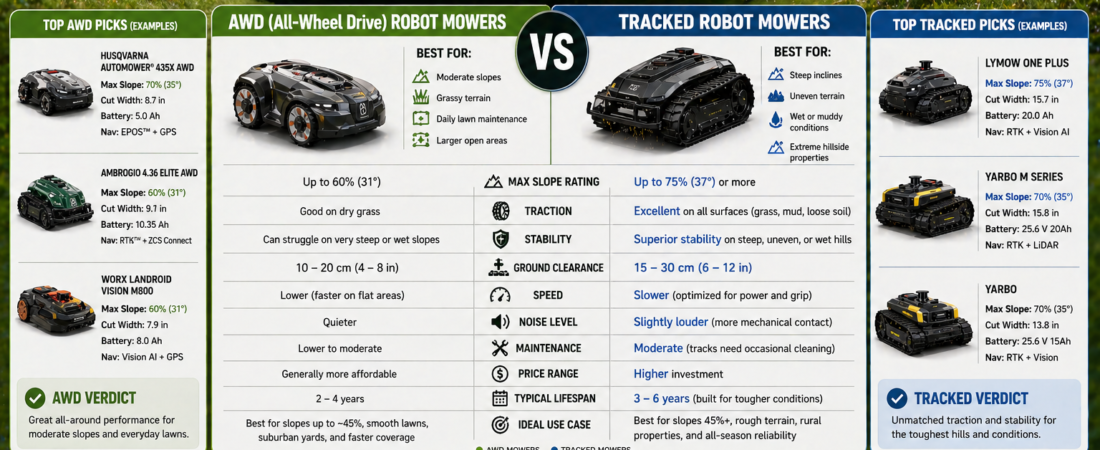
AWD vs Tracked Robot Mowers for Hills — Head-to-Head Comparison
| Factor | Premium AWD | Tracked |
|---|---|---|
| Max slope (dry conditions) | 80–84% / 38–40° | 100% / 45° |
| Max slope (wet clay) | ~50–60% effective | ~75–85% effective |
| Turf damage during turns | Moderate (standard AWD) to minimal (Xero-Turn) | Low-moderate |
| Rut formation on soft slopes | Moderate risk | Low risk |
| Maneuverability in tight spaces | Good | Limited |
| Mowing speed | Faster | Slower |
| Ground pressure | Concentrated (4 points) | Distributed (full track) |
| Navigation options | Full range — LiDAR, RTK, Vision | Full range available |
| Model availability | Wide — Mammotion, Segway, Kress, Husqvarna | Very limited — Lymow, Yarbo only |
| Weight | 20–30 kg typical | 35+ kg |
| Starting price | From ~$2,399 | From ~$2,999 |
| Best terrain | 25–40°, most conditions | 35–45°, wet/clay/rough ground |
| Worst scenario | Wet clay above 40°, skid steering on soft turf | Tight spaces, fine turf finish |
The Problems That Occur — And How to Stop Them
Understanding AWD vs tracked robot mowers for hills means understanding both categories’ failure modes and what to do about them.
Problem 1: Wheel Spin and Ruts on Wet AWD Slopes
Wet conditions are AWD’s main vulnerability on hills. Spinning wheels on saturated ground dig ruts at turning points that deepen with every mowing cycle.
Solutions: Enable TCS in app settings before the first run — never leave it disabled on sloped properties. Configure rain sensor delay to a minimum of 6 hours after heavy rain, not the standard 2–3 hour default designed for flat lawns. Choose models with turf-safe turning systems (Segway Xero-Turn) to eliminate the turning rut problem at its source. Always choose a model rated at least 10° above your steepest section to avoid operating at the machine’s limit.
Problem 2: Skid Steering Turf Damage on Standard AWD Slopes
If you have been burned by a “hill-capable” mower that just dug ruts in your slope, AWD is the only specification that actually delivers on the promise. Standard AWD without turf-safe turning will progressively damage slope grass at every direction change point.
Solutions: Specifically choose AWD models with independent front-wheel steering (Segway Xero-Turn on X4 and i2 AWD) or omni-wheel turning technology (Mammotion LUBA 3) rather than standard skid-steer AWD. Configure mowing patterns to minimize turns on the steepest sections. Use zone boundaries to create gentler approach angles to slope transitions.
Problem 3: Navigation Loss on Wooded Slopes
RTK GPS degrades under tree canopy. On sloped wooded properties, this causes navigation drift, missed strips, and false stuck alerts on both AWD and tracked machines.
Solutions: Choose hybrid navigation systems for any property combining slopes with significant tree cover. The Mammotion LUBA 3 AWD’s Tri-Fusion (360° LiDAR + RTK + AI Vision) and Kress EyePilot 4×4’s RTKn + V-SLAM are specifically engineered for this combination. Position the charging dock on flat ground with an open sky view, never on the slope itself.
Problem 4: Boundary Wire Overrun on Wet Descents
On wet descents, momentum can carry the mower past its boundary detection point before it stops.
Solutions: Always lay the boundary wire on flat ground before the slope begins. This buffer zone ensures that the mower detects the boundary in time to stop or turn around, especially when descending. For steep slopes, extend this buffer to give additional stopping distance. Use app-based no-go zones for additional margin at dangerous descent edges.
Problem 5: Tracked Turning Damage on Soft Ground
While tracks dramatically reduce straight-run ground pressure, differential turning still creates surface stress.
Solutions: Choose rubber tracks with non-aggressive tread patterns. Configure mowing patterns to minimize turns on soft sections. Avoid operating tracked machines on fully saturated ground — the advantage over AWD is significant, but optimal timing still matters. Keep grass cut short with frequent light sessions so each pass is lighter on the surface.
Problem 6: Battery Drain Reducing Coverage on Slopes
Both AWD and tracked machines consume 20–40% more power on slopes than flat terrain, meaning rated coverage drops significantly.
Solutions: Choose a mower with rated coverage at least 40% above your actual lawn size if the property is predominantly sloped. Schedule multiple shorter sessions rather than attempting full coverage in one cycle. The Lymow One Plus’s LiFePO₄ battery (rated for 2,000 charge cycles vs ~500 on standard Li-Ion) provides meaningful long-term energy economics on demanding terrain.
Making the Decision — Which System Fits Your Property
The AWD vs tracked robot mowers for hills decision is clearer once you apply it to specific terrain profiles.
Choose Premium AWD When:
Your steepest slope is below 38–40 degrees. Your property has tight passages, complex layouts, or frequent direction changes between zones. Your terrain is dry to moderately wet rather than persistently saturated clay. You want the broadest choice of brands, navigation systems, and support networks. You value fine cut quality and turf preservation above all — and specifically choose Xero-Turn AWD technology to achieve it. Fully autonomous wheeled AWD mowers generally offer faster mowing speeds on flatter sections and may be more energy-efficient on mixed terrain. They’re ideal for property owners who want a true “set it and forget it” solution and whose slopes fall within the 50–70% range that quality AWD systems can handle.
Best AWD picks for hills: Segway Navimow X4 (84% slope, Xero-Turn, dual suspension, ~$2,499), Mammotion LUBA 3 AWD (80%, Tri-Fusion nav for wooded slopes, ~$3,499), Sunseeker X7 AWD (70%, best AWD value, ~$2,399).
Choose Tracked When:
Your slopes push toward 40–45 degrees on any section of the property. Your ground includes persistent wet clay, soft soil, or waterlogged sections that remain saturated long after rainfall. Cross-slope traversal is required — your mowing paths run laterally across gradients rather than straight up and down. Rut formation has been a recurring problem with previous wheeled mowers on your slopes. If your property has slopes exceeding 60–70%, or if you deal with frequently wet or muddy conditions, tracks provide the best autonomous performance.
Best tracked picks for hills: Lymow One Plus (45° / 100% grade, fully autonomous tracked, ~$2,999), Yarbo 2025 (70%, estate-scale, modular year-round, ~$5,000+).
The Mixed Property Solution
Many serious slope properties need both. The AWD machine handles daily autonomous mowing across accessible terrain. The tracked machine — or a remote-controlled tracked mower for truly extreme sections — handles the parts of the property that fall outside safe autonomous operation. This is not an admission of failure; it is intelligent terrain management.
The Bottom Line on AWD vs Tracked Robot Mowers for Hills
The AWD vs tracked robot mowers for hills debate doesn’t have a universal winner — it has a clear answer for each terrain profile.
For the majority of homeowners with slopes up to 38–40 degrees, premium AWD is the right choice. It offers more models to choose from, better maneuverability, faster mowing, and — with the right turf-safe turning system — excellent long-term results without the trade-offs tracked systems carry.
For the minority with genuinely extreme slopes, persistent wet clay, rough uneven ground, or cross-slope traversal requirements, tracked systems deliver performance that AWD physically cannot match. The physics of distributing weight across a full track surface rather than four contact points is not a marketing claim — it is real, measurable terrain advantage that shows clearly in side-by-side wet-slope testing.
The AWD vs tracked robot mowers for hills question ultimately comes down to one thing: what does your specific hill actually demand? Measure your slope, assess your ground conditions across seasons, and choose the drive system engineered for your actual terrain — not the one with the best marketing or the most impressive headline spec.
Make this the year your lawn mows itself! Explore our top picks and secure the best robot mower for steep slopes through the trusted affiliate links above and below. Your weekends (and your back) will thank you.
Disclaimer: This article contains affiliate links. As an Amazon Associate, I earn from qualifying purchases. Prices fluctuate, but the recommendation logic remains the same. Always check the slope rating before buying.
 [Use our free Slope Calculator to measure your grade and find the right mower]
[Compare all top AWD robot mowers for hills side by side]
[Compare all top tracked robot Mowers for hills side by side]
[See the Lymow One Plus tracked mower for extreme slopes]