You know the feeling. It’s Friday evening, and instead of relaxing, that familiar dread creeps in. The weekend forecast is perfect, but you’re staring down 2–4 hours of walking behind a hot, loud machine, battling slopes and dodging tree roots. For the time-poor property owner managing 0.25 to 2+ acres, the physical strain and mental burden of traditional mowing are no longer just annoyances—they are thefts of your most finite resource: free time.
The promise of automation seduces you. You’ve seen the sleek ads and heard the whispers of a perfectly striped lawn with zero effort. But as a pragmatic, tech-savvy decision-maker, you pause. The burning question isn’t about the gadget’s curb appeal; it’s about logistics. Will a robot mower work in my yard?
This isn’t a simple yes or no question. The answer lives in the grey area between your terrain’s unique challenges and the latest smart-mowing technology. Let’s take an interactive deep dive to diagnose your property and prescribe the exact solutions you need to stop mowing and start living.
The “Time Audit”: Diagnosing Your Mowing Pain Points
Before we dissect your turf, let’s quantify what your current routine is costing you. The target user of a smart mower isn’t someone with a postage-stamp city lot; it’s a high-capacity individual with a demanding physical property.
- The Weekend Trap: A 0.5-acre lot typically consumes 2 hours weekly. Over a 7-month growing season (April–October), that’s over 60 hours—the equivalent of a full-time work week and a half spent just on cutting grass.
- The Physical Toll: For the 45–65 demographic managing estate properties, the slip risk on damp inclines and the cardiovascular strain in 90-degree heat aren’t just discomforts; they are safety hazards. A riding mower on a 15-degree slope feels less like landscaping and more like a rodeo.
- The Mental Load: It’s the task that “looms.” It competes with kids’ soccer games, client meetings, and actual relaxation. The psychological drain of an unkempt lawn is real, but so is the resentment of having to fix it.
Knowing if a robot mower will work in your yard starts with a hard look at the specific obstacles stealing this time. Let’s audit your terrain.
Interactive Quiz: Will a Robot Mower Work in My Yard?
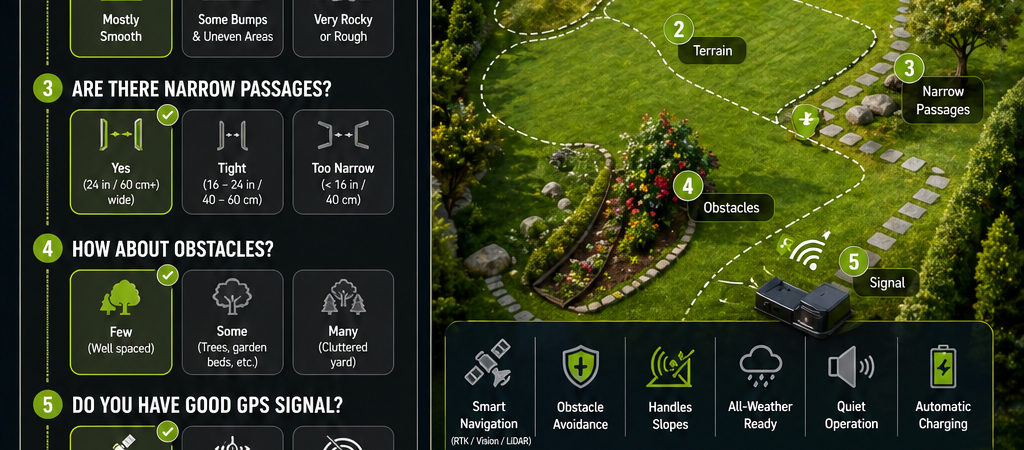
(Editor’s Note: This is a text-based simulation of an interactive tool. Mentally check the boxes that apply to your property.)
1. Complexity Check:
- My yard is a simple, flat square/rectangle (Score: +1)
- I have 2-4 distinct “zones” separated by a driveway or fence (Score: -1)
- I have 5+ zones or significant wooded areas with exposed roots (Score: -2)
2. The Slope Challenge:
- My entire yard is flat or gently rolling (Score: +1)
- I have slopes up to 20 degrees (a moderate hill) (Score: -1)
- I have steep embankments exceeding 25 degrees (Score: -3)
3. Obstacle Density:
- Few obstacles, just clean tree trunks (Score: +1)
- I have a trampoline, swing set, and garden furniture to navigate (Score: -1)
- I have dense roots, exposed rocks, and low-hanging shrubs (Score: -2)
4. Clutter Quotient (Be Honest):
- I never leave hoses, toys, or tools on the lawn (Score: +1)
- We often have a kids’ soccer ball or a stray bone in the grass (Score: -2)
Results:
- Score 3-4 (Prime Candidate): An entry-level wire-installed bot will likely solve your problem immediately.
- Score -1 to 2 (Technical Solution Needed): Don’t worry. You need a high-torque, AI-driven unit. Read the “Problem-Solving Matrix” below.
- Score -3 or Lower (The “Impossible” Yard): Your yard isn’t impossible; it just requires the most advanced tech and strategic landscaping tweaks. This guide is built for you.
Why They Get Stuck: The 4 Barriers to “Set-it-and-Forget-it”
If a high-end owner asks, “Will a robot mower work in my yard?” the default answer isn’t yes, but “Yes, after we solve for X.” Based on deep dives into installer forums, Reddit’s r/automower community, and manufacturer white papers, failures almost never stem from the robot’s motor, but from the environment.
1. The “No-Man’s Land” Geometry
Traditional wire-guided bots rely on a closed loop. Narrow passages—those “pinch points” between a flower bed and a retaining wall—are murder for random-navigation bots. It bumps, turns, bumps again, and triggers a “trapped” error. For estate properties with separated lawns, a guaranteed way to ensure a robot mower will work in my yard is to ensure you have a multi-zone management capability.
2. The Suspension-Crusher Terrain
Not all slopes are created equal. A 20-degree incline measured by a manufacturer is a smooth plane. A 20-degree bumpy, rutted hill is entirely different. Wheels lose traction, the rear end spins out, and the machine digs itself into a grave. If you have bare spots under trees where rain has washed out the topsoil, that’s a choke point.
3. The “Invisible” Boundary Issues
For wired systems, the perimeter is a delicate antenna. A break caused by aeration, a chewing rodent, or a loose connector is the #1 cause of “dead bot” syndrome. It’s the “check your router” equivalent of the lawn care world.
4. The Maintenance Disconnect
A robot is not a brush hog. It relies on shaving microscopic clippings. If you activate a mower for the first time in June when the fescue is eight inches high, the cutting deck becomes a clogged, green paste factory. The bot will error out, and you’ll conclude it’s a toy. It’s not; it’s a maintenance tool that requires a one-time “rough cut” to baseline the height.
The Ultimate Problem-Solving Matrix: Stopping Failures Before They Happen
This is where we transition from identifying pain to prescribing relief. To guarantee a robot mower will work in my yard, we must match the specific problem with a specific tech or behavioral solution.
| If You’re Facing… | The “Band-Aid” Fix (Immediate) | The Permanent, Smart Upgrade |
|---|---|---|
| Steep, Slippery Slopes | Install terramesh or sod on bare soil to restore traction; schedule mowing only when grass is bone dry. | Upgrade to an All-Wheel Drive (AWD) chassis with deep-tread tires (like the MOVA NAVAX 5000 AWD). These units redistribute torque mid-slope. |
| Narrow Passages & Tight Gaps | Create “virtual funnels” by angling temporary physical borders (stones/bricks) to guide the bot through. | Ditch the wire. A LiDAR or Vision-based RTK bot (like the Toro Haven) maps the yard in 3D. It knows the GPS coordinates of a 36-inch gap as specifically as a Tesla navigates a garage. |
| Broken Perimeter Wires | The “AM Radio Trick”: A portable radio tuned to static can detect the wire break signal underground. | Go Wire-Free. Modern RTK-GPS systems use a reference antenna (now often integrated into the charging station) for cm-level accuracy without a physical loop. |
| Getting Stuck on Roots | Inspect the area and fill ruts with a sand/soil mix to smooth the terrain. | Use the app’s “Digital No-Go Zone” feature. Draw an invisible fence around the exposed root cluster. The bot will mow right up to the edge without trying to climb it. |
| Overgrown Grass | Do a manual “rough cut” with a traditional high-wheel mower first. Bag the clippings. | Set the robot’s schedule to “Adaptive Growth” mode. Sensors detect grass resistance and automatically boost blade speed or extend run time during spring growth spurts. |
The Tech Behind the Freedom: Wire-Free vs. Wired vs. Vision
To a property manager or wealthy homeowner, time is the ultimate luxury, not money. Here is how the architecture of the bot directly dictates whether a robot mower will work in my yard seamlessly.
Wired Systems (Legacy but Sturdy)
These are the “closed circuit” workhorses. If you have a massive, uninterrupted field of grass—think 1-2 acres of pure turf with a simple shape—a wired bot is a cost-effective tank. The downside? Installation can be a half-day affair of hammering stakes, and if you’re a landscape renovator, cutting that wire with a spade is a constant risk.
RTK-GPS Systems (The High-End Estate Solution)
This is the current gold standard for complex suburban estates. A base station on your roof or the charging dock talks directly to satellites, correcting the signal so the mower knows its position within 2 centimeters.
- Why it Matters for You: If your question is “Will a robot mower work in my yard if it has a front and back section separated by a gravel driveway?” the RTK system is your answer. It doesn’t need a physical wire to cross the driveway; it simply drives over, knowing exactly where the grass begins again.
Vision & AI Systems (The Future)
Brands like Toro’s Haven and the next-gen ecoVacs GOAT series are ditching both wires and complex satellite setups. Using multiple HDR cameras and neural network processors, the mower physically “sees” the difference between grass and gravel, or a daisy and a dog toy.
- The Killer Use Case: If you have fruit trees dropping heavy debris or a constantly shifting obstacle set (like a trampoline moved by the wind), vision-based systems avoid obstacles dynamically without needing to physically bump into them.
The 60-Second “Robot-Proofing” Audit
Even the smartest AI eye can’t clear physical debris. Adopting a simple “robot clean” habit makes the difference between a 100% success rate and a 40% failure rate.
Before you close the garage each night, perform a quick sweep of the mowing edge:
- The Hose Check: A dark green hose on dark green grass is the #1 object that destroys cutting blades.
- The Stick Sweep: After a storm, walk the zone. A 1-inch thick branch jamming the blade disc is the most common “trapped” alert on Reddit threads.
- The Sprinkler Audit: Mowers read protruding sprinkler heads as immovable walls. Ensure all pop-ups retract fully. Level any fixed metal donuts to be flush with the soil.
Case Studies: “But My Yard Is Different”
To reassure you that a robot mower will work in my yard, let’s look at how specific high-end problems were solved.
The San Francisco Hillside Estate:
A property manager oversaw a 1.5-acre lawn with a 28-degree slope ending in a koi pond. Traditional ride-ons were a turnover risk. The solution? A fleet of two AWD robots with a boundary wire offset 5 feet from the water’s edge. The bots mow horizontally across the face during dry windows (10 a.m. to 2 p.m.) via the app’s schedule, eliminating slippage.
The Multi-Zone Suburbanite:
A homeowner had a front yard, a side passage, and a fenced backyard pool area. The passage was a tight 40-inch pinch point. Wire guided bots kept getting lost. The upgrade? An RTK mower with a single base station. The owner created three distinct “work areas” in the app. The mower now traverses the sidewalk three times a week autonomously, achieving coverage that previously took 3 separate manual sessions.
Conclusion: The Smart Upgrade
You’re not just buying a machine; you’re investing in a lifestyle where weekends feel like weekends again. The mental load of the “looming” task evaporates when the algorithm takes over.
The path to success isn’t just asking “Will a robot mower work in my yard?” It’s asking if you’re ready to adapt the yard slightly to receive the technology. If you can fill in the ruts, clear the hoses, and—crucially—choose the right guidance system (wire for simplicity, RTK for complexity, Vision for obstacle-heavy), the answer is a definitive, liberating yes.
The physical relief from heat and fatigue, the safety assurance of not balancing a 300-pound machine on an embankment, and the sheer pride of a perpetually manicured golf-course turf are not just promises; they are the standard experience of the owners who made the switch.
Stop battling the terrain. Connect it to the cloud. That smart, modern upgrade isn’t just about the lawn; it’s about reclaiming ownership of your time, every single day.
Make this the year your lawn mows itself! Explore our top picks and secure the best robot mower for steep slopes through the trusted affiliate links above and below. Your weekends (and your back) will thank you.
Disclaimer: This article contains affiliate links. As an Amazon Associate, I earn from qualifying purchases. Prices fluctuate, but the recommendation logic remains the same. Always check the slope rating before buying.