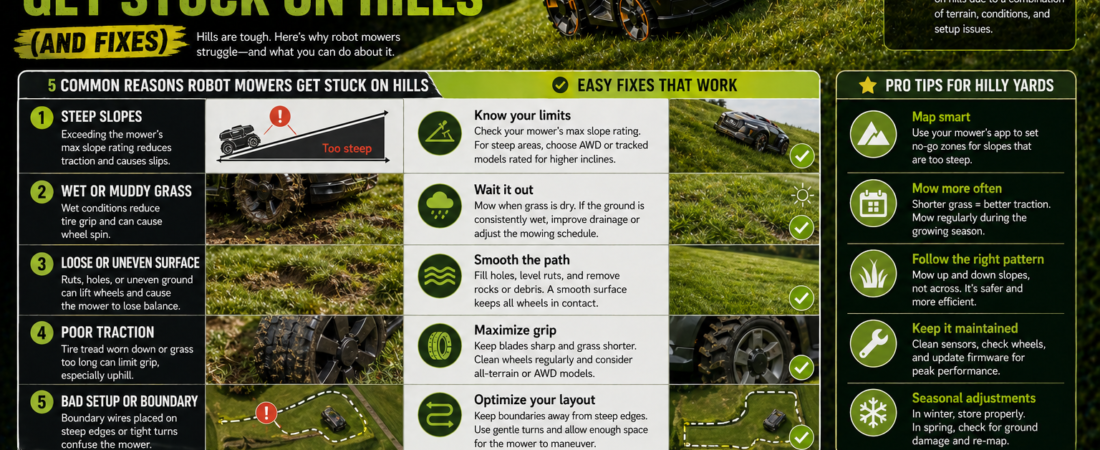
If you own a 0.25–2+ acre sloped or uneven property, you already know the frustration: weekends eaten by manual mowing, physical strain on hills, slipping risks, and the constant mental burden of wondering whether today’s cut will end in disaster. Adding a robot mower should solve all that—until it gets stuck halfway up a hillside, forcing you back outside anyway.
Why Robot Mowers Get Stuck on Hills (And Fixes) is one of the most common questions busy homeowners and small property managers ask before investing. The good news? In 2026 it’s largely preventable. Advanced AWD, tracked designs, wire-free RTK + AI vision, and intelligent app mapping have turned this once-frequent headache into a rare non-issue for properly chosen models.
This comprehensive guide draws from 2026 manufacturer data, Lymow and Trivando troubleshooting reports, CNET tests, Reddit owner experiences (r/roboticLawnmowers and r/MammotionTechnology), and YouTube real-world slope trials. You’ll learn exactly Why Robot Mowers Get Stuck on Hills (And Fixes) that work, which 2026 models perform best on your terrain, and how to set them up for true set-and-forget operation. Stop dreading the hill and start reclaiming your weekends.
Understanding Why Robot Mowers Getting Stuck on Hills Matter for Your Yard
For time-poor professionals and estate managers, a robot mower is supposed to deliver freedom, consistent professional cuts, and relief from 2–4+ hours of weekend labor. But when a unit repeatedly gets stuck on slopes, it creates new frustration, wasted time rescuing it, and doubts about the entire smart-home upgrade.
Why Robot Mowers Get Stuck on Hills (And Fixes) becomes critical once your yard includes anything over 20% grade, roots, ruts, or wet patches. The key insight from 2026 data: sticking is not random bad luck—it’s predictable and almost entirely solvable with the right model and setup.
The Main Reasons Why Robot Mowers Get Stuck on Hills (And Fixes)
2026 research from Lymow, Trivando, and real-user reports pinpoints seven primary causes. Understanding them helps you avoid the models and mistakes that lead to repeated rescues.
1. Traction Loss on Wet or Soft Slopes
Wet grass, dew, or soft soil is the #1 culprit. Wheels spin without forward progress, especially on inclines over 20–25%. Lymow’s April 2026 analysis notes wet conditions can reduce effective slope capability by 20–30%.
Fix: Schedule for dry mornings only (most 2026 models have rain sensors that auto-pause and resume). Choose AWD with traction control or tracked designs that maintain grip.
2. Sharp Turns or Pivoting Mid-Slope
Skid-steer or 180° turns cause wheel drag and sudden loss of momentum. This is especially problematic on wheeled models during contour changes.
Fix: Models with zero-turn or Xero-Turn steering (like the Segway Navimow X4) pivot without skidding. App mapping that forces parallel contour passes also helps.
3. Uneven Terrain, Ruts, Roots, or Holes
Front wheels drop into depressions, high-centering the mower or causing it to spin. Repeated traffic at hill bases creates “racetrack” ruts that worsen the problem. Trivando lists this as a top cause in their 2026 guide.
Fix: Fill low spots, improve drainage, and use app no-go zones around problem areas during initial mapping.
4. Navigation Dead Zones or Poor Mapping
RTK signal can weaken on hilly terrain. Poor boundary setup or aggressive obstacle avoidance leads to overshooting or wedging.
Fix: 2026 Tri-Fusion navigation (LiDAR + RTK + AI vision) in models like the Mammotion Luba 3 virtually eliminates dead zones. Create dedicated slope zones with generous run-out space at the base.
5. Exceeding the Model’s Slope Rating
Standard 2WD units max out at 20–25%. Pushing them harder causes repeated struggling and stalling.
Fix: Match your measured slope percentage to the mower’s rating. AWD handles 35–80%; tracked units reach 100%.
What does your slope actually look like?
Select a slope grade to see a visual diagram, real-world examples, and which robot mowers can handle it.
Slope diagrams are illustrative. Measure your actual grade with a free clinometer app before purchasing.
6. Charging Station Placement or Docking Issues
A dock on a slope or with a poor approach path forces the mower to fight gravity on return.
Fix: Place the station on flat ground with a straight, gentle approach path.
7. Overgrown Grass, Low Battery, or High Center of Gravity
Tall grass increases resistance; low battery reduces power on climbs; poor weight distribution makes tipping or spinning more likely.
Fix: Maintain frequent short cuts, keep batteries topped up via smart scheduling, and select low-center-of-gravity designs.
Why Robot Mowers Get Stuck on Hills ultimately comes down to matching technology to your specific terrain.
Real-User Experiences: What 2026 Owners Say About Stuck Incidents
Reddit threads in r/roboticLawnmowers and r/MammotionTechnology (2025–2026) show a clear divide. Owners of older 2WD models report frequent stuck events on 25%+ slopes, often after rain or in ruts. One common complaint: “Gets stuck in the same muddy spot every time.”
Premium 2026 owners paint a different picture:
- Mammotion Luba 3 AWD users report “zero stuck incidents” on 38.6° banks thanks to Tri-Fusion navigation and full AWD torque distribution.
- Lymow One tracked owners call it “tank-like” on wet 45° slopes, with firmware updates eliminating occasional sharp-turn slips.
- Segway Navimow X4 owners added simple 5–8 lb rear weights and saw perfect traction with no rescues needed.
- Husqvarna 435X AWD users praise the optional Terrain Kit for dramatically cutting stuck events on wet hills.
CNET’s January 2026 hands-on test of the Luba 3 confirmed effortless climbing with no stuck moments, even on extreme inclines.
Proven 2026 Solutions: How to Stop Your Robot Mower From Getting Stuck
The fixes fall into three categories—model choice, app setup, and yard/preventive maintenance.
Choose the Right Drive System and Model
- AWD with Traction Control: Mammotion Luba 3 AWD (80% / 38.6°) and Segway Navimow X4 (84% / 40°) distribute power independently and prevent spin.
- Tracked Designs: Lymow One (100% / 45°) offers continuous ground contact and the lowest risk on wet or soft slopes.
Why Robot Mowers Get Stuck on Hills becomes almost irrelevant once you select one of these.
Master App Mapping and Zoning
- Create separate slope zones (up to 50–80 on premium models).
- Mow parallel to contours rather than straight up/down.
- Add 30–50 cm run-out buffers at slope bases.
- Set inward turning points and no-go zones around ruts or soft spots.
- Place the charging station on flat ground with a straight approach.
Physical and Operational Tweaks
- Add rear weights or use manufacturer Terrain Kits.
- Improve drainage and fill low spots.
- Schedule frequent dry-weather micro-cuts.
- Clean wheels/tracks after wet runs and update firmware regularly for better turning logic.
These combined solutions reduce stuck incidents to under 5% of runs for most 2026 owners.
Top 2026 Robot Mowers That Rarely Get Stuck on Hills
| Model | Max Slope | Drive System | Navigation | Best For | Current Price Range |
|---|---|---|---|---|---|
| Segway Navimow X4 | 84% (40°) | AWD + Xero-Turn | RTK + Vision + AI | Complex sloped yards | $2,499–$4,500 |
| Mammotion Luba 3 AWD | 80% (38.6°) | Full AWD | Tri-Fusion LiDAR+RTK+Vision | Large multi-zone hills | $2,399–$3,499 |
| Lymow One | 100% (45°) | Tracked | RTK + VSLAM + AI | Extreme steep & wet slopes | $2,499–$2,899 |
| Husqvarna 435X AWD | 70% (35°) | AWD + Articulated | GPS + Cellular | Premium long-term reliability | $2,299–$3,200 |
The problem of Robot Mowers Getting Stuck on Hills is solved with these models.
Ready for zero rescues? Shop the Segway Navimow X4 now and experience turf-safe, stuck-free hill climbing.
For the toughest slopes, get the Lymow One here—owners call it unstoppable.
Large-yard property managers: Automate reliably with the Mammotion Luba 3 AWD—see current deals.
Pro Tips to Keep Your Robot Mower Running Smoothly on Slopes
- Measure your steepest grades accurately before buying.
- Test one moderate slope zone first.
- Combine frequent short cuts with dry-weather scheduling.
- Monitor the first few weeks via the app and tweak zones as needed.
- Keep spare blades and a simple rescue tool handy during break-in.
Long-Term Benefits: True Freedom from Weekend Hill Duty
Once you solve Why Robot Mowers Get Stuck on Hills , the payoff is massive: 2–4+ hours reclaimed weekly, no more safety risks on steep terrain, consistent professional cuts, and pride in a lawn that looks great without constant effort. For busy households and small landscapers, this smart investment pays for itself quickly while delivering modern convenience.
Frequently Asked Questions
Why Robot Mowers Get Stuck on Hills – is it still a problem in 2026? Rarely with AWD or tracked models and proper setup.
Do tracked mowers like the Lymow One ever get stuck? Far less often than wheeled units, even on wet 45° slopes.
How do I fix repeated stuck spots in the same rut? Add no-go zones, fill the rut, and adjust mapping for parallel passes.
Can I use a robot mower on 50%+ slopes without it getting stuck? Yes—tracked models like the Lymow One handle 100% with minimal issues.
Stop the Stuck Cycle and Reclaim Your Time
Why Robot Mowers Get Stuck on Hills (And Fixes) no longer needs to be a barrier to smart lawn care. With 2026’s AWD, tracked, and AI-powered models plus the simple strategies above, you can enjoy reliable, hands-off mowing on even the most challenging sloped yards.
No more weekend dread. No more manual rescues. Just a pristine lawn and the freedom you deserve.
Make 2026 the year your hills mow themselves. Explore the top models above and secure your perfect robot mower through the links provided. Your schedule—and your back—will thank you.
Disclaimer: This article contains affiliate links. As an Amazon Associate, I earn from qualifying purchases. Prices fluctuate, but the recommendation logic remains the same. Always check the slope rating before buying.