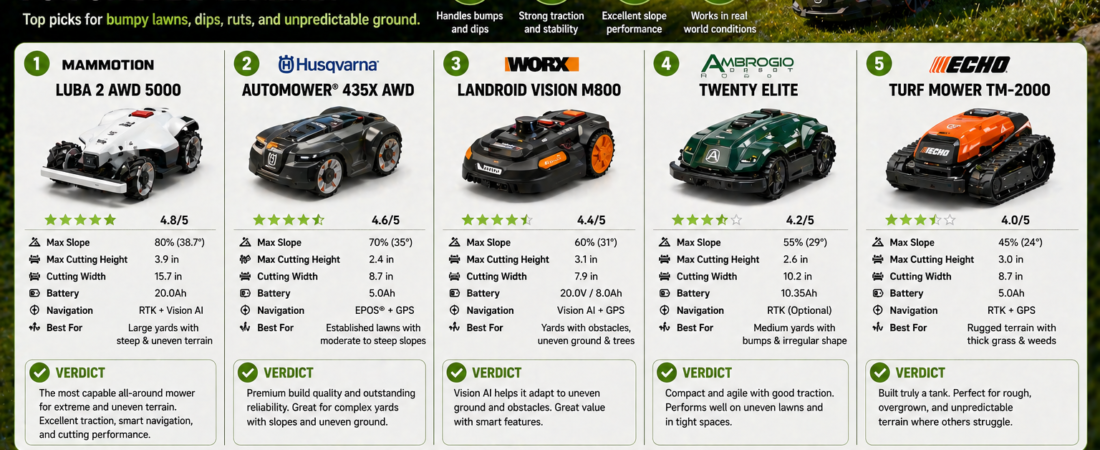
If your lawn has divots, exposed roots, drainage dips, or ground that rolls and shifts in every direction, you’ve probably already discovered that most robot mower reviews weren’t written with your yard in mind. The typical test lawn is flat, smooth, and obstacle-free. Your yard is none of those things.
Uneven terrain creates a set of problems that are distinct from slopes alone — and most buyers don’t fully understand what those problems are until they’ve already bought the wrong machine. Scalping on raised sections. Missed strips in depressions. Wheels that drop into holes and beach the chassis. Ruts dug by spinning wheels at turning points. Tilt sensors that stop the machine unnecessarily on natural ground variation.
This guide covers exactly what happens when a robot mower meets uneven ground, why it happens, what solutions exist, and the five robot mowers for uneven terrain that handle it best in 2026.
Why Uneven Terrain Is Harder Than It Looks
The Three Real Problems — Not Just One
Most homeowners assume bumpy ground is a traction problem. It’s actually three separate problems operating simultaneously.
The scalping and deck geometry problem. When a robot mower’s chassis tilts over a raised section, a fixed cutting deck tilts with it. Blades that were set to cut at the correct height are now too close to the raised ground — they scalp it — while the opposite side of the deck is now too high and misses the grass entirely. Uneven ground causes the cutting deck to tilt, which produces irregular results. Higher spots may be left uncut, while lower sections may be scalped. This inconsistency creates a distracting visual effect and can weaken turf health.
The beaching problem. When a wheel drops into a depression, the chassis can bridge the gap and lose ground contact entirely. The machine is stuck — not because it ran out of traction, but because its geometry won’t let it climb out. Small wheels, low ground clearance, and rigid chassis are the cause. Many robot mowers will drive into a little divot in the ground and dig it out; even the ones that are smarter and can move each wheel independently will dig holes in your garden while unsticking themselves.
The rut and compaction problem. When wheels spin on soft or uneven ground — especially at turning points where the machine changes direction — they dig into the turf. On robot mowers that follow consistent paths, this creates ruts at predictable locations that worsen with every mowing cycle. The general advice among lawn experts is to never mow a waterlogged lawn with either a robot or a standard mower. Davis says it’s especially important to avoid using a robot mower, as the wheels are likely to spin and cause ruts, the mower will get stuck, and it will result in a poor overall cutting performance.
Understanding these three separate failure modes is what separates buyers who choose the right robot mowers for uneven terrain from buyers who return their machine after the first month.
Before You Buy: Prepare Your Yard First
Here’s the advice most buying guides skip entirely: the best investment you can make before buying a robot mower for an uneven yard is often not the mower — it’s ground preparation. A moderately capable mower on a well-prepared lawn will consistently outperform a premium mower on a neglected surface.
Topdressing with sand-soil mix is the most accessible fix for minor bumps and depressions. Prepare your topsoil mixture by combining equal parts topsoil and sand. Spread the prepared soil over the depressions on your lawn, then use the back of a push broom, garden rake, or leveling rake to smooth the soil mixture. Apply no more than half an inch at a time to allow grass to grow through. Repeat over multiple seasons for significant unevenness.
For deeper holes, the sweeping-under-the-carpet technique works without damaging existing grass. Start by cutting and lifting the healthy grass patch with a shovel, ensuring the roots remain intact. Once lifted, fill the hole with a soil mix until it levels with the surrounding ground. Then, reposition the grass patch and press it down for good soil contact.
For areas that cannot be levelled — large exposed roots, embedded rocks, drainage features — use app-based no-go zones to exclude them from the mowing path. The machine handles accessible terrain, and problem sections are managed separately or excluded entirely.
Before the first robot run, use a normal mower to trim your lawn to lower than 10cm, and remove from the lawn any items that may trap the robot such as piles of leaves, stones, toys, fruits, and loose wires. Check the locations where the robot gets stuck for small holes and fill any you find.
What to Look for in Robot Mowers for Uneven Terrain
Not all premium robot mowers are built equally for complex ground. These are the specific features that actually make a difference.
Adaptive or independent suspension is the most important hardware upgrade for uneven terrain. This allows each wheel to follow the terrain independently while the chassis stays level — keeping the cutting deck parallel to the ground regardless of surface variation. The Mammotion LUBA 3 AWD clears obstacles up to 3.15 inches via its adaptive suspension. The Segway Navimow X4 has dual suspension specifically designed for bumpy ground traversal.
Floating cutting decks adjust blade height relative to the actual ground surface, not the chassis angle. This directly prevents scalping on raised sections.
AWD with Traction Control prevents the wheel-spin digging that creates additional unevenness at turning points. The Segway TCS system detects wheel slip in real time and redistributes power before spinning occurs.
Turf-safe turning mechanisms — like Segway’s Xero-Turn technology — prevent the turning damage that standard skid steering creates, which compounds unevenness over time. The i2 AWD’s turf-safe Xero-Turn AWD technology allows the mower to pivot tightly and change direction without scuffing, digging, or leaving unsightly divots behind.
High obstacle crossover rating determines whether the mower can traverse roots and uneven sections without beaching. Look for 70mm or above.
AI navigation that learns — rather than random-pattern mowing — identifies problem areas over time and adjusts routes to avoid repeated stuck incidents.
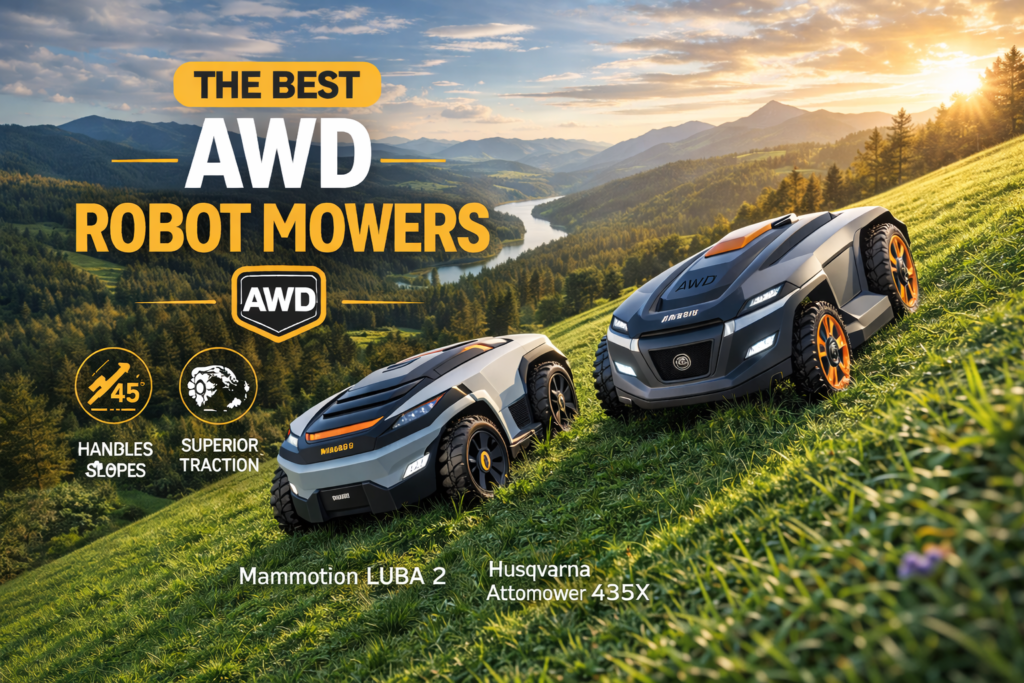
Chekout our deep dive into the best AWD Robot Mowers
The 5 Best Robot Mowers for Uneven Terrain
Quick Comparison Table
| Model | Suspension | Obstacle Clearance | Drive | Navigation | Coverage | Price |
|---|---|---|---|---|---|---|
| Mammotion LUBA 3 AWD | Adaptive (3.15 in) | 80mm | AWD | Tri-Fusion (LiDAR + RTK + AI) | 1.25 ac | ~$3,499 |
| Segway Navimow X4 | Dual suspension | High | AWD + TCS | RTK + Vision | 1.5 ac | ~$2,499 |
| Segway Navimow i2 AWD | Standard | Moderate | AWD + TCS | RTK + Vision | 0.25 ac | ~$1,299 |
| Mammotion LUBA 2 AWD | Adaptive (3.2 in) | 80mm | AWD | RTK + AI Vision | 1.75 ac | ~$2,999 |
| Lymow One Plus | Tracked (conforms) | 70mm | Tracked | RTK + VSLAM | 1.73 ac/day | ~$2,999 |
1. Mammotion LUBA 3 AWD — Best Overall Robot Mower for Uneven Terrain
Max slope: 80% / 38.6° | Coverage: 1.25 acres | Price: ~$3,499 Obstacle clearance: 80mm (3.15 in) | Navigation: Tri-Fusion (LiDAR + RTK + AI Vision)
 [Check current price on Mammotion’s official site → CLICK HERE]
The Mammotion LUBA 3 AWD is the most technically capable robot mower for uneven terrain among wheeled residential machines in 2026. Its upgraded adaptive suspension clears obstacles up to 3.15 inches — curbs, thick roots, and raised thresholds that beach most competitors. Four independently driven motors deliver confident control on steep or uneven ground, climbing 80% slopes, holding a steady line on hillsides, and pivoting cleanly with an omni wheel to protect turf.
The Tri-Fusion Navigation system — combining 360° LiDAR, dual-camera AI Vision, and RTK satellite positioning — is what sets the LUBA 3 apart for the specific combination of uneven terrain and tree cover that characterises most complex residential properties. Under tree canopy where GPS-only systems drift and miss strips, the LiDAR provides positional backup that keeps the machine on track. Unlike many RTK-only competitors, the system is designed to remain stable under tree cover, changing light conditions, and uneven terrain.
Independent testing confirmed its real-world capability: the AWD system tackled our 45-degree test bank. The terrain was wet after January’s rainy spell, yet it experienced minimal slippage.
Pros:
- Highest suspension clearance among wheeled robot mowers (80mm)
- Tri-Fusion navigation handles uneven terrain under tree cover reliably
- Four independent AWD motors prevent wheel spin on complex ground
- Omni-wheel turning reduces turf damage at direction change points
- Recognises 300+ obstacle types including pets and toys
Cons:
- Premium price at ~$3,499
- App zone management can be fiddly for first-time users
- LiDAR module is a moving part — adds a degree of long-term fragility
- Some reports of turf damage from skid steering on soft ground after extended use
2. Segway Navimow X4 — Best for Turf Preservation on Uneven Ground
Max slope: 84% / 40° | Coverage: Up to 1.5 acres | Price: ~$2,499 Navigation: RTK + Vision | Drive: AWD + Xero-Turn + TCS
[Check current price on Amazon → CLICK HERE]
The Segway Navimow X4 approaches uneven terrain from a different angle than the Mammotion — rather than prioritising maximum obstacle clearance, it prioritises preventing the additional damage that a mower causes to uneven ground over time. The Xero-Turn system eliminates skid-steering entirely, which means the X4 doesn’t dig new ruts and divots at turning points the way standard AWD machines do. On already-uneven lawns, this is a meaningful long-term advantage.
The AWD of the X4 series is phenomenal. It powers all wheels so that the mower can conquer any kind of terrain, especially those where normal robotic and traditional mowers fail. It handles uneven and bumpy lawns because of its dual suspension and powerful drive system. It can go over border curbs, potholes, gravel paths, and almost any complicated turf.
The Traction Control System adds an important layer specifically for uneven terrain: it detects wheel slip and redistributes power before spinning begins — preventing the hole-digging that makes uneven ground progressively worse. The Navimow X4 Series addresses the three problems that have held the category back for years: slope capability, turf damage during turns, and navigational reliability without perimeter wires.
Pros:
- Xero-Turn technology is the most turf-friendly AWD turning system available
- Dual suspension handles potholes, curbs, and gravel paths
- TCS prevents wheel-spin hole digging in real time
- 84% slope rating — highest among wheeled residential mowers
- Polished Segway app with strong multi-zone management
Cons:
- Vision-based obstacle avoidance is less effective at night
- ~$2,499 is a significant investment for smaller yards
- Coverage tops out at 1.5 acres — not suitable for large estates
3. Segway Navimow i2 AWD — Best Value Robot Mower for Uneven Terrain
Max slope: 45% / 24° | Coverage: Up to 0.25 acres | Price: From ~$1,299 Navigation: RTK + Vision | Drive: AWD (3-wheel) + Xero-Turn + TCS
[Check current price on Amazon → CLICK HERE]
For smaller properties with uneven terrain — the suburban backyard with drainage dips, animal-dug holes, and surface roots — the Segway Navimow i2 AWD delivers the same Xero-Turn and TCS technology as the flagship X4 at a significantly lower price. The coverage limitation of 0.25 acres means it isn’t right for large properties, but for the homeowner battling a genuinely awkward small or medium yard, it is one of the smartest purchases in the category.
Bringing AWD to an entry-level robot isn’t just impressive, it’s essential. Many will drive into a little divot in the ground and dig it out; even the ones that are smarter and can move each wheel independently will dig holes in your garden while unsticking themselves. Nobody wants to have to move around the garden, levelling it out and fixing the holes a robot might dig.
The 9.8-inch off-road wheels give it meaningful ground clearance for its size class, and the real-time traction adjustment prevents the progressive worsening of terrain that basic mowers cause. For the average, slightly bumpy, sloped British garden below 1000sqm, this is one of the smartest purchases you can make in 2026.
Pros:
- Most accessible price point for genuine AWD + TCS capability
- Xero-Turn prevents turning damage on soft, uneven ground
- 9.8-inch off-road wheels handle roots and minor surface obstacles
- Excellent app maturity and reliability
- Ideal for 0.25-acre yards that previous mowers consistently failed on
Cons:
- Coverage limited to 0.25 acres — not for large properties
- 45% slope rating only — not for extreme terrain
- Standard suspension lacks the premium clearance of the LUBA 3 or X4
4. Mammotion LUBA 2 AWD — Best Proven Platform for Uneven Terrain
Max slope: 80% / 38.6° | Coverage: Up to 1.75 acres | Price: ~$1,999 Obstacle clearance: 80mm (3.2 in) | Navigation: RTK + AI Vision (UltraSense)
[Check current price on Amazon → CLICK HERE]
The LUBA 2 AWD is the most field-tested robot mower for uneven terrain on this list. While the LUBA 3 has newer hardware, the LUBA 2 has the largest real-world user base of any premium AWD wire-free mower, meaning the performance data on complex ground is extensive and well-documented. For buyers cautious about first-generation hardware, the LUBA 2’s track record is a meaningful advantage.
The LUBA 2’s most impressive feature is how it handles rough ground thanks to its adaptive suspension arm system and terrain sway technology. It easily clears bumps up to 3.2 inches high, which makes it perfect for lawns with small holes, stones, or different ground levels.
The UltraSense AI Vision system provides triple-redundant obstacle detection that handles the unpredictable nature of uneven terrain — roots that appear seasonally, animal holes that weren’t there last month, debris that accumulates in depressions after rain.
Pros:
- Largest real-world user base of any premium AWD wire-free mower
- 80mm obstacle clearance proven across thousands of real properties
- Triple-redundant obstacle detection for complex terrain
- 1.75-acre coverage — best in the wheeled AWD category
- Strongly established community for troubleshooting support
Cons:
- Being superseded by LUBA 3 — may become harder to find new stock
- App has had stability issues (improved but ongoing)
- Some users report navigation hesitation on steep side-hill traverses
- Turf damage at turning points reported after extended use
5. Lymow One Plus — Best for Extreme Uneven Terrain
Max slope: 45° / 100% | Coverage: 1.73 acres/day | Price: ~$2,999 Navigation: RTK + VSLAM | Drive: Continuous rubber tracks | Waterproofing: IPX6
[Check current price on Amazon → CLICK HERE ]
The Lymow One Plus solves the uneven terrain problem from a fundamentally different engineering angle than every other machine on this list. While wheeled mowers rely on suspension and traction control to manage uneven ground, the Lymow’s continuous rubber tracks simply conform to whatever surface they encounter. There is no suspension gap to bridge, no wheel to drop into a hole, no turning rut to create. On uneven terrain, on slopes or on soft ground, the robot remains more stable, controllable, and tracks better than many robotic mowers with a classic wheel drive. The wide tracks distribute the weight better on the ground and significantly improve traction.
For properties where the uneven terrain includes genuinely rough ground — large roots, drainage ruts, gravel patches, soft clay after rain — the tracked approach outperforms even the best wheeled AWD systems. For more complex terrain challenges like large oak roots or uneven ground, the ultrasonic sensors provide precision distance data that allows the mower to navigate the crossing safely without getting stuck. eufy
The 70mm obstacle crossover capability, combined with the track system’s inherent ability to bridge short gaps without beaching, makes it the most capable robot mower for genuinely rough, complex ground.
Pros:
- Tracks conform to terrain rather than trying to overcome it — the most fundamental terrain solution
- 70mm obstacle clearance handles roots, ruts, and raised surfaces
- No turning ruts — tracks distribute turning stress across a larger surface
- Real rotary blades (not razor strips) handle thick grass and debris better
- LiFePO₄ battery rated for 2,000 cycles — best longevity on this list
Cons:
- Heavy at ~78 lbs — requires two people for initial setup and repositioning
- Newer brand with a developing support network
- Occasional app stability issues reported by early users
- Thick wet grass can clog the side discharge port
- Not for perfectly flat fine lawns where precision cut finish is the priority
Which Robot Mower for Uneven Terrain Is Right for You?
Choosing between these five robot mowers for uneven terrain comes down to the specific type and severity of your ground challenges.
If your yard has moderate unevenness with roots and drainage dips across a large area — the Mammotion LUBA 3 AWD is the complete package: highest suspension clearance, Tri-Fusion navigation under tree cover, and independent AWD for complex surfaces.
If your priority is protecting your lawn’s condition while mowing uneven ground — the Segway Navimow X4’s Xero-Turn and TCS combination is the most turf-preserving option. It doesn’t just cope with uneven terrain — it actively avoids making it worse.
If your yard is smaller (under 0.25 acres) with genuinely awkward terrain — the Segway i2 AWD delivers the same core technology at a fraction of the flagship price. For the suburban homeowner whose smaller yard has defeated every previous mower, this is the value pick.
If you have proven success with the LUBA platform and want maximum coverage capacity — the LUBA 2 AWD remains the most field-tested robot mower for uneven terrain in the residential category, and its 1.75-acre coverage edges out the LUBA 3 on pure area capacity.
If your ground is genuinely extreme — soft clay slopes, dense root systems, drainage ruts, or terrain that has broken multiple wheeled machines — the Lymow One Plus’s tracked system is the only residential robot mower where uneven terrain is a genuine design strength rather than a managed limitation.
The Bottom Line
Uneven terrain is the scenario that separates robot mowers that genuinely work in the real world from ones that look good in controlled reviews. The problems it creates — scalping, beaching, rut formation, missed strips — are solvable, but only by choosing a machine with the right hardware for your specific ground conditions and, critically, by doing the groundwork to prepare your yard before the mower starts.
The best robot mowers for uneven terrain don’t just tolerate complex ground. They’re engineered for it. Every model on this list handles the three core failure modes differently — through suspension, traction control, turf-safe turning, or tracked drive — and understanding which solution fits your terrain is what drives the right buying decision.
For most homeowners, the LUBA 3 AWD or Segway X4 will be the answer. For smaller yards, the i2 AWD. For the most demanding ground, the Lymow One Plus.
Stop fighting your yard. Let the right machine fight it for you.
[Use our free Yard Compatibility Checker to match the right mower to your terrain → CLICK HERE]
[Compare all top-rated robot mowers side by side → CLICK HERE]
[Check current pricing on the Mammotion LUBA 3 AWD → CLICK HERE]
Make this the year your lawn mows itself! Explore our top picks and secure the best robot mower for steep slopes through the trusted affiliate links above and below. Your weekends (and your back) will thank you.
Disclaimer: This article contains affiliate links. As an Amazon Associate, I earn from qualifying purchases. Prices fluctuate, but the recommendation logic remains the same. Always check the slope rating before buying.