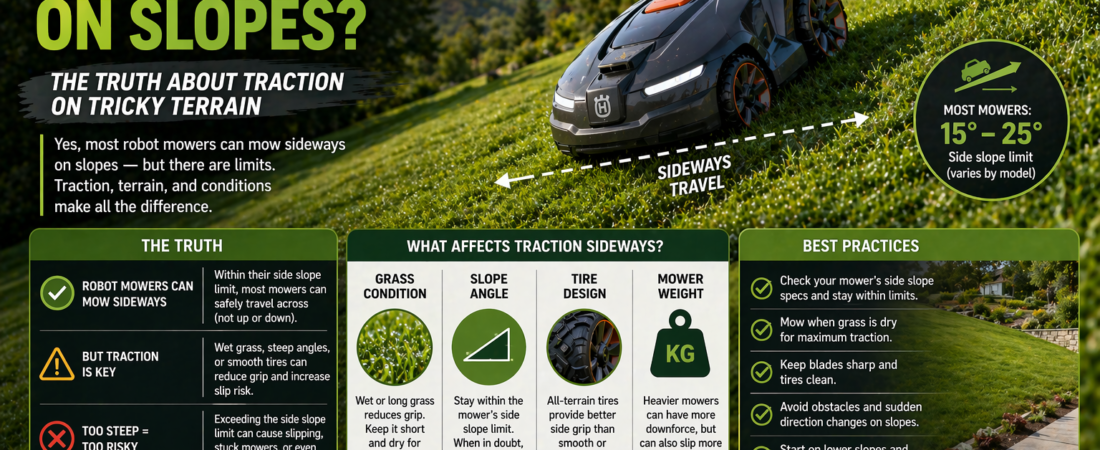
There is a specific kind of dread reserved for the homeowner of a sloped lawn. It’s not just the physical exertion of pushing a 200-pound gas mower up a 25-degree incline while sweat stings your eyes. It’s the mental calculation: Is this the weekend I finally slip? Is this the pass where the mower decides to slide and scalp the turf down to the dirt?
For the time-poor property owner—the one managing a half-acre estate, juggling a career, family, and the constant “to-do” list that never shrinks—the lawn is often the loudest, most obnoxious reminder that you are out of time.
Enter the robotic mower. It promises freedom. It promises relief. But before you click “buy” on that high-end unit, there is a critical, make-or-break question that separates a smart investment from a $3,000 paperweight: Can robot mowers mow sideways on hills?
If your property has contours, undulations, or a serious grade, you aren’t just asking about convenience. You are asking about physics, engineering, and whether this machine will actually work where your yard is most difficult.
Based on deep technical analysis of manufacturer specifications, user forum data from Reddit, and performance reviews from professional landscapers, here is the unfiltered answer.
The Brutal Physics of Sideways Mowing
Let’s address the core question head-on: Can robot mowers mow sideways on hills?
For 90% of the market, the answer is a definitive No. And it’s not a software suggestion—it’s a mechanical and safety imperative.
Standard robotic mowers, even those costing $2,000+, are typically two-wheel drive (2WD). They are engineered with a low center of gravity to prevent tipping forward or backward, but they lack the lateral grip required to hold a straight line across a slope. When you ask a standard robot mower to mow sideways on hills, gravity pulls it diagonally down the grade.
What happens next is a cascade of failure:
- Side-Slipping: The rear wheels lose lateral friction. The mower begins to “crab walk” downhill.
- Scalping: As the mower slides, the cutting deck tilts and digs into the turf, carving out ruts and bare spots.
- Boundary Wire Breach: The mower slides over the perimeter wire, stops abruptly, and sends an error notification to your phone. You are now spending your Saturday fishing the robot out of the bushes.
Manufacturers and deep-dive YouTube tests consistently confirm that for the vast majority of units, robot mowers mow sideways on hills only in the sense that they attempt it and fail spectacularly. The standard operating procedure is vertical (up and down) mowing. This utilizes the tread pattern for maximum forward bite and prevents the dreaded lateral drift.
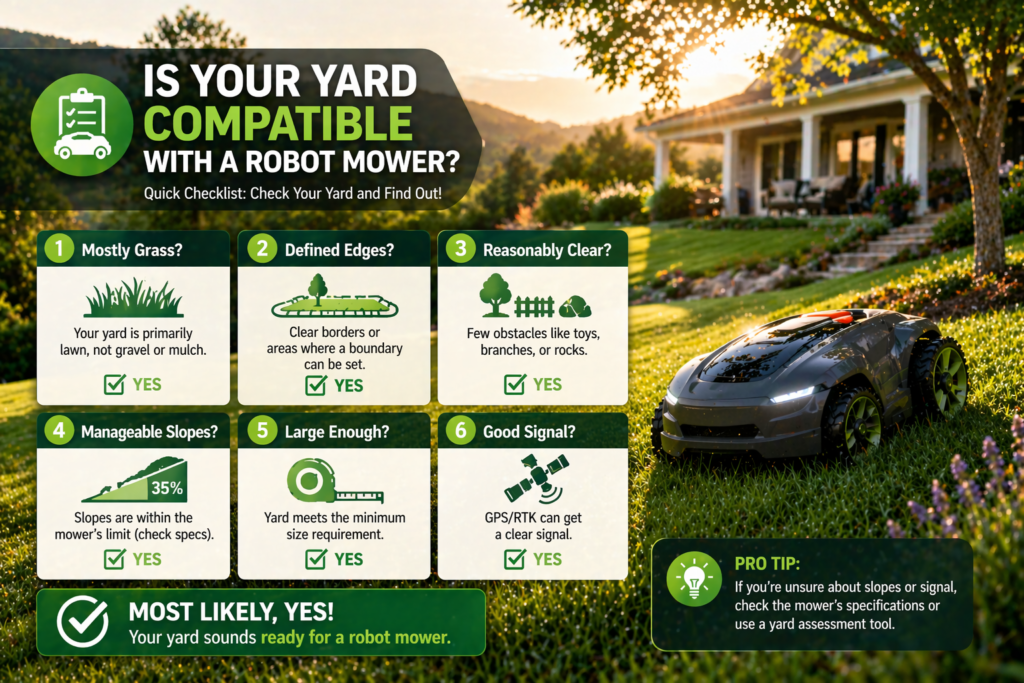
Take a look at our FREE Robot Mower Yard Compatibility tool.
When Robot Mowers Can Mow Sideways on Hills: The AWD Revolution
There is, however, an elite class of machinery where the answer changes. If you are the target reader of this article—a discerning buyer with a challenging, sloped acreage and a willingness to pay for performance—you need to know about All-Wheel Drive (AWD) technology.
In recent years, brands like Mammotion and Segway Navimow have disrupted the market by essentially building robotic utility vehicles disguised as lawn mowers. These are not the bump-and-go bots of the early 2000s.
These premium models utilize four independent drive motors and deep, aggressive tread (often resembling ATV tires rather than lawnmower wheels). While even these beasts are programmed to mow vertically for maximum efficiency, the traction reserve in an AWD system is so high that it can safely execute complex maneuvers and turns on the slope itself.
This is the critical distinction: A 2WD mower needs a perfectly flat, level “runway” at the bottom or top of the hill to turn around. An AWD mower like the Mammotion LUBA 2 AWD or Segway Navimow X4 can perform a 3-point turn on a 35-degree incline without tearing the grass and without sliding.
For the property manager or estate owner, this is the difference between:
- Failed Docking: A mower that gets stuck halfway up the hill and drains its battery.
- Flawless Autonomy: A mower that navigates complex, multi-zone slopes with the precision of a surveyor.
So, while the specific pattern of robot mowers mow sideways on hills remains rare as a primary cutting direction, the capability of premium AWD units to traverse and maneuver sideways without damage is what justifies their premium price tag. They have the grip to correct the slide before it happens.
The High-End Solutions: Hardware Built for the Battle
If you are managing a property with slopes exceeding 20 degrees (36%)—or if you simply refuse to accept “good enough” from your smart home upgrades—here is the hardware tier you need to consider. This is the gear small landscaping crews are using to replace zero-turn mowers on dangerous banks.
1. The Heavy-Duty Contender: Mammotion LUBA 3 AWD Series
This is the mower you buy when you want to forget the slope exists. The LUBA 3 series is built on a commercial-grade chassis with a max slope rating of 80% (38.6°) . That is steeper than the roof pitch on many homes.
- Why it handles hills: It uses a Four-Wheel Independent Suspension system. This isn’t just about comfort; it means all four wheels maintain ground contact on uneven, rutted, or washboard terrain. When you ask can robot mowers mow sideways on hills, the LUBA 3 is the machine that nods and says, “Watch this.”
- GPS-RTK Precision: No perimeter wire. It uses centimeter-level GPS to map your property. This is crucial for slopes because the mower knows exactly where the edge of the drop-off is. It won’t “search” for a wire that has been pulled out of the ground by erosion.
- Ideal For: The property owner with 0.5 to 2.5 acres of truly awful terrain. The kind of yard where riding mowers feel tippy.
2. The Connected Workhorse: Segway Navimow X4
Segway brought their gyroscopic balancing expertise to the lawn. The X4 series is the benchmark for traction control algorithms. While many AWD mowers have four spinning wheels, Segway excels at managing that power. It detects wheel slip in milliseconds and shifts torque to the wheels with grip.
- Why it handles hills: Rated up to 84% (40°) slope. This is achieved through deep tread tires and a wide stance that lowers the center of gravity.
- The Experience: Users on specialized forums note that watching the X4 handle a complex slope is “unnerving” the first time because it looks like it should slide, but it simply doesn’t. It claws its way across.
- Ideal For: The tech-forward homeowner who wants a seamless app experience (VisionFence AI avoids obstacles) combined with raw, physical climbing power.
The Software Strategy: Zone Management is Your Best Friend
Even if you invest in premium AWD hardware, you shouldn’t just send the mower out with a blanket command. The smartest approach to sloped lawns is Zone Management.
Robot mowers mow sideways on hills poorly, but they mow vertical zones exceptionally well. Here is the optimal setup for a property with mixed flat and sloped terrain:
- Create a Dedicated “Hill Zone”: In the mower’s app (whether it’s Mammotion, Husqvarna, or Segway), draw a separate work area exclusively for the steep section.
- Set the Mowing Angle: Force the mowing pattern to be 0 degrees or 90 degrees (straight up and down the fall line). Do not allow it to set a random or “optimal” pattern here.
- Schedule Separately: The flat lawn can be mowed daily at 4:00 PM. The slope should be mowed only when the grass is bone dry. Moisture on a 30-degree incline turns grass into ice. Schedule the hill zone for 1:00 PM after the morning dew has fully evaporated.
- Increase Overlap: Because turns at the top and bottom of the hill are tricky, increase the “border lap” or “cutting overlap” setting by 10-15%. This ensures no uncut strips are left behind at the apex of the climb.
These are the best AWD Robot Mower Models we found.

The Installer’s Secret: Base Station Placement
If you take nothing else from this guide, take this: Never place the charging station at the bottom of a steep hill.
This is the #1 mistake made by DIY installers and the #1 cause of “My robot mower won’t dock on a slope” threads on Reddit.
The Problem: When the mower finishes cutting the hill and tries to return to base at the bottom of the slope, it must brake while descending. If the grass is wet or the slope is steep, physics wins. The mower slides past the charging contacts, rams the station, or gets stuck in a loop of failed docking attempts.
The Fix:
- Place the charging station on a flat, level patch at the TOP of the slope.
- Or: Place it 15-20 feet away from the base of the slope on perfectly level ground, allowing the mower a long, flat “runway” to slow down and align.
Maintenance: The Hidden Cost of Hills
Slopes are hard on equipment. This is true for gas mowers, and it is doubly true for robots. The constant torque required to climb hills eats through wheel tread faster than flat-lawn mowing.
If you find that your AWD mower used to climb the hill fine but is now slipping—and you’ve confirmed the grass is dry—check the tires. You are likely looking at smooth tread. Unlike a car, robot mowers don’t wear tires out from highway miles; they wear them out from micro-slipping on inclines.
Solution: Replace the rear (or all four) tires annually if you have a heavy slope schedule. Some high-end brands sell “Terrain” or “All-Terrain” replacement tires with deeper, more aggressive lugs specifically for this issue. This is a small price to pay for the freedom of not having to push a mower up that hill yourself.
The Verdict: Can Robot Mowers Mow Sideways on Hills?
Let’s close the loop on our key phrase. We’ve established the technical reality, but let’s reframe it for your decision-making process.
- If you buy a 2WD robot mower: Robot mowers mow sideways on hills only if you enjoy watching them slide downhill and tear up your turf. They must be run up and down.
- If you buy a premium AWD robot mower: Robot mowers mow sideways on hills with enough stability to turn around and navigate complex edges without damage. They still primarily cut vertically, but their mobility sideways is unrivaled.
For the time-poor homeowner with 0.25 to 2 acres of awkward, sloping terrain, the upgrade to an AWD robotic mower isn’t a luxury. It’s a utility upgrade, akin to installing an irrigation system or a backup generator. It removes the mental burden of the looming weekend chore.
When robot mowers mow sideways on hills safely, they unlock the true potential of your property. They reclaim the steep back bank that has been a weedy eyesore for years. They allow you to look out the window at a perfectly manicured, 35-degree slope and feel pride instead of dread.
Because ultimately, you didn’t buy the house for the lawn. You bought it for the view, the space, and the life you live inside it. The right mower lets you stop fighting the ground and start enjoying the estate.
Looking for the right hardware to tame your slope?
*Check out our detailed comparison guide on the [Mammotion LUBA 3 AWD vs. Segway Navimow X4] to see which heavy-lifter fits your property blueprint.*

Make this the year your lawn mows itself! Explore our top picks and secure the best robot mower for steep slopes through the trusted affiliate links above and below. Your weekends (and your back) will thank you.
Disclaimer: This article contains affiliate links. As an Amazon Associate, I earn from qualifying purchases. Prices fluctuate, but the recommendation logic remains the same. Always check the slope rating before buying.