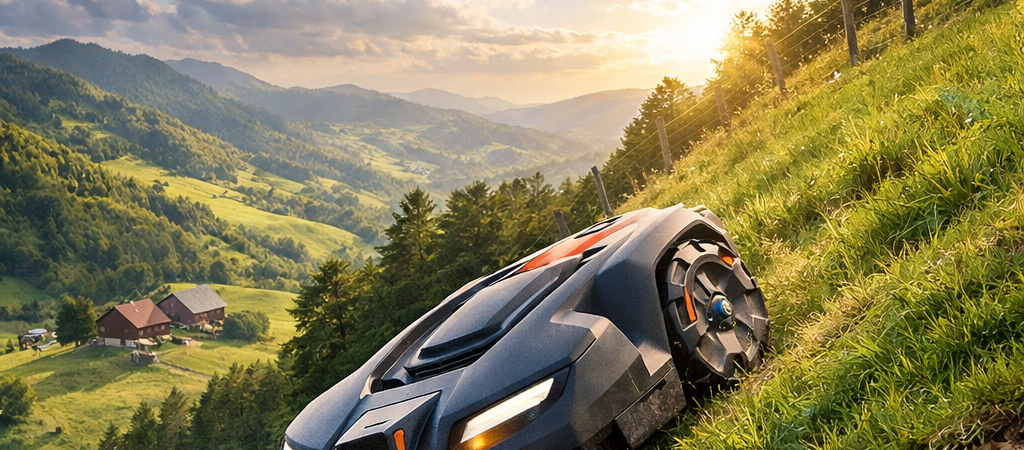
You already know what mowing a sloped yard feels like. The effort of pushing uphill in summer heat. The grip tightening on the handles of a riding mower when the grass is wet. The knowledge, somewhere in the back of your mind, that one wrong move on a steep descent could end badly. So the question isn’t really whether robot mowers work on steep hills in theory — it’s whether they’ll actually work on your hill, in your conditions, consistently enough to justify the investment.
The answer, backed by manufacturer testing data, independent reviews, and real user experiences, is yes. Robot mowers work on steep hills — but only with the right machine, the right setup, and a clear understanding of where the real limits are. This article gives you the full picture, not the marketing version.
The Short Answer — And Why It Comes With Conditions
Robot mowers work on steep hills when three things align: the mower’s slope rating genuinely covers your grade, the machine is installed correctly for sloped terrain, and environmental conditions are managed properly. Miss any one of these and you get the version of the story that shows up in negative reviews — a $3,000 machine that slips sideways on wet grass, misses sections, or gets stuck repeatedly on the steepest part of the yard.
Understanding why those failures happen is exactly what separates buyers who are satisfied from buyers who are not.
Most standard robot mowers are rated for 20 to 35 percent slopes — roughly 11 to 19 degrees. That covers gently rolling suburban terrain. For anything steeper, you need a different class of machine entirely. Premium AWD and 4×4 models now push the ceiling to 70 to 85 percent, and tracked systems handle genuine 45-degree terrain. The category has genuinely advanced in the last few years, and robot mowers work on steep hills in ways that simply weren’t possible with older hardware.
What the Slope Rating Actually Means in Practice
This is where most buyers go wrong before they’ve even chosen a model. Slope ratings are tested on dry, firm, short grass under controlled conditions. Your yard is rarely that.
Wet conditions reduce effective slope performance by 15 to 30 percent on any platform. Clay soil is the most problematic surface — a machine that handles 50 percent grade on dry grass can slip repeatedly on wet clay at 35 percent. Long or dense grass creates additional resistance that standard test conditions don’t capture.
The practical rule is straightforward: choose a mower rated at least 20 percent above your actual steepest section. If your worst grade is 40 percent, you need a machine rated for 60 percent or higher — not 45 percent. That buffer is what delivers consistent performance across seasons, rainfall, and varying grass conditions.
There is also a boundary wire rule that almost no review site mentions. On most standard models, the boundary wire cannot be laid across ground steeper than 15 percent — even if the mower is rated for 40 percent inside the working area. This means a significant installation constraint that affects how the mowing zone is designed for sloped properties. Understanding this before installation prevents the most common setup frustrations.
Check out our FREE yard slope calculator
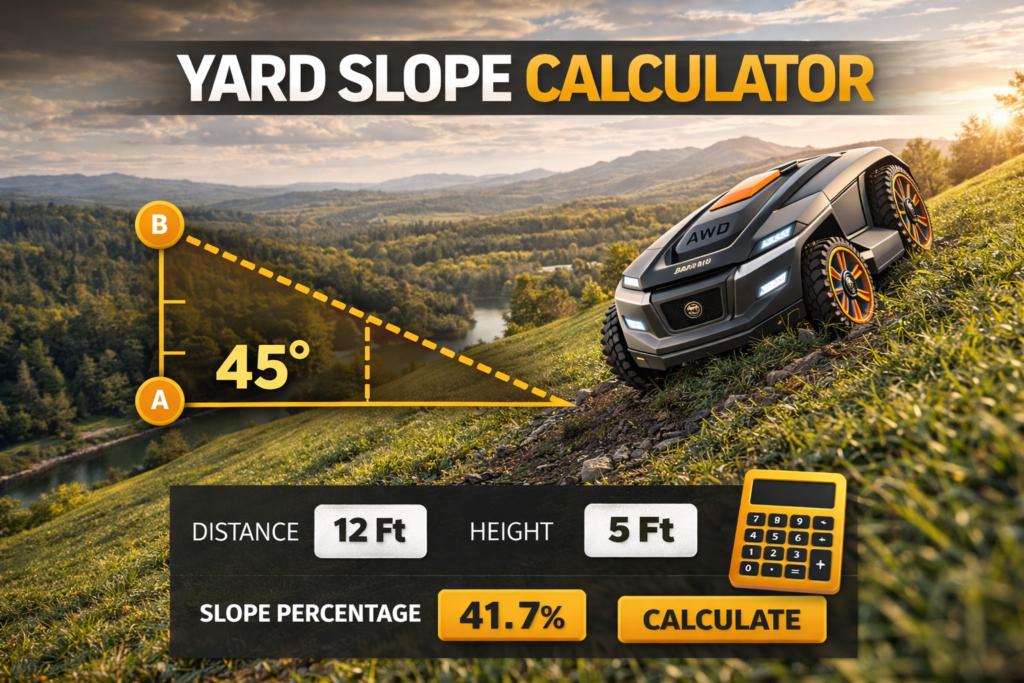
Enter your yard measurements to find your slope percentage and see which robot mowers are the right fit.
The Real Problems — What Research and Real Users Actually Report
To say robot mowers work on steep hills is true. To leave it there would be incomplete. Here are the specific problems that show up consistently across user reviews, manufacturer support documentation, and independent testing.
Slipping and Traction Loss
Wheel slip is the most common complaint from sloped property owners, and the trigger is almost always wet conditions. When wheels spin without grip on a gradient, the mower doesn’t just pause — it can slide sideways, create bare patches from spinning in place, and fail to complete its mowing path. This happens even on AWD machines above certain slopes in wet conditions.
Independent side-by-side testing on a 35 percent clay slope after light rain showed a top-rated AWD wheeled mower experiencing noticeable spin and hesitation. A tracked machine on the same slope distributed its weight across a larger surface area, crawled uphill without slipping, and crossed a shallow muddy rut that stopped the wheeled model entirely. The difference in traction between wheeled and tracked systems on wet steep ground is not marginal — it is significant.
Getting Stuck
Every robot mower gets stuck occasionally. On sloped terrain, the frequency increases because turning on a gradient is the mechanically hardest movement these machines make. Obstacles on hills — rocks, roots, dips, garden borders — force direction changes at exactly the moment when traction is most precarious. This is a solvable problem with correct setup, but buyers who don’t prepare their slopes for autonomous mowing will encounter it frequently.
Scalping and Uneven Cuts
A rigid-chassis mower on uneven sloped terrain can “bottom out” — one side of the cutting deck lifts as the machine tilts, scalping high ground and missing low sections. Two-wheel-drive machines are most vulnerable to this. Premium AWD designs with independent suspension on each wheel address the problem mechanically by maintaining deck contact across terrain variations. When evaluating whether robot mowers work on steep hills for your specific yard, the suspension system matters as much as the slope rating.
GPS Signal Loss in Shaded Areas
Many steep properties also have significant tree cover, and this creates a navigation problem specific to RTK GPS systems. Signal accuracy degrades under dense canopy. A mower that navigates perfectly on an open slope can lose position under shade, leading to missed strips, repeated incorrect paths, or failed returns to dock.
The solution is selecting a machine with hybrid navigation — RTK GPS combined with visual positioning (V-SLAM), AI vision, or LiDAR. These systems maintain accuracy where satellite-only machines struggle. If your property combines steep terrain with heavy shade, hybrid navigation is not a premium add-on — it is a functional requirement.
Software Instability
Capable hardware does not guarantee capable software. Real user reviews of premium slope-rated mowers consistently flag app stability as a separate variable from mechanical performance. Premature dock returns, false stuck alerts, inconsistent boundary recognition on complex terrain — these are software problems that hardware ratings don’t address. Always check recent user reviews for app stability alongside slope ratings when evaluating whether robot mowers work on steep hills in your specific situation.
Proven Solutions — What Actually Works
Match Your Drive System to Your Actual Grade
The evidence from real-world testing is consistent. Standard 2WD works up to about 20 to 25 percent reliably. AWD wheeled systems cover 25 to 80 percent depending on model and conditions. 4×4 wheeled platforms handle up to 84 percent. Tracked systems are the only residential option for genuine 45-degree terrain — distributing weight approximately 40 percent more evenly than wheels and maintaining grip where wheels lose traction on wet or loose ground.
Check out our guide on the 7 Best AWD Robot Mowers for Hills
For most homeowners where robot mowers work on steep hills in the 25 to 50 percent range, a premium AWD machine is the correct tool. For terrain approaching or exceeding 45 degrees, a tracked system is the more reliable long-term choice.
Install the Guide Wire and Boundary Wire Correctly for Slopes
Husqvarna’s official slope installation documentation — the most detailed publicly available guidance on this topic — is specific. Lay the guide wire diagonally across the slope, not parallel to it. For AWD models, run it in a straight line from bottom to top. Running the wire parallel to the slope increases both grass wear and the risk of the mower losing its path.
Boundary wire needs flat-ground buffer distance. Place the wire on level ground before the slope begins, not across the gradient. This gives the mower time to detect the boundary and change direction before momentum carries it over. For sections that genuinely exceed your mower’s rated grade, isolate them using app-based stay-out zones or boundary wire islands. The rest of the yard runs fully automated while extreme sections are either excluded or handled separately.
Enable Rain Sensors and Slope Control Settings
Rain sensors should always be enabled on sloped properties and configured to delay mowing for a period after precipitation — not just during rain. Wet grass remains slippery long after rainfall stops. Most premium models also have a Slope Control setting buried in the app or display menu. This reduces speed on steep sections, adjusts path behaviour near boundary wires on gradients, and decreases turf wear on hills. It is worth taking fifteen minutes to find and configure this before the first run.
Mow Frequently and Cut Less Each Session
Robot mowers work on steep hills most effectively when scheduled to run daily or every other day at a moderate cutting height rather than weekly deep cuts. Frequent, light passes maintain grass at an easier length to cut, reduce blade resistance on slopes, and minimise the chance of the machine getting stuck in long grass. This is the mowing pattern that produces the most consistent results on difficult terrain — and it’s one of the genuine advantages of autonomous mowing over manual weekly sessions.
Keep Wheel Treads Clean and Consider Terrain Kits
Grass clippings and soil pack into wheel treads quickly on sloped properties, reducing grip even on machines with strong dry-condition ratings. A soft brush cleaning of the treads after each session maintains traction between deeper maintenance cleans. Most premium brands also offer terrain kits — upgraded rear wheels with more aggressive tread patterns as accessories. On any property where robot mowers work on steep hills daily, these are a worthwhile addition.
The Safety Case — The Argument Most Reviews Miss
For homeowners on genuinely steep terrain, this is the most compelling argument of all, and it rarely gets the attention it deserves. Manual mowing on steep hills carries documented injury risk. The statistical likelihood of a mowing accident is 1 in 2,626 for male operators. Riding mowers on steep slopes are a rollover risk that causes serious injuries every year. Robot mowers have tilt and lift sensors that stop blades instantly if the machine tips, and honestly, they exist to keep people entirely off the steepest ground.
For estate managers, property owners, or anyone responsible for a team, removing the human from steep-slope mowing is a risk management decision as much as a convenience one. A well-chosen robot mower works on steep hills every day without putting anyone at risk. That calculation matters.
Which Models Are Worth Considering
For slopes in the 25 to 50 percent range with reasonable ground conditions, the Mammotion LUBA 2 AWD, Dreame A3 AWD, Sunseeker X7 AWD, and Segway Navimow X4 all deliver solid results with correct setup. For extreme slopes above 50 percent, or properties combining serious grades with heavy tree cover, the Mammotion LUBA 3 AWD and Kress EyePilot 4×4 are the most capable wheeled options available. For terrain approaching true 45 degrees, or properties with wet clay soil and rough uneven ground, the Lymow One Plus tracked system is the only residential machine genuinely engineered for those conditions.
The technology has genuinely caught up with the problem. Robot mowers work on steep hills — reliably and consistently — when the machine is matched to the terrain, the installation follows slope-specific guidance, rain sensors are active, and maintenance is kept up. That combination is what separates the owners who reclaimed their weekends from the ones who returned their mowers.
If you’ve been fighting a steep yard manually for years, the right machine and the right setup will change how you experience your property entirely.
👉 [Use our free Slope Calculator to find your exact grade and get matched to the right mower]
👉 [Compare the top-rated robot mowers for steep terrain side by side]
👉 [Check current pricing on the Mammotion LUBA 3 AWD]
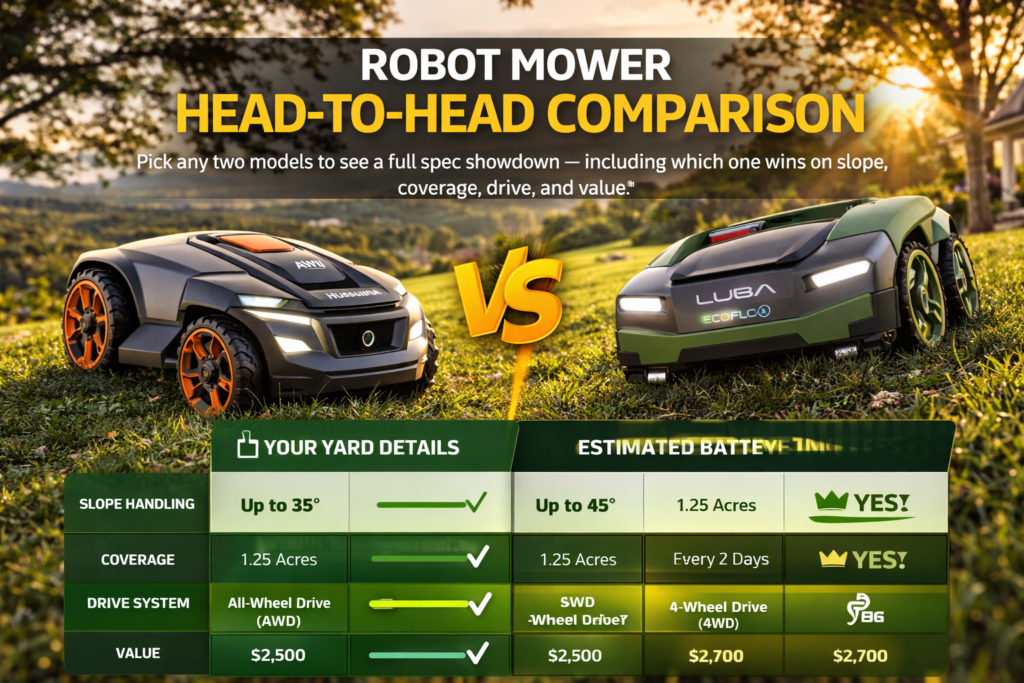
👉 [Compare all recommended models with specs using our FREE Head to Head comaprison tool ]
Make this the year your lawn mows itself! Explore our top picks and secure the best robot mower for steep slopes through the trusted affiliate links above and below. Your weekends (and your back) will thank you.
Disclaimer: This article contains affiliate links. As an Amazon Associate, I earn from qualifying purchases. Prices fluctuate, but the recommendation logic remains the same. Always check the slope rating before buying.