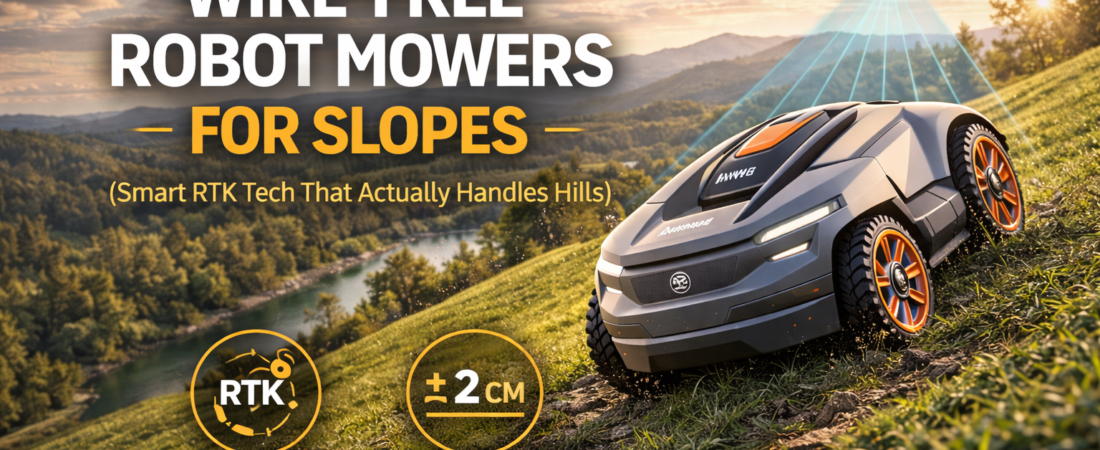
The End of the Perimeter Wire Era
The days of spending a grueling weekend burying hundreds of feet of copper wire—only for a stray shovel or a persistent gopher to snap it—are officially over. Boundary wires are becoming obsolete. The newest Wire-Free Robot Mowers for Hills use Real-Time Kinematic (RTK) GPS, high-definition AI mapping, and sophisticated inertial navigation to maintain your lawn without a single inch of buried cable.
For the homeowner with a 2-to-5-acre estate, the transition to wire-free tech isn’t just about convenience; it’s about sanity. Traditional wire-based systems are a nightmare to install on large, complex properties, and adjusting your mowing zones later feels like a civil engineering project.
However, there is a catch. While many new models claim to be “plug-and-play,” the intersection of satellite navigation and gravity is a tricky place. These new wire-free models promise an easier setup—but only a select few possess the torque and signal stability to actually handle hills.
How robot mowers navigate
Select a navigation system to see an animated diagram, plain-English breakdown, and what it means for your sloped yard.
Navigation diagrams are illustrative. Real-world performance varies by terrain, tree cover, and environmental conditions.
Navigation diagrams are illustrative. Real-world performance varies by terrain, tree cover, and environmental conditions.
Navigation diagrams are illustrative. Real-world performance varies by terrain, tree cover, and environmental conditions.
Navigation diagrams are illustrative. Real-world performance varies by terrain, tree cover, and environmental conditions.
The Catch With Wire-Free Tech
Before you invest thousands into a Wire-Free Robot Mowers for Hills setup, you need to understand the unique challenges this technology faces when the ground isn’t flat. Most review sites will tell you that GPS is perfect; as an expert in the field, I’m here to tell you it has “moods.”
Why Most Wire-Free Robot Mowers Struggle on Hills
- RTK Signal Shadowing: RTK technology requires a clear line of sight to both the satellites and a local base station. If your sloped yard is “wooded” or if the hill itself blocks the line of sight to the base station, the mower can lose its centimeter-level precision.
- GPS Drift vs. Gravity: On a steep incline, a mower needs to know exactly where it is to prevent sliding past a virtual boundary. If there is even a minor “drift” in the GPS signal while the mower is on a 35% slope, the machine might overcorrect, leading to navigation errors or “trapped” sensors.
- The Traction Gap: Because the tech is so focused on the software, many manufacturers skimp on the hardware. Most wire-free units are 2-wheel drive (2WD). While 2WD works on a flat suburban lot, it’s a recipe for disaster on a hillside property where the grass might be damp or the soil loose.
The Expert Insight: A successful Wire-Free Robot Mowers for Hills installation requires a perfect marriage of high-frequency signal processing and raw mechanical traction. If you have the “brains” (RTK) without the “legs” (AWD), your mower will spend more time stuck in a ditch than cutting grass.
What to Look For (The Tech Filter)
If you are shopping for Wire-Free Robot Mowers for Hills in 2026, these are the non-negotiable features. If a model lacks more than one of these, keep scrolling.
1. RTK-GNSS + Vision Positioning
Pure GPS is no longer enough. The best mowers now use “Vision+RTK.” This means they have cameras or LiDAR that “see” the terrain. If the GPS signal drops under a large oak tree on your hill, the camera takes over, using visual landmarks to keep the mower on its path.
2. Verified Slope Ratings (35%+)
Don’t trust the “maximum climb” marketing without checking the “working slope” rating. For a Wire-Free Robot Mowers for Slopes setup, you want a machine rated for at least 35% to 45% (roughly 20-24 degrees). If your yard is a “mountain,” you must look specifically for All-Wheel Drive (AWD) units.
3. Multi-Zone Smart Mapping
Large estates usually have a front yard, a backyard, and maybe a side orchard. Your wire-free app should allow you to create “virtual bridges” between these zones. This allows the mower to navigate across a driveway or path to get to the next sloped area without you having to carry it.
4. Active Obstacle Detection
Hillsides are prone to fallen branches, washouts, and exposed roots. A high-end Wire-Free Robot Mowers for Hills model must have AI-driven obstacle avoidance to navigate around these hazards without constantly triggering a “tilt” or “collision” error.
The Top Wire-Free Robot Mowers for Hills
Best Overall: The Balanced Performer
Model: Mammotion Luba 2 AWD
This is currently the gold standard for anyone needing Wire-Free Robot Mowers for Hills. It combines a dual-vision system (3D Vision + RTK) with a true All-Wheel Drive system. It handles up to an 80% slope—which is nearly 38 degrees. For the homeowner who wants “set it and forget it” reliability on a hillside, this is the one.
- Best Feature: Dual-vision navigation that works even when GPS is weak.
[For Pricing on the Mammotion Luba 2 AWD CLICK below]
Best for Extreme Steepness: The Traction King
Model: Husqvarna Automower 435X AWD (with EPOS Kit)
Husqvarna is the “old guard” that finally went wire-free with their EPOS (Exact Positioning Operating System). The 435X features an articulated chassis, meaning it “bends” in the middle to keep all four wheels glued to the slope. It is arguably the most stable Wire-Free Robot Mowers for Slopes option for “mountain-style” properties.
- Best Feature: Articulated steering for unmatched stability.

- Smart Navigation: Husqvarna Automower iQ Series robotic mowers are customizable to fit your needs, navigating slopes and…
- Reliable Performance: Exact Positioning Operating System (EPOS) provides centimeter-accurate location data; onboard rada…
- Wire-Free Installation: Use smartphone app to drive the robot mower around lawn, creating virtual map with mowing areas …
Best for Large Open Estates
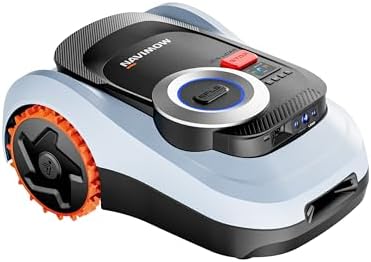
Model: Segway Navimow i Series / H Series
If you have a 3-acre hillside that is mostly open sky, the Segway Navimow is an incredible value. It uses the “EFLS” (Exact Fusion Locating System) which is very stable in open spaces. It’s a fantastic Wire-Free Robot Mowers for Hills choice if you don’t have heavy forest cover.
- Best Feature: Highly intuitive app and quiet operation.


Best Smart Features & AI Navigation
Model: Ecofacs GOAT G1-2000
Instead of just relying on satellites, the GOAT uses “beacons” that you place around the yard. This creates a local “GPS” network that is incredibly stable on slopes where satellite signals might bounce. It’s one of the most intelligent Wire-Free Robot Mowers for Hills for complex landscaping.
- Best Feature: 360-degree camera for incredible obstacle avoidance.

- Dual LiDAR Navigation – Smarter Than RTK, No Wires, No Worries: Featuring 360° LiDAR and front ToF sensors, the GOAT A30…
- High Mowing Efficiency & Wide Cutting Path – Powered by a 32V battery, the GOAT A3000 delivers exceptional cutting speed…
- Ultra-Fast 45-Minute Charging for Maximum Efficiency – Equipped with a durable 5Ah battery, the GOAT A3000 charges in ju…
 Wire-Free Comparison Table (2026 Models)
| Model | Max Slope | Navigation Tech | Drive System | Best For |
| Mammotion Luba 2 | 80% (38°) | RTK + 3D Vision | AWD | Extreme Slopes |
| Husqvarna 435X | 70% (35°) | EPOS (Satellite) | AWD | Professional Estates |
| Segway Navimow H | 45% (24°) | EFLS 2.0 | 2WD (High Torque) | Large Open Lawns |
| Ecofacs GOAT G1 | 35% (19°) | Beacon + Vision | 2WD | Complex Gardens |
| Dreame A1 | 35% (19°) | Omni-directional LiDAR | 2WD | High-Tech Homes |
Is Wire-Free Truly Worth It for a Sloped Yard?
When you are weighing the cost of Wire-Free Robot Mowers for hills, you have to look beyond the sticker price.
The Pros:
- Zero Installation Labor: You don’t have to hire a crew or spend your Saturday digging trenches. You simply “drive” the mower around the perimeter with your smartphone like an RC car to set the map.
- Dynamic Mapping: If you add a new garden bed or a fire pit on your hill, you can update the “no-go zones” in the app in seconds. With a wire system, you’d be cutting and splicing cable.
- Better Aesthetic: No wires means no wire-breaks and no plastic pegs sticking out of your grass.
The Cons:
- Price Premium: Expect to pay 20% to 40% more for wire-free technology compared to boundary-wire models.
- Technical Sensitivity: A Wire-Free Robot Mowers for Hills setup is only as good as its signal. If you have a yard with “deep canyons” or massive metal structures, the signal can reflect (multipath errors).
The Final Verdict:
A Wire-Free Robot Mowers for Slopes setup is the superior choice for homeowners with 2+ acres and moderately open slopes. The time you save on installation and maintenance pays for the technology within the first season. However, if your hill is covered in dense, old-growth forest with zero sky visibility, you may still need a professional-grade boundary wire unit.
Ready to Skip the Wires?
You’ve spent enough weekends fighting gravity and tangled wires. It’s time to let the satellites and AI take over. Whether you have a steep front yard or a sprawling hillside property, there is a wire-free solution that can handle the job.
Don’t wait until the grass is knee-high.
- [Compare Prices on Top AWD Wire-Free Models]
- [Read: How to Test Your RTK Signal Before Buying]
Disclaimer: As an Amazon affiliate, I may earn a commission from purchases made through links in this post. I only recommend Wire-Free Robot Mowers for Slopes that have been vetted for performance and reliability in real-world difficult terrain.